


See the Series Introduction for Just Tao It, Part I: HERE
See the Just Tao It Series Introduction Tao/It on-ramp, PART II: HERE
See Just Tao It, Chapter 1: HERE
From my interpretation of Chapter 76 of the Tao Te Ching (Unpublished):
Life comes—
soft,
supple.Death comes—
hard,
inflexible.Soft and supple—
living.
Hard and inflexible—
dying.—
[Author’s NOTE: This Chapter was written after Chapter 2, which related directly to this story. To hear more about how and when this issue landed, GO HERE]
The chapter is easy to read as a rejection of strength. I’ve come to hear something more demanding in it: strength that cannot bend eventually loses its capacity to serve life.
I used to think strength meant pushing through. I experienced it as commitment, even when others might have seen recklessness. Take the hit, absorb it, keep moving. There was a steadiness to that identity that made it easy to trust, especially when it produced results. For long stretches of my life, it did exactly that.
What I failed to recognize then was what I was pushing against — and what I was pushing past.
Then my spine entered the conversation in a way that no longer allowed me to frame it as just another obstacle to manage. You don’t need a medical background to see that something fundamental has shifted. There’s a visible accumulation — years of load, compression, compensation, adaptation, and choices about when to continue and when to adjust.
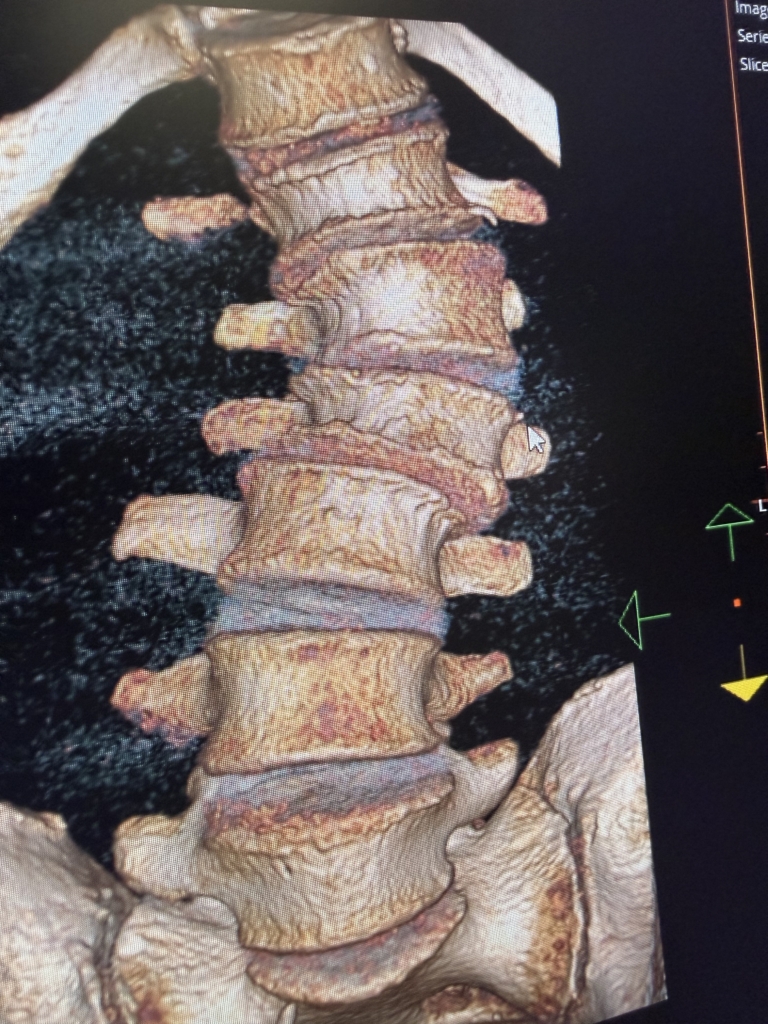
The body doesn’t argue. It records. Every load. Every adjustment. Every choice to continue when pausing may have been wiser.
Pain was familiar. What changed was my confidence that more effort would continue producing better outcomes. The pattern had survived surgeries, setbacks, and long recoveries: push, endure, recover, repeat. The change happened slowly enough that I almost missed it, and eventually the pattern stopped delivering what it once had. Recovery became less predictable. What once responded reliably to effort began responding differently, and the strategy I trusted stopped producing the future I expected.
Only later did I recognize the tension that had been there all along.
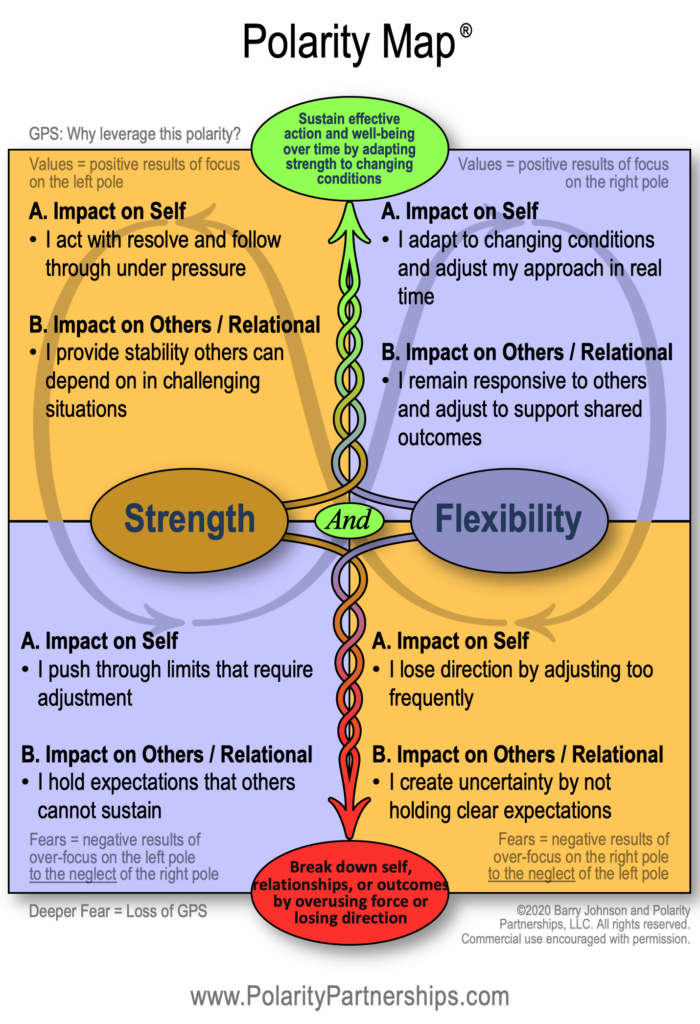
Strength AND Flexibility. Both serve life by helping us respond as conditions change.
I am learning to recognize decisions that remain alive as conditions change — decisions capable of adapting while preserving what they were meant to serve.
When I finally mapped the polarity directly — the same way I’ve taught leaders, teams, and organizations to do for years — something important shifted. My body remained the same and the pain remained present. The map changed my relationship with what was happening by revealing the full pattern: the strength that had built capacity, the flexibility that could preserve it, and how thoroughly I had become hooked by one side of it.
There is a form of strength that expands capacity by pressing against limits and refusing to abandon what the moment required simply because conditions got difficult. That form of strength carried me a long way. It also carried consequences I was slow to recognize.
Flexibility had served me too, though I’d rarely named it as strength. It appeared every time I accepted help, changed a plan, found another way to move, let someone else carry what I’d expected to carry myself, or reorganized work around the body I have now, not the one I remembered. Those choices required a different kind of resolve.
Tracy started driving on longer trips two years ago — the ones I would have insisted on driving myself before. She never made it a conversation. She just started driving, and I let her. That’s a small thing to write down and a strange thing to live through: watching someone recalibrate their expectations of you before you’ve fully recalibrated your own.
My body recorded realities I chose not to read until the evidence became impossible to ignore.
The value of Strength had hooked me long before its costs became visible. What once created capacity gradually produced strain. What once moved life forward began holding it in place. Most of us arrive there gradually, after a successful pattern has had enough time to outlive the conditions that once made it useful.
The body is less interested in judgment than continuity. What we repeat becomes part of what the body must carry.
Those moments rarely arrive alone. They alter conversations, force plans to be reconsidered, and ask the people around us to adjust to capacities that no longer behave as they once did. Some responsibilities are postponed. Others are handed off. A few disappear before anyone fully names what has been lost.
What’s required now asks for a different way of living inside life itself. Sitting differently. Moving differently. Paying attention differently. I’m beginning to recognize flexibility as one of Strength’s most important expressions.
It would be easy to experience this entirely as loss. Part of it is. There are things I can’t do the way I once did them, with no clear sign some capacities are returning in the same form. The people around me feel those changes too — partners, family, friends, and others who had grown accustomed to relying on a version of me that is less consistently available.
Loss is part of the story. The changing conditions have also opened another relationship with effort, timing, dependence, and responsiveness — something else has become available: a more patient sense of timing, and a deeper respect for responsiveness itself.
The Tao continually returns us to the responsiveness of life. Living systems adapt as conditions change. When rigidity exceeds a system’s capacity to adjust, what flexibility might have absorbed becomes a breaking point.
The body teaches this. So does everything my capacity touches — the relationships and systems that carry the consequences of how I use it. The same pattern appears in larger systems whenever the methods that once produced stability become too rigid to receive changing conditions.
The deeper discipline is responsiveness: recognizing when adaptation serves the present better than escalation, and when a familiar strategy has outlived the conditions that once made it effective.
Trust grows when people experience adaptation without abandonment. The people around me need to know that changing what I can carry doesn’t mean withdrawing from the relationship. I need to learn that accepting their support doesn’t erase the strength I once expressed through carrying more.
The Tao calls for full participation in life — effort where effort serves, restraint where conditions require it, and enough responsiveness to meet reality as it unfolds.
I still value Strength deeply. I’m learning to trust the form that can listen, adjust, and release structures that no longer fit the conditions. Flexibility allows Strength to preserve life, relationship, trust, and the capacity to continue.
I still don’t know what capacities will return or what forms life will require next. I know the body has changed the terms of the conversation. Strength can no longer mean overriding every limit. It must also mean listening early enough to adjust, accepting support, and preserving enough movement for life to continue teaching me.
Soft and supple — living.
Polarity Map for Strength AND Flexibility:
Here’s a Polarity Map of Strength And Flexibility to help see the pattern:
INVITATIONS
How do you make decisions under uncertainty, over time? To take a short Polarity Assessment based on the Strength And Flexibility polarity, CLICK HERE
NOTE: the results include Leveraging Action Steps and Early Warnings (to support maximizing upside benefits and minimizing downside limitations).
To use an “AI-trained Chat w/Cliff for Step 1, Seeing” CLICK HERE.
Ready for the Polarity Advantage? Go deeper into Polarity Thinking, see our online self-directed Credentialing and Introduction to Polarity Practice or in-person training with Barry Johnson and me at Kayser Ridge by CLICKING HERE.