


See the Series Introduction for Just Tao It, Part I: HERE
See the Just Tao It Series Introduction Tao/It on-ramp, PART II: HERE
See Just Tao It, Chapter 1: HERE
From my interpretation of the Tao Te Ching, Chapter 78 (Unpublished):
There is nothing
as soft and yielding
as water.
Yet against the hard
and rigid,
nothing works
better.
What appears weak
overcomes the strong.
What appears soft
endures long.
Many know this.
Few live it.
—
I didn’t understand this chapter until I spent enough time watching water—at Kayser Ridge, at the Grand Canyon, anywhere it was willing to teach. The longer you stay with it, the harder it is to miss what’s right in front of you. Water expresses two distinct and inseparable energies at the same time, and once you see them, you start to recognize them everywhere—including in yourself.
One is shaping energy. It moves, directs, cuts, breaks, and advances. It’s what you see when a river carves through stone, when waves crash with force, when frozen water expands and fractures rock that has held for centuries. It’s active, focused, and decisive. It brings clarity, direction, progress, and the ability to act. Without it, nothing forms, nothing moves, nothing gets done.
Taoist philosophy traditionally names this energy Yang. Throughout this chapter I’ll also call it Masculine—a universal pattern of energy available to every human being, not a claim about gender.
The other is adapting energy. It yields, receives, gathers, and conforms without losing its nature. It finds the low places, collects, nourishes, and sustains life. It takes the shape of whatever holds it, waits when waiting is required, and persists without forcing. It brings connection, responsiveness, resilience, and the capacity to hold what is emerging. Without it, nothing lasts, nothing connects, nothing holds together.
Taoist philosophy traditionally names this energy Yin. Throughout this chapter I’ll also call it Feminine, for the same reason—a universal pattern of energy available to every human being, not a claim about gender.
Water doesn’t have to choose between these. It leverages both. It just waters the way water works.
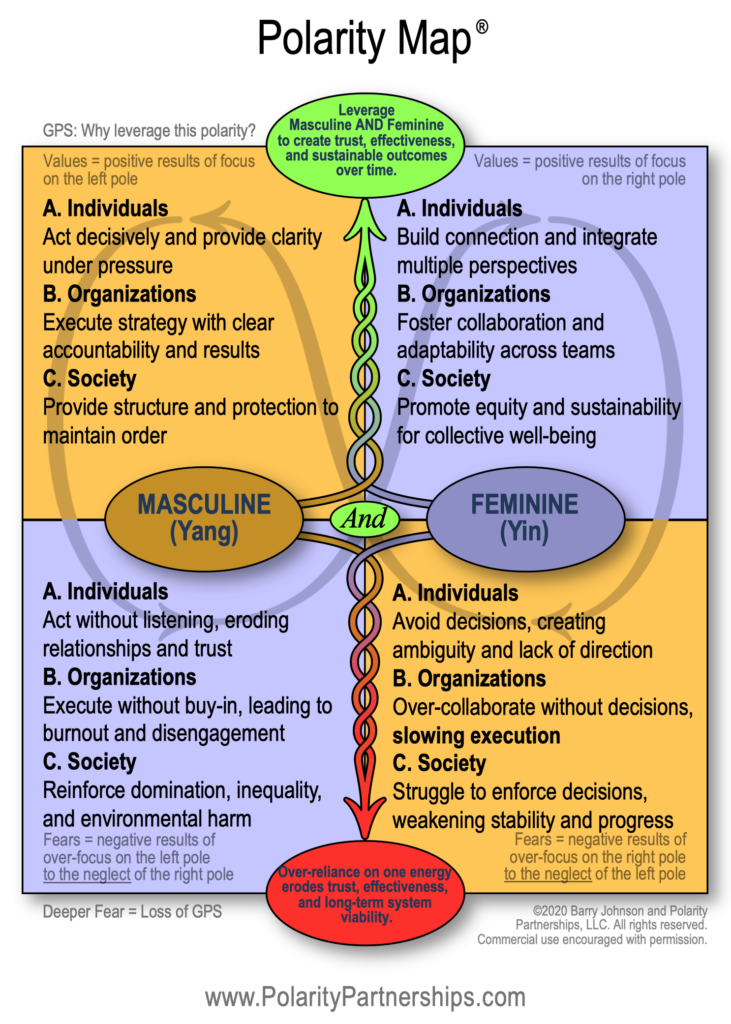
When shaping energy is overused to the neglect of adapting, force replaces alignment. Things get done, but they don’t hold. Systems become brittle. Progress happens at the cost of connection, and over time what looked like strength turns into breakdown.
I’ve watched this in organizations. A leader pushes relentlessly for results—shaping to the neglect of adapting—and the team delivers. For a while. Then people start leaving. Not all at once, just a steady exodus or disengagement from those who couldn’t or wouldn’t sustain the environment. What looked like high performance was high-turnover grind culture disguised as success.
When adapting energy is overused to the neglect of shaping, responsiveness replaces direction. Everything stays open, but nothing takes form. Systems drift. Connection remains, but without clarity or movement, what could have emerged never does.
I’ve seen this, too. A leader with all good intention creates such openness and space—adapting to the neglect of shaping—that people feel heard but never clear. Meetings end without decisions. Initiatives launch without direction. Connection is high, but nothing moves forward.
Neither works on its own. Both are required, over time, for something to sustain.
Water offers the outcome almost everyone recognizes: life. Sustainability. Flourishing. We all depend on it. We all thrive when it’s available, when it flows, when it nourishes and sustains. That’s what shaping AND adapting produce together.
But there’s also a deeper fear that shows up when they’re not. The same water that sustains life can take it. It can erode, overwhelm, destroy, and kill.
The difference lives in how the energy is understood and worked with, rather than resisted and misused.
I first learned this on the Gulf Coast. Rip currents don’t look dangerous until you’re in one. They form where waves break onto shore from opposite directions, creating a powerful flow that pulls everything caught in it out to sea. If you don’t understand how that energy works, the instinct is to fight it—to swim directly back to shore, to push harder, to try to overpower it with sheer effort.
That instinct, as logical as it feels, is exactly what puts people at risk. Even the strongest swimmers exhaust themselves fighting energy they don’t understand. Fear sets in. Panic follows. What could have been managed becomes life-threatening. The danger comes from how we respond to the current, not from the current itself.
But the current itself isn’t the problem. Not seeing it is.
Swim parallel to shore long enough to exit the pull, shift direction instead of fighting force, and the threat disappears. What was dangerous becomes navigable. And here’s what grabbed me when I first learned this: surfers don’t just avoid rip currents. They use them. They jump on the current, let it carry them out to the waves, ride the waves back toward shore, and then catch the current again to go back out.
The same energy that puts people at risk becomes a natural conveyor for those who understand it. What looks like danger becomes movement. What looks like threat becomes rhythm. And what can take a life becomes something you can learn to move with—if you know how the energy works.
The same is true for us. And that’s true for all energy—including the kind we carry in ourselves.
Masculine/Yang/Shaping and Feminine/Yin/Adapting describe recurring patterns of energy available to every human being. Biology influences these expressions. Culture reinforces them. Individual experience shapes how comfortably we access each one. Regardless of those differences, both energies remain available to us.
Do we have agency in how we use these energies? Agency begins when we recognize the energies we are already using. Seeing them is a start. Learning to work with them is where things begin to change.
When we turn that tension into a choice—when we try to decide which one is better—we end up working against something we don’t fully see. We push when we need to yield. We yield when we need to shape. We exhaust ourselves trying to control what can only be navigated.
Water doesn’t make that mistake. It moves with what is.
Maybe that’s what water has been showing us all along. A different way of relating to the energy that’s already here. The kind that forms and the kind that adapts. The kind that can destroy and the kind that sustains. The kind that moves forward and the kind that waits.
We see it in water easily enough. Recognizing it in ourselves—and learning to leverage both instead of choosing sides—is the harder work.
Many know this. Few live it.
Here’s a Polarity Map for Masculine And Feminine:
INVITATIONS:
To use an “AI-trained Chat w/Cliff for Step 1, Seeing” CLICK HERE.
Ready for the Polarity Advantage? Go deeper into Polarity Thinking, see our online self-directed Credentialing and Introduction to Polarity Practice or in-person training with Barry Johnson and me at Kayser Ridge by CLICKING HERE.