

See the Series Introduction for Just Tao It, Part I: HERE
See the Just Tao It Series Introduction Tao/It on-ramp, PART II: HERE
See Just Tao It, Chapter 1: HERE
From my interpretation of the Tao Te Ching, Chapter 81 (Unpublished):
True words don’t depend on eloquence,
while eloquent words don’t define what’s true.
The wisest words have no need to convince,
while shallow words often do.
Great leaders don’t depend on power.
They hold it for benefit of another.
The more the leader becomes the giver,
the more fulfilling lives become.
Needing neither control nor domination,
others rise with them.
—
You can learn a great deal about people holding influence by paying attention to what happens to other human beings around them over time. Do people become more capable, or more dependent? More honest, or more guarded? More thoughtful, or more performative? Do they become able to speak difficult truths, or skilled at sensing what is safe to say before they speak at all?
I’ve spent enough decades around organizations, leadership teams, and institutional systems to notice that some people seem to expand human capability while others slowly drain it from the room. Under one kind of influence, people stop thinking out loud. Meetings become rehearsals in agreement. Information gets filtered before it reaches authority.
Responsibility travels downward while recognition travels upward.
Eventually, even intelligent people begin editing themselves before they speak. People learn that protecting image matters more than protecting reality. Under another kind of influence, something entirely different begins happening. Problems surface earlier. Accountability spreads outward instead of concentrating upward. Initiative increases. Trust deepens. Human beings become more capable in each other’s presence.
The difference often has less to do with charisma than with a person’s relationship to control.
After decades working with executive teams, I’ve become less interested in the person who speaks first than in the leader after whose presence everyone else begins speaking more honestly.
That feels especially important right now because we are living through a strange transformation in how influence itself operates. Artificial intelligence can now generate persuasive language endlessly. Political movements depend heavily on emotional amplification and algorithmic reinforcement. In that kind of environment, eloquence becomes dangerous when disconnected from truth.
True words don’t depend on eloquence, while eloquent words don’t define what’s true.
That line grows harder to ignore in an age where persuasive language may soon become nearly infinite while wisdom remains painfully scarce.
Confidence can be manufactured. Conviction can be simulated. Entire identities can be engineered around performance.
Yuval Noah Harari has warned that many leaders still misunderstand what artificial intelligence represents, treating it as a tool rather than recognizing how deeply it may reshape human decision-making, social trust, and political stability. One of the defining challenges of this century may become whether human beings can maintain shared reality inside systems shaped by persuasion, tribal identity, and machine-generated influence.
That is not merely a technological challenge. It is a human development challenge.
Robert Kegan’s work on adult development helps explain why. Less mature forms of consciousness tend to remain fused with identity, certainty, and inherited assumptions. More developed forms of consciousness grow capable of examining their own thinking instead of automatically defending it. Human beings develop greater capacity to hold uncertainty, contradiction, and complexity without immediately retreating into rigid certainty or emotional reactivity.
That developmental difference shapes entire human systems.
People unable to question themselves often create systems unable to question themselves.
And systems unable to question themselves eventually lose relationship with reality.
You can watch this happen in governments, corporations, religious institutions, media ecosystems, and families. Once preserving identity becomes more important than remaining open to truth, distortion begins spreading through the system. Fear replaces inquiry. Loyalty begins outranking reality. Edgar Schein understood something similar. Healthy influence requires curiosity strong enough to keep learning. The moment people become overly attached to needing to convince, they often stop listening. Other human beings gradually become audiences, followers, obstacles, or threats rather than sources of insight.
The wisest words have no need to convince, while shallow words often do.
That line does not suggest truth should never be spoken strongly. Some moments require enormous courage and clarity. History has never lacked examples of human beings remaining silent in the presence of cruelty, corruption, or organized deception. But there is a profound difference between speaking with conviction in service of truth and speaking from the need to dominate perception.
Carl Jung warned that people who fail to confront their shadow often become possessed by it. The hunger for control disguises itself as strength. The need for admiration disguises itself as leadership. Fear disguises itself as certainty. I suspect we are witnessing a great deal of that now, not only politically, but culturally. Entire systems reward appearance over depth. Public figures learn to project certainty because certainty attracts attention, and attention functions as a form of power. Frightened human beings often confuse domination with safety.
The Tao cuts directly through that illusion.
Great leaders don’t depend on power. They hold it for benefit of another.
The verb matters. Hold. Not grasp. Not display. Not weaponize. Hold. As stewardship. As temporary responsibility. As something entrusted rather than owned.
Jim Collins found something remarkably similar in his work on Level 5 Leadership. The strongest leaders were often ambitious, but ambitious primarily for the mission, the organization, and the future beyond themselves. They built people instead of dependency systems. They strengthened institutional capacity instead of feeding personal importance. Research continues revealing the same paradox: the qualities that help people gain influence are often the very qualities influence erodes. Empathy weakens. Listening narrows. Certainty expands. People begin confusing control with strength and visibility with wisdom. Positional authority can force compliance for a while, but it cannot create mature human beings.
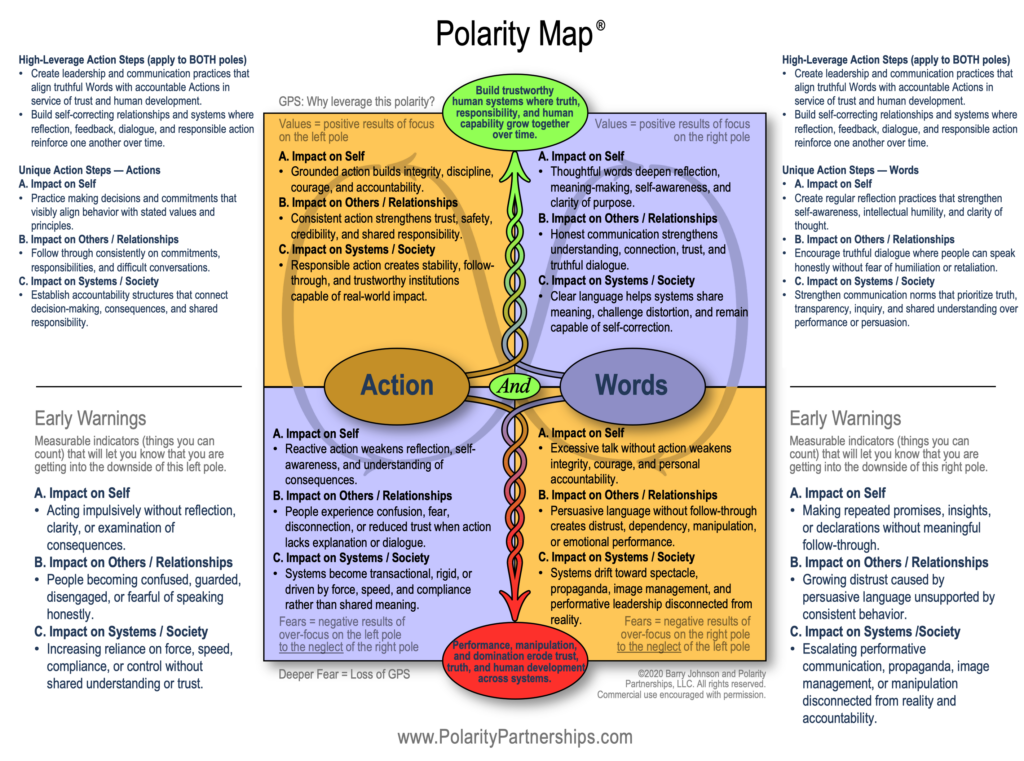
Words to the neglect of Action produces vision without accountability. Action to the neglect of Words produces power without shared meaning. Positional authority to the neglect of earned trust produces control without development.
The Tao points toward something far more difficult: influence grounded enough to stop organizing human relationships around fear, dependency, domination, or personal glorification. Instead, it creates conditions where other human beings become more capable of responsibility, courage, wisdom, and truthful participation.
The more the leader becomes the giver, the more fulfilling lives become.
There is deep paradox in that line. The more human beings use influence to develop others rather than secure themselves, the stronger the entire system becomes. Trust deepens. Initiative spreads. Accountability becomes shared rather than hoarded. Capability lives throughout the system instead of bottlenecking through one controlling figure.
This may be one of the defining questions of our time: can human beings become mature enough to hold influence without becoming consumed by the need to control? Can we create environments where truth travels more freely than fear?
The future will not be shaped only by technology, economics, or political struggle. It will also be shaped by the developmental capacity of the human beings holding influence inside those systems.
The deepest test of influence is whether people become more capable of wisdom in our presence.
The Tao seems to suggest that maturity no longer needs to stand above people in order to guide them. At its best, it creates conditions where others rise too.
Here’s a Polarity Map for Action AND Words:
INVITATIONS:
To use an AI-trained “Chat w/Cliff” for Step 1, Seeing” CLICK HERE.
Ready for the Polarity Advantage? Go deeper into Polarity Thinking, see our online self-directed Credentialing and Introduction to Polarity Practice or in-person training with Barry Johnson and me at Kayser Ridge by CLICKING HERE.