

See the Series Introduction for Just Tao It, Part I: HERE
See the Just Tao It Series Introduction Tao/It on-ramp, PART II: HERE
See Just Tao It, Chapter 1: HERE
From my interpretation of the Tao Te Ching, Chapter 10 (Unpublished):
Do you travel in body, spirit, and soul,
without losing their unity?
Are you as tender in your energy
as a baby?
Is your mirror
clear?
Are you present in such a way
others follow easily?
When you meet anxiety,
can you be simple?
Be useful.
Hold, without possessing.
Act, without controlling.
—
I was halfway up a trail at Kayser Ridge last week when I came across a doe with her fawn. She stood perfectly still, watching me, positioned between me and her young. Everything about her posture said I will not move. Everything about her eyes said I will not hurt you unless I have to. Power AND Love in a single stance. She had the capacity to act and the restraint to wait. I kept walking. She stayed exactly where she was.
I’ve been thinking about that moment ever since. Because most of us don’t hold both that well.
We tend to default. When pressure increases, we either tighten our grip or soften our stance. We become more controlling or more accommodating. We push harder or we let things drift. And we tell ourselves this is necessary, that the situation demands it, that we’re being realistic.
But what we’re often doing is choosing one pole and calling it the whole truth.
From my interpretation of the Tao Te Ching, Chapter 10 (Unpublished):
Do you travel in body, spirit, and soul, without losing their unity?
Are you as tender in your energy as a baby?
Is your mirror clear?
Are you present in such a way others follow easily?
When you meet anxiety, can you be simple?
Be useful.
Hold, without possessing. Act, without controlling.
You can travel in body, spirit, and soul, and still lose your way if they are not connected. The question is not whether you have capability, but whether what you do is grounded in who you are. Lao Tzu is pointing to a form of mastery that is easy to misunderstand. It is not about refining technique until it is flawless. It is about developing the capacity to use Power without becoming dependent on it, and to embody Love without becoming passive within it.
Can you remain integrated while you act? Can your energy stay soft even as you take on hard responsibilities? Can you see clearly without distortion? Can you influence without forcing? Can you meet anxiety without amplifying it?
These are not questions about skill alone. They are questions about presence. And presence is what allows us to hold Power AND Love together.
Power is the capacity to act. To set direction. To make decisions. To intervene when something is not working. To establish structure, accountability, and consequence. It operates at the level of systems, policies, outcomes—the outer architecture that shapes what happens. This is the domain of the Sustainable Development Goals: the structural work of building systems that function, scale, and endure.
Love is the capacity to stay connected. To see people, not just problems. To care about impact beyond immediate results. To build trust, not just compliance. To remain present to what is happening in relationship, not just in metrics. It operates at the level of presence, empathy, awareness—the inner capacity that allows us to sense what is needed. This is the domain of the Inner Development Goals: the personal work of becoming capable of holding complexity, staying grounded, and acting with integrity.
Inner Capacity AND Outer Systems. Part AND Whole. Power AND Love.
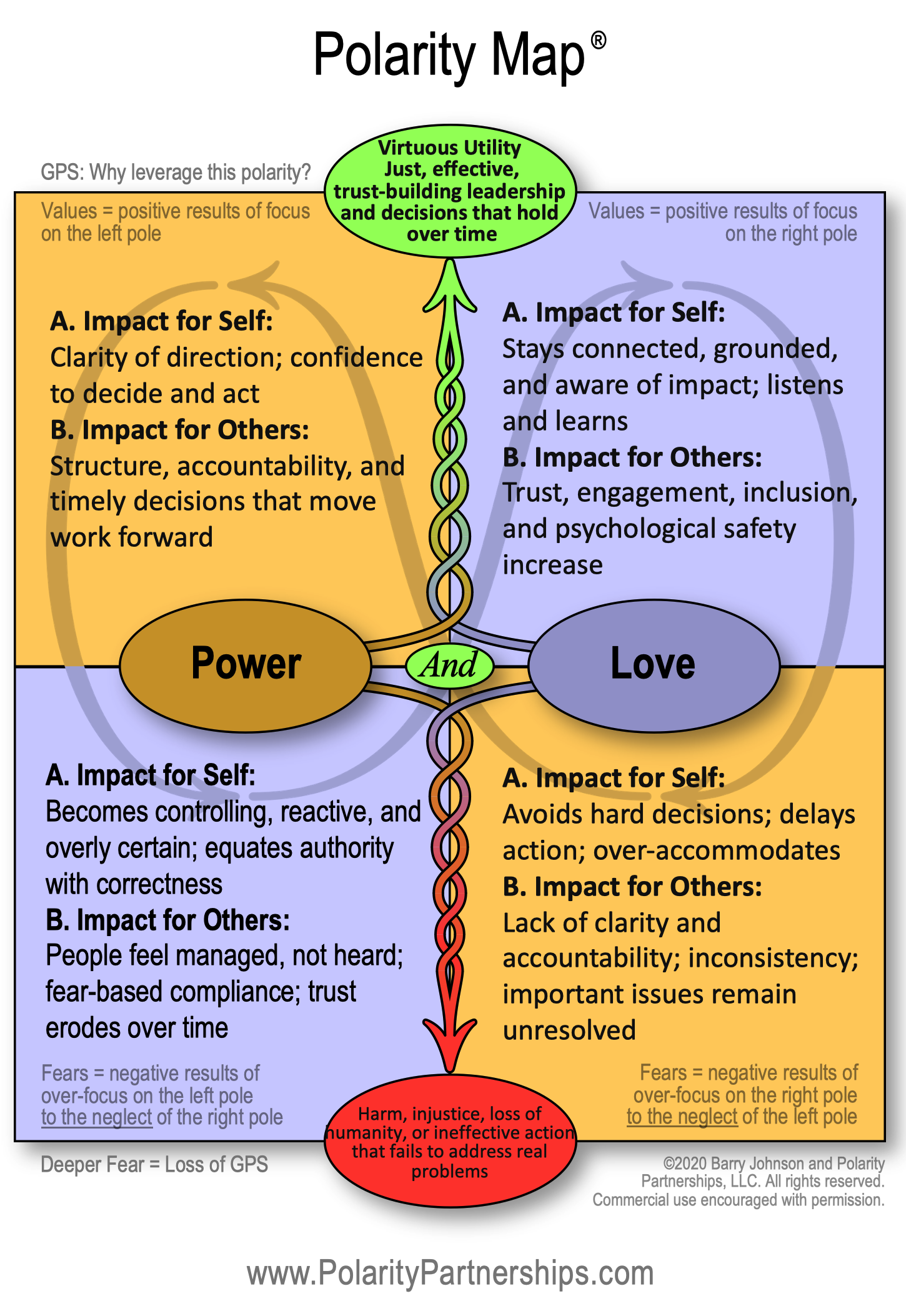
When Power is developed to the neglect of Love, it becomes controlling, coercive, and eventually abusive. Results may be achieved, but trust erodes. People comply, but commitment weakens. Systems tighten, but adaptability disappears. (I’ve worked in those environments. Everyone performs. No one speaks up.)
When Love is developed to the neglect of Power, it becomes well-intentioned but ineffective. Care is present, but the ability to act, decide, and follow through weakens. Problems are understood but not addressed. Relationships matter, but results suffer. People feel valued but not led.
The work is not choosing between them. The work is holding both. And that requires something most of us are still learning: Trust.
Trust in yourself—that you can hold both without defaulting to the one that feels safer. Trust in others—that they need both Direction AND Connection, Clarity AND Care. Trust in systems—that the structures you build must enable both Accountability AND Humanity, or they will not hold over time.
This is not a new idea. Martin Luther King Jr. named it directly: “Power without love is reckless and abusive, and love without power is sentimental and anemic.” At their best, Power AND Love are not in opposition. They reinforce each other. Power grounded in Love becomes the capacity to act in ways that serve more than immediate outcomes. Love grounded in Power becomes the willingness to take action that reality requires.
Adam Kahane has written extensively about this tension—the need to achieve results AND build relationship, neither sufficient alone. Barry Oshry names it structurally, showing how Power Processes and Love Processes operate in every system whether we see them or not. In Chapter 36 of And: Volume Two, I explored how Oshry’s Organic Systems Framework connects with Polarity Thinking to make this interdependence practical. Different language. Same truth. When Power differentiates without integrating, systems fracture. When Love integrates without differentiating, systems stagnate.
The same dynamic runs through democracy. Democratic systems require Power—the authority to make decisions, enforce laws, establish order—AND Love—the civic commitment to care about one another’s welfare, to see the whole, to sustain connection across difference. This is why the Polarities of Democracy Institute identifies five core tensions that must be held together: Freedom AND Authority, Justice AND Due Process, Diversity AND Equality, Human Rights AND Communal Obligations, Participation AND Representation. Each pairing requires Power AND Love. Authority without care becomes tyranny. Care without authority becomes chaos. Democracy does not survive when we abandon either pole. It survives when we learn to hold both, even when it is uncomfortable.
And now Artificial Intelligence is accelerating our capacity for Power at a pace we have never experienced before.
AI can optimize decisions, scale actions, enforce rules, and generate outputs faster than any human system ever could. It extends Power dramatically. What it does not do—what it cannot do—is generate Love. It cannot sense when enforcement is damaging trust. It cannot feel the cost of a decision on the people it affects. It cannot cultivate empathy, moral courage, or the relational awareness that keeps Power humane.
We are generating Power at AI speed while developing Love at human speed. And the gap is widening.
If we do not address this, we will build systems that are extraordinarily capable and profoundly disconnected. Systems that perform efficiently and erode trust systematically. Systems that succeed by every visible metric and fail by every measure that matters over time.
So the question Lao Tzu leaves us with is not whether we can become more capable. We will. The question is whether we can remain fully human as we do. Whether we can act with strength while staying connected to what is happening. Whether we can lead without forcing. Whether we can hold Power AND Love together—not once, but consistently, in the decisions that shape what comes next.
Because the decisions that hold over time are not the ones made with Power alone or Love alone. They are the ones made with both. The ones that serve Immediate Need AND Long-term Trust. The ones that Address what is broken AND Strengthen what sustains. The ones that Produce Results AND Deepen Capacity to keep producing them.
That is the test. Not whether a decision worked once, but whether it continues to work. Whether it served both Part AND Whole. Whether it built the trust required for the next decision.
I think about the doe on the trail. She did not choose between protecting her fawn and letting me pass safely. She held both. She stayed present to the whole situation, ready to act if needed, but not forcing action before it was necessary.
Maybe that is what we are being asked to do. Not to resolve the tension between Power AND Love, but to live inside it with enough presence that we know which is needed when, and enough integration that we do not lose one in the pursuit of the other.
I am still learning this. I get it wrong more than I would like to admit. But I am more convinced than ever that it is the work.
Here’s a Polarity Map for Power And Love:
INVITATIONS
If you want to take a quick self-assessment for Power And Love: CLICK HERE
NOTE: the results include Leveraging Action Steps and Early Warnings (to support maximizing upside benefits and minimizing downside limitations).
How is Power And Love showing up for you now?
Try the “AI-trained Chat w/AI Cliff for support for Step 1, Seeing Polarities
Ready for the Polarity Advantage? Check out our online self-directed Basics, Credentialing, or in-person training with Barry Johnson and me at Kayser Ridge! Certifications and Courses