

See the Series Introduction for Just Tao It, Part I: HERE
See the Just Tao It Series Introduction Tao/It on-ramp, PART II: HERE
See Just Tao It, Chapter 1: HERE
From my interpretation of the Tao Te Ching, Chapter 11 (Unpublished):
Spokes unite at the center of a wheel.
But the wheel’s use
takes place where the wheel is not.
Clay is molded to make a bowl.
But the bowl’s use
takes place where the bowl is not.
Walls are raised to build a house.
But the house’s use
takes place where the walls are not.
In the “And” between
there and not,
is the useful spot.
—
I keep a small wooden bowl on my desk at Kayser Ridge. Walnut, turned by hand, smooth from years of holding nothing in particular. Every time I reach for it—to hold paper clips or loose change or nothing at all—I’m reminded that its usefulness has almost nothing to do with the wood.
The wood just holds the space.
We don’t think this way naturally. We focus on what we can see, measure, and optimize. The spokes. The clay. The walls. The structure. The Form. It draws our attention because we can point to it, photograph it, put it in a budget line. Lao Tzu saw this 2,500 years ago and offered a different lens: usefulness does not live in Form alone. It lives in the relationship between Form AND Space.
The center of the wheel where the spokes converge—that’s Space, and it’s what allows the wheel to turn. The clay holds the Space. The walls define the Space. Without Form, there’s nothing to hold. Without Space, there’s nothing to use. Each gives meaning to the other.
The “And” between what is there and what is not.
This pattern appears everywhere, especially where the stakes are highest.
We say we want sustainable development, thriving communities, and a livable future. The Sustainable Development Goals focus on outer systems—policies, investments, measurable outcomes. That’s Form. The Inner Development Goals focus on Inner Capacity—awareness, empathy, courage, the ability to stay present with complexity. That’s Space.
Inner Capacity AND Outer Systems. A modern expression of Form AND Space.
Build Outer Systems to the neglect of Inner Capacity and implementation becomes rigid, hollow, or performative. (I’ve sat in those meetings. Everyone nods. Nothing changes.) Develop Inner Capacity without strengthening Outer Systems and good intentions remain just that—intentions that never translate into durable impact.
Both are required. And both degrade when overextended.
The same dynamic shows up in how we govern ourselves. Democracy is a Form—laws, institutions, procedures, the whole constitutional apparatus. But its usefulness depends on civic Space: the interior capacity of a society to hold tension responsibly.
The tension between Freedom AND Authority. Between Justice AND Due Process. Between Diversity AND Equality. Between Human Rights AND Communal Obligations. Between Participation AND Representation.
These are the five core polarities identified by the Polarities of Democracy Institute, and they create the Space that makes democratic Form usable. When Form is overextended to the neglect of Space, the structure may remain while the capacity that sustains it weakens. Trust erodes. Nuance disappears. The system tightens until it can’t flex. When Space is emphasized without sufficient Form, cohesion frays and shared direction becomes difficult to sustain. Democracy falters not only when Form disappears, but when Space narrows—or when Space expands without the structure needed to hold it.
(I’m not sure we talk about this enough. We argue about policies and platforms, but rarely about whether we’re capable of holding the disagreement those policies require.)
We are remarkably good at turning partial truths into total truths. We amplify one side, defend it, organize around it. It feels efficient. It feels decisive. And it works—for a while.
Overfocus on Form to the neglect of Space and systems become tighter, faster, more controlled. Output increases. Metrics improve. Then trust thins. Candor decreases. Adaptability shrinks. Everything looks strong until the first real strain reveals the brittleness underneath.
Emphasize Space without enough Form and decisions drift. Accountability softens. Momentum stalls. Meetings multiply but nothing moves forward.
And here’s the part that makes this harder: once either pattern takes hold, it tends to reinforce itself. The tighter the system becomes, the more control it seeks. The looser it becomes, the more it avoids structure. The cycle continues until something interrupts it—usually something painful: a crisis, a collapse, or a reckoning that could have been avoided.
This matters even more now because Artificial Intelligence dramatically accelerates our capacity to generate Form.
AI can design, optimize, scale, and automate at unprecedented speed. It strengthens systems, processes, and output. ChatGPT can generate a business plan in 30 seconds. It can draft policies, create organizational charts, simulate scenarios, and produce deliverables faster than any human team.
What it does not automatically generate is Space.
It does not cultivate wisdom, moral courage, or relational discernment. It cannot sense when a system is eroding trust. It cannot tell you whether a decision serves the whole or just looks good on paper. It can scale a message to millions but cannot cultivate the interior capacity to know if that message should be scaled at all.
AI increases our structural capability faster than humanity is developing the interior capacity to make sense of it. We are generating Form at AI speed while developing Space at human speed.
When Form accelerates without corresponding Space, we become more powerful without becoming more discerning. That imbalance doesn’t merely reduce effectiveness—it destabilizes the very systems we’re trying to improve. And the inverse risk is no less real: when concern for Space slows the development of Form, we can fail to act with the clarity and structure the moment requires.
This isn’t a future risk. It’s happening now.
So the work is not building more or opening more. It’s strengthening Form AND Space together.
Acting with clarity while developing the capacity to understand the consequences of that action. Building structures that perform while cultivating the awareness that keeps those structures humane. Not once, but over time.
The tension does not resolve.
It must be lived.
Here’s a polarity map that makes the dynamic visible—not to solve it (you cannot solve a polarity), but to navigate it more consciously:
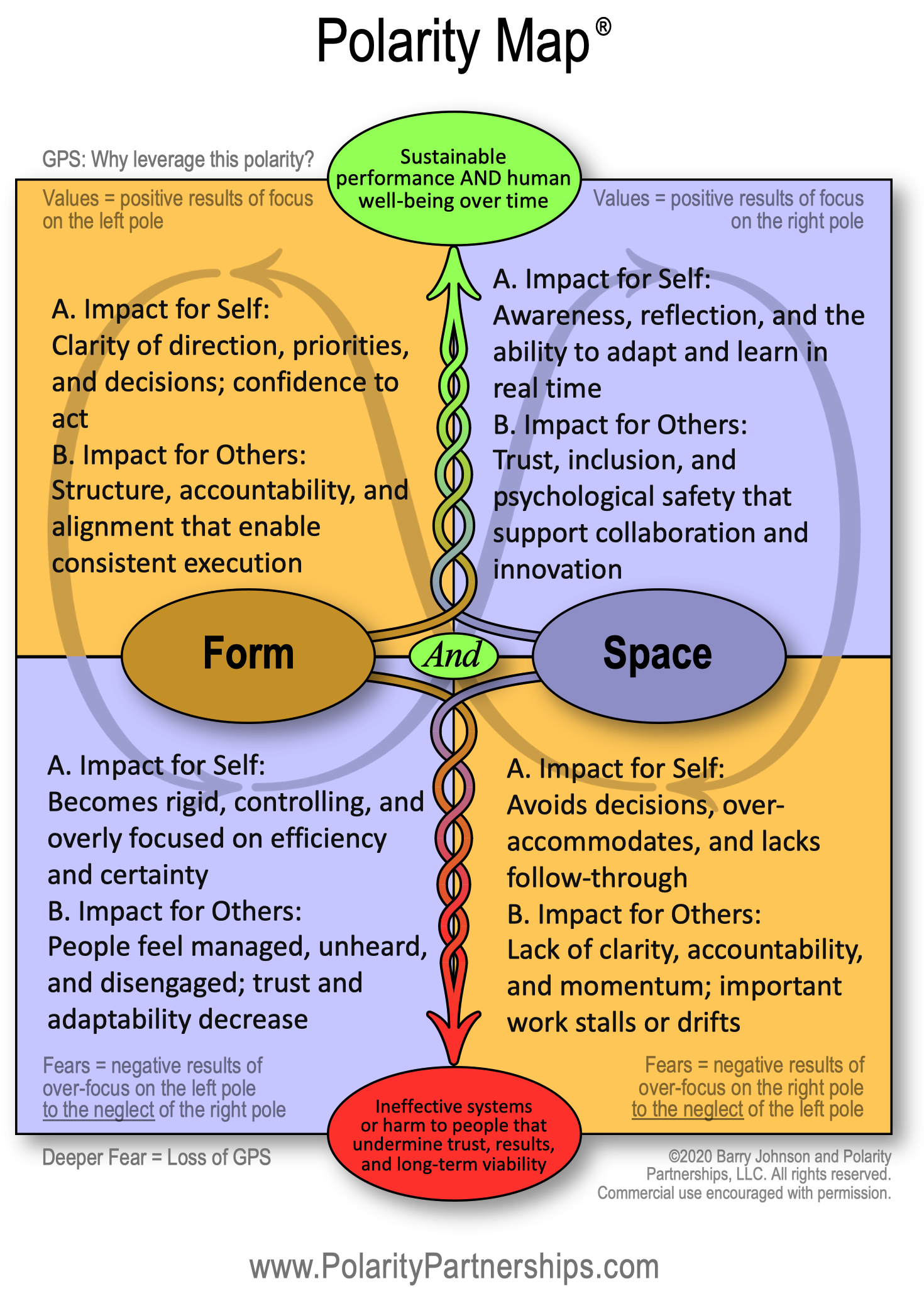
Notice: Both poles have genuine value (upper quadrants). Both have real dangers when over-emphasized (lower quadrants). The work is not choosing sides. It’s learning to move between them with increasing skill, aware of where you are and what the moment requires.
Usefulness is not found in what we build alone, nor in what we leave open alone. It is found in how Form AND Space come together in service of something larger.
Leaders who can work inside this tension—who can tighten when structure is needed and open when space is required, who can sense which is called for and act accordingly—develop something less visible than strategy and more durable than intention.
They develop trust. In themselves, in their teams, in the systems they steward.
Not because they got it right every time. But because their decisions continued to hold over time, even as conditions changed.
That’s the test. Not whether a decision worked once, but whether it stands the test of time. Whether it served both Part AND Whole. Whether it strengthened the capacity for the next decision.
And that responsibility, whether we like it or not, belongs to us.
The bowl sits on my desk. The space inside it holds whatever I need it to hold. The wood just does its job.
Maybe that’s enough.
INVITATIONS
If you want to take a quick self-assessment for Form And Space: CLICK HERE
NOTE: the results include Leveraging Action Steps and Early Warnings (to support maximizing upside benefits and minimizing downside limitations).
How is Form And Space showing up for you now?
Try the “AI-trained Chat w/AI Cliff for support for Step 1, Seeing Polarities
Ready for the Polarity Advantage? Check out our online self-directed Basics, Credentialing, or in-person training with Barry Johnson and me at Kayser Ridge! Certifications and Courses