

See the Series Introduction for Just Tao It, Part I: HERE
See the Just Tao It Series Introduction Tao/It on-ramp, PART II: HERE
See Just Tao It, Chapter 1: HERE
From my interpretation of the Tao Te Ching, Chapter 22 (Unpublished):
Be broken to be whole.
Be empty to be full.
Be small to be great.
Be bent to be straight.
Let the old depart,
the new appears.
What is true—
already here.
Unmoved by appearance—
esteemed.
Unconcerned with reverence—
admired.
Uninterested in applause—
celebrated.
The sage does not contend,
and none contend.
What is bent
becomes whole.
—
Be broken to be whole.
I’ve spent a lot of my life avoiding that instruction, especially in leadership rooms. Two shapes of avoiding it show up in almost every leader I’ve worked with, including me.
The first is the All-Knower. Confident to a fault. Has the answer, says it cleanly, demonstrates certainty fast. It’s genuinely useful — people need direction, decisions matter. But something underneath starts tightening over time. Conversations narrow. People manage what they say around the leader instead of contributing honestly to the work itself.
The system compensates.
The second moves the opposite direction — the All-Shoulder. Humble to a fault. Carries everything, questions everything, seeks more input, more time. It looks thoughtful and collaborative. It’s genuinely valuable too — reflection matters, people need to feel heard. But eventually decisions slow past usefulness, and frustration accumulates while the leader tells themselves they’re just being careful.
Both patterns work for a while. Both eventually exhaust the system they were trying to protect.
Broken is permeability — the crack that lets something in instead of just something out. The All-Knower can’t afford a crack. The All-Shoulder is so busy examining the crack that nothing gets built.
Lao Tzu is pointing at something underneath both of them. To be broken is to stop organizing yourself around appearing whole. To be empty is to leave room for what you don’t understand yet. To be small is to stop putting your identity at the center of every outcome.
Empty is room — space left for what you don’t understand yet.
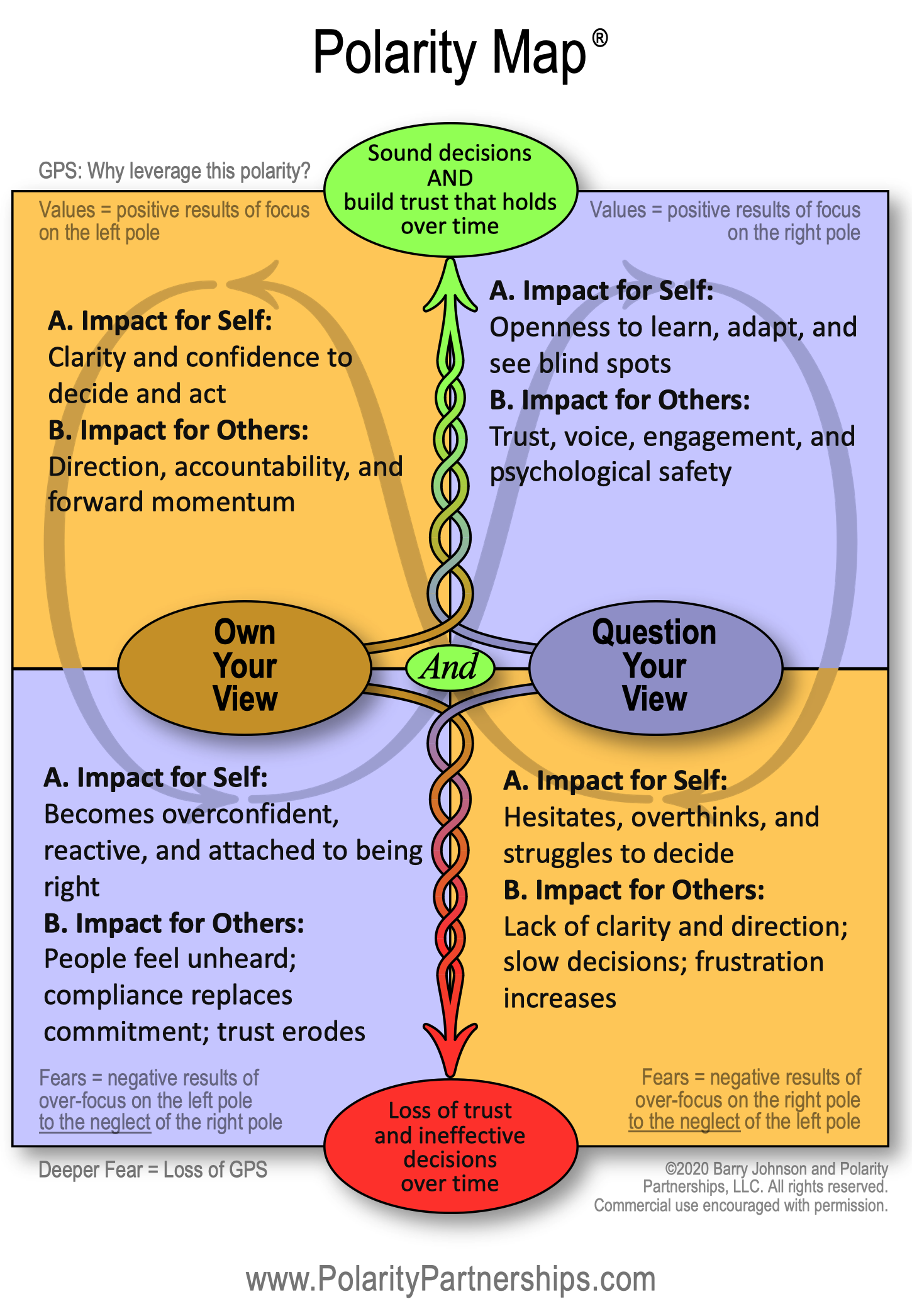
The All-Knower overfocuses on owning and loses questioning. The All-Shoulder overfocuses on questioning and loses owning. Both can sound reasonable. Both can feel morally superior to the other. Once trust erodes, each side pushes the other further — the All-Knower more declarative, the All-Shoulder more delayed — while neither notices its own hand in the pattern.
Modern culture increasingly rewards sounding certain over being thoughtful. The loudest person gets mistaken for the clearest thinker. Mockery gets mistaken for strength. Once a whole system organizes around certainty as performance, people stop learning.
Appearance fades the moment you need it to hold you up. Applause asks for an encore you can’t always give.
Adult development researchers describe something similar. Earlier stages seek stability through certainty and fixed answers — useful capacities that eventually run into a wall. More mature stages start recognizing that reality is larger than the frameworks used to explain it. Other people stop looking wrong and start looking like carriers of something you might still be missing.
Small is undefended — nothing propped up that has to keep standing.
Brené Brown calls this vulnerability, not weakness — the risk of staying exposed instead of armoring up. Protect yourself constantly, and you build the very distance you were afraid of.
Jim Collins found the same pairing in his research on Level 5 leadership: the leaders whose results lasted longest combined fierce professional will with real personal humility. Both. Not one.
Own your view. Question your view too. Without the first, leadership weakens. Without the second, it hardens.
Be bent to be straight. Democracies need the same hinge. Shared governance depends on people who can hold conviction without absolutism, disagreement without dehumanization. Democracies don’t survive because everyone agrees. They survive because people stay capable of disagreeing without abandoning the relationship. Harari calls democracy an ongoing conversation more than a set of institutions — a society’s way of staying able to correct itself. Once questioning starts feeling like betrayal, that hinge is gone.
AI is accelerating all of this. What it uniquely tests here isn’t speed — it’s identity, performance, certainty. How much of what we call conviction is really armor.
The older I get, the more wisdom looks less like becoming certain and more like staying present while a larger reality continues to reveal itself. That doesn’t eliminate conviction. It changes how tightly we grip it.
Let the old depart. The new appears.
What is bent becomes whole.
Here’s a Polarity Map for Own Your View AND Question Your View:
INVITATIONS
If you want to take a quick self-assessment for Own Your View AND Question Your View: CLICK HERE
NOTE: the results include Leveraging Action Steps and Early Warnings (to support maximizing upside benefits and minimizing downside limitations).
Where is Own Your View AND Question Your View challenging you now?
Try the AI-trained Chat w/Cliff for support for Step 1, Seeing Polarities
Ready for the Polarity Advantage? Check out our online self-directed Basics, Credentialing, or in-person training with Barry Johnson and me at Kayser Ridge! Certifications and Courses