

See the Series Introduction for Just Tao It, Part I: HERE
See the Just Tao It Series Introduction Tao/It on-ramp, PART II: HERE
From my Cliff’sNOTES interpretation of the Tao Te Ching, Chapter 1 (Unpublished).
You will see first in this Chapter and later throughout the series, that I use “It” synonymously with “Tao”):
Names fail describing Tao.
Never, always—
in all ways,
It unspoken,
It spoken,
arising together.
Nowhere, everywhere—
in everything.
Everywhere, nowhere—
in nothing.
Without grasping,
the secret reveals.
Forms appear with grasping,
meaning disappears.
Silent—chorus.
Empty—fullness.
Partness—wholeness.
Infinite—source.
Ancient, new.
Below, above.
Unseen, seen—
moving together.
It, as love moves,
without names.
—
The world is tearing itself apart because we keep choosing sides of tensions that require both. Climate becomes Growth OR Sustainability. Technology becomes Human OR Artificial. Politics becomes Freedom OR Order. Economics becomes Profit OR Planet. Religion becomes Faith OR Reason. Healthcare becomes Efficiency OR Compassion. We’ve become exceptionally good at naming what we’re for and demonizing what we’re against, building movements around one pole, treating the other as the problem, and then wondering why our solutions keep making half the problem worse.
This isn’t abstract. Democracies strain. Ecosystems degrade. Trust erodes—personally, relationally, systemically. And the harder we push for one side, the more entrenched the other becomes. The Tao saw this pattern long before we named it. Polarity Thinking makes it practical. And for years, I was hesitant to bring them together—not because they didn’t fit, but because I suspected they might fit too well.
Using Polarity Thinking to make sense of the Tao felt like it might reduce it, contain it, turn Mystery into something manageable. It felt like overreach at best and distortion at worst, so I kept them separate—Tao in one corner of my life, Polarity Thinking in another—like two relatives I wasn’t sure should sit next to each other at dinner. The irony wasn’t subtle. I had spent decades helping leaders hold tensions together while carefully managing my own.
A near-death mountain biking accident in 2021 put my life on pause—traumatic brain injury, fractured C2 vertebrae, arterial dissection — months of recovery—and that forced stillness created an opening I didn’t know I needed. In that space came a realization that now feels obvious: the Tao doesn’t diminish when you look at it through a useful lens; what diminishes is the illusion that the lens is the whole. Pattern clarifies. Mystery deepens. Pattern without Mystery becomes control, while Mystery without Pattern becomes avoidance.
What shifted wasn’t brilliance. It was discomfort. I began to suspect my restraint might not be humility, but avoidance—not because the Tao needs Polarity Thinking (it doesn’t), but because people do. When I met Barry Johnson decades ago, something inside me exhaled. I had the unmistakable sense that I’d been given language for what I’d been trying to live—the tension between opposites, the futility of choosing one side of a dynamic that requires both.
Polarity Thinking didn’t replace Mystery; it honored it. It offered structure without pretending structure was ultimate and gave me ways to work with what I was already experiencing in real systems, with real leaders, under real pressure. What mattered even more was that Barry lived it—not perfectly, no one does, but sincerely. When he missed something, he owned it. When he leaned too far, he adjusted. Watching someone walk the talk—especially in a field that does a lot of talking—meant something.
Through him, I found a community that shaped me as much as any theory ever has—people willing to stay in hard conversations without defaulting to Certainty OR Avoidance, who could challenge without diminishing and support without suffocating. That community, along with Polarity Thinking and Taoist mystery, eventually brought me back to Chapter 1.
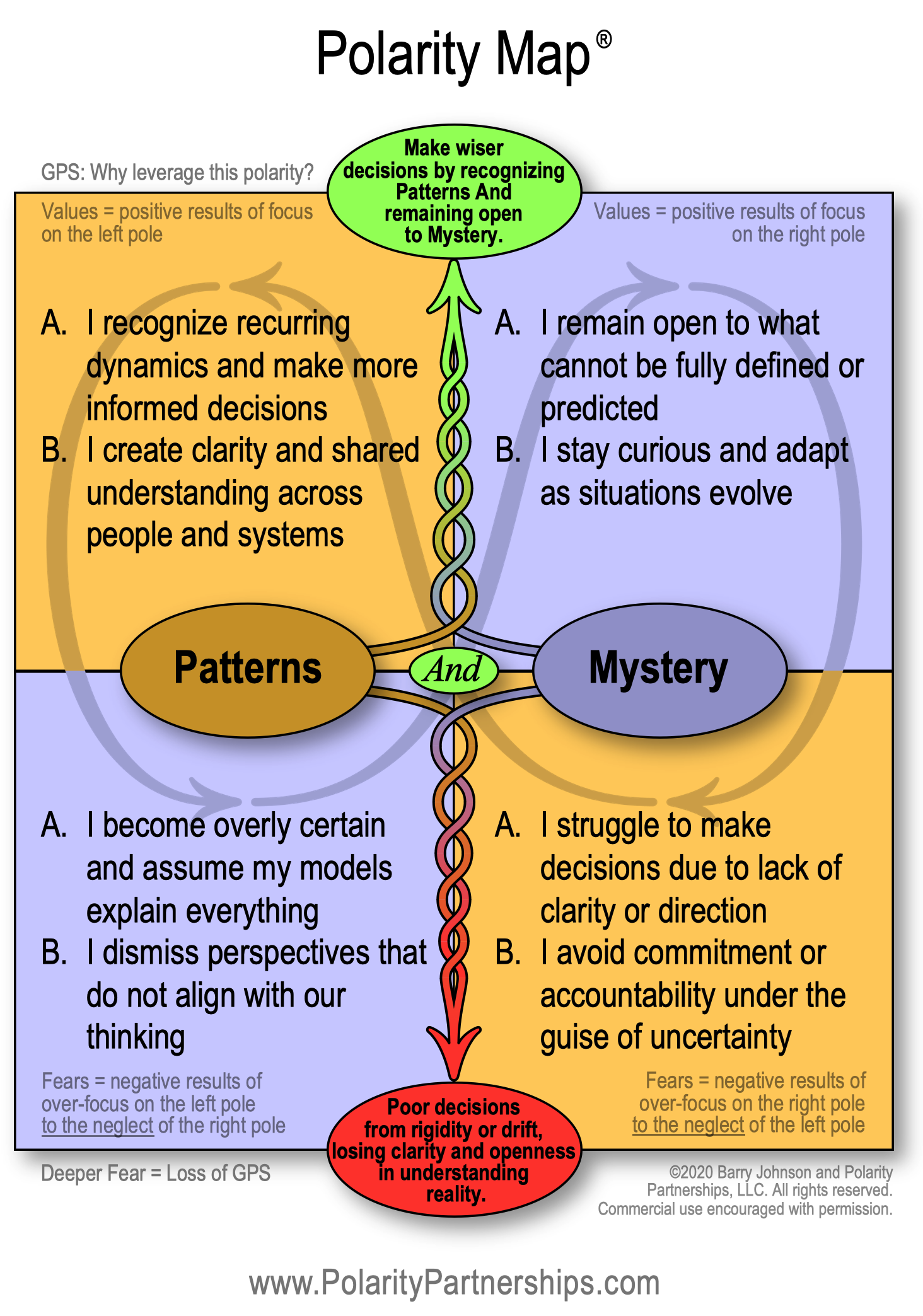
Patterns AND Mystery.
This polarity shows up everywhere, and in organizations it rarely appears as incompetence. It shows up as friction—decisions that don’t hold, alignment that drifts, trust that erodes not dramatically but steadily. Leaders tighten what is measurable when the issue isn’t measurement, and once that begins, it reinforces itself. What can be measured gets more attention, what cannot gets less, and the gap widens.
It’s showing up with new intensity as we integrate artificial intelligence into decision-making. AI excels at Pattern—it analyzes data, recognizes correlations, and optimizes outcomes at speed—but it cannot hold Mystery. It cannot discern meaning beyond data, navigate ethical ambiguity, or stay present to what resists quantification. We are generating Pattern at AI speed while developing Mystery at human speed, and that gap is widening in ways that show up as drift between what systems can do and what people trust them to do.
Leaders who over-rely on Pattern risk optimizing systems toward outcomes no one actually chose, while leaders who resist Pattern in the name of Mystery risk avoiding clarity where clarity is available. The work isn’t choosing. It’s developing the capacity to operate with both—grounded enough to make a call, open enough to adjust as conditions evolve, structured enough to act, and humble enough to recognize when structure becomes obstruction.
Not perfectly. Just wisely enough that decisions begin to hold.
Over time, leaders who stay with this tension develop something more durable than Certainty. They develop discernment that holds—not just once, but as conditions shift—and that capacity shows up in decisions that remain connected to both what can be mapped and what must be respected.
I’ve come to think of this as the work of a pollinator—not in the branding sense, but in the ecological sense of moving between domains, carrying insight from one place to another, helping ideas take root where they otherwise wouldn’t. Pollinators don’t control the system. They participate in it. They don’t own what grows. They help create the conditions for growth.
That’s what this work has become for me—not explaining the Tao, not replacing Mystery with Pattern, but helping people loosen their grip on one side of tensions that require both.
So here’s the invitation behind Chapter 1. Where in your world are you holding Pattern so tightly that Mystery has no room to inform it, and where might you be leaning into Mystery in a way that lets you avoid naming what can, in fact, be named?
That tension isn’t a problem to solve. It’s the work.
And the leaders, teams, and systems that learn to stay with it begin to notice something change. Their decisions start to hold—not because they get it right every time, but because they remain connected to both sides of what reality is asking of them.
The world doesn’t need more people choosing sides.
It needs more people willing to move between them.
Maybe you’re one of them.
(Thank you to my friend/colleague, Dr. Gemma Jiang, for encouraging me to include more of my personal story to this Chapter.)
Here’s the interior portion of a Polarity Map for Patterns And Mystery:
Invitations:
Take a quick self-assessment for Patterns And Mystery: CLICK HERE
NOTE: the results include Leveraging Action Steps and Early Warnings (to support maximizing upside benefits and minimizing downside limitations).
How do Patterns And Mystery show up for you right now?
Try the “AI-trained Chat w/AI Cliff for support for Step 1, Seeing Polarities
Ready for the Polarity Advantage? Check out our online self-directed Basics, Credentialing, or in-person training with Barry Johnson and me at Kayser Ridge! Certifications and Courses