

See the Series Introduction for Just Tao It, Part I: HERE
See the Just Tao It Series Introduction Tao/It on-ramp, PART II: HERE
See Just Tao It, Chapter 1: HERE
From my interpretation of the Tao Te Ching, Chapter 9 (Unpublished):
Brim-fill the teacup,
it spills.
Sharpen incessantly,
the edge dulls.
Overfill the house with possessions,
guarding becomes obsession.
Chase fame and celebrity,
and lose your clarity.
Without extremes—
enough remains.
—
(Just FYI…This and Chapter 48 mutually support one another — link to 48 included at the end.)
You’ve probably heard the story about the cobbler’s children having no shoes. I’m not immune either.
The moment I become convinced more effort will fix what isn’t working, I’m usually already approaching the point where effort itself is becoming part of the problem.
That pattern took me an embarrassingly long time to recognize, partly because effort works. Especially at first.
Push harder. Stay later. Respond faster. Tighten control. Add more meetings. Push through exhaustion. Keep producing. Modern culture rewards all of it. Leaders rise because they outwork everyone around them. Organizations survive hard periods because people stretch past ordinary limits.
Effort matters. Deeply.
Though over time, effort begins changing shape. The same intensity that once created movement starts creating strain. Exhaustion accumulates underneath productivity. Decisions stop holding. Listening weakens. People start operating in reaction more than reflection.
The system compensates.
What makes this hard to see coming is that modern systems reward the early stages of overextension and hide the consequences until later — by the time burnout or bad judgment becomes visible, people are usually already well past sustainable capacity. American culture especially treats exhaustion like proof of seriousness. Social media accelerates all of it, rewarding speed and outrage over discernment.
Kahneman’s work on fast and slow thinking explains part of the mechanism — under stress and overload, we default to fast, efficient shortcuts, and those shortcuts start distorting what we see. Democracy needs the slower capacities too: deliberation, listening, self-correction. All of it takes longer than reacting, and all of it erodes first when a system stays activated too long.
AI is accelerating effort faster than we’re developing the wisdom to steward it. The gap matters.
Effort becomes psychologically rewarding too. People start organizing identity around productivity, indispensability, relentless output — until slowing down stops feeling like a behavior change and starts feeling like a threat to who they are. That’s Chapter 48’s territory more than this one.
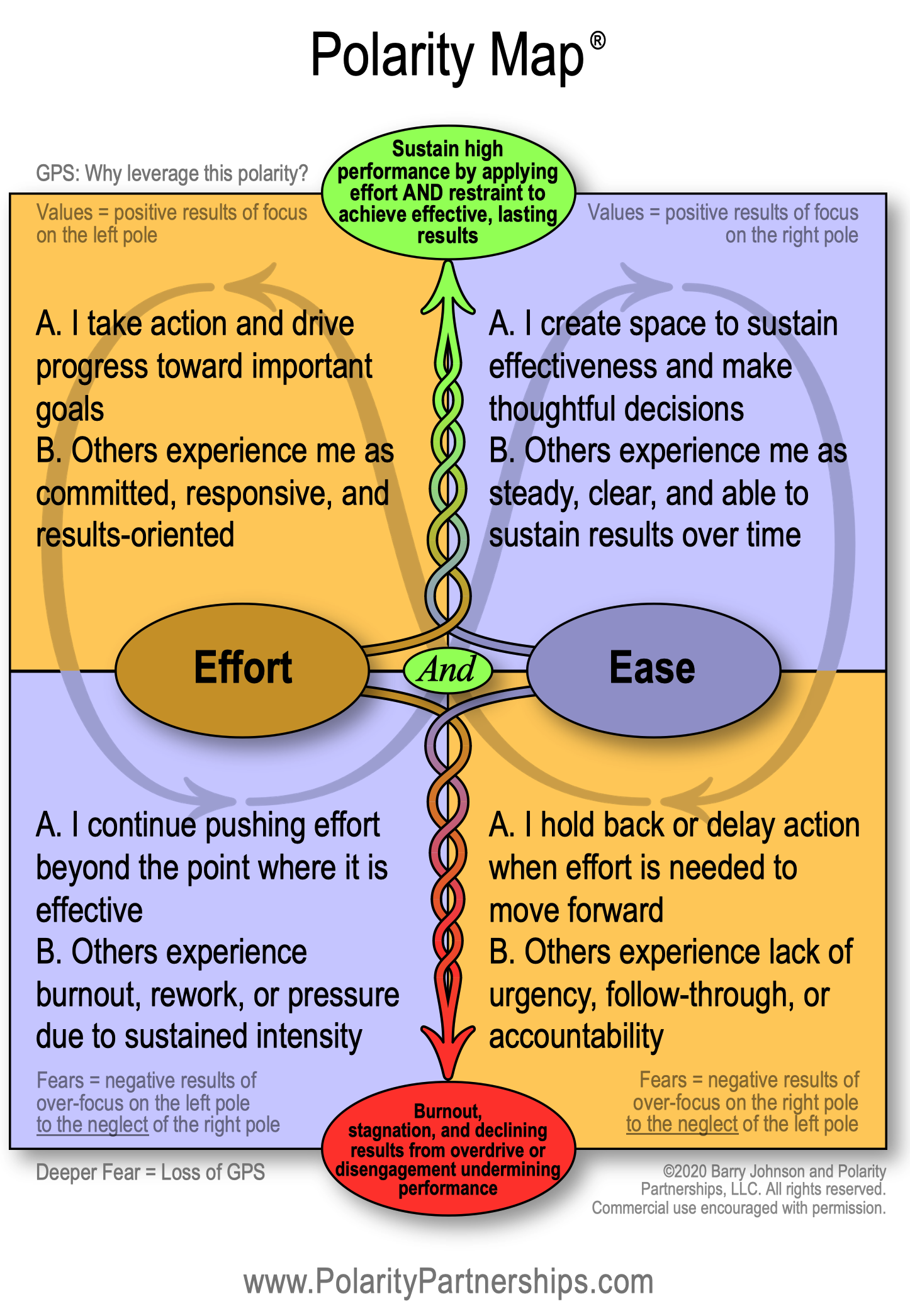
Effort creates movement. Ease sustains movement over time. Ease isn’t laziness — it’s recovery, integration, the room needed to absorb what constant acceleration would otherwise overwhelm. Without Ease, Effort loses wisdom. Without Effort, Ease loses traction. Both matter. Always both.
I’ve watched my sister Lori navigate this longer and better than almost anyone I know. She’s managing cancer, and on most days she has about four hours of usable energy — not four hours of easy energy, four hours total, the whole budget for the day. Everything else requires rest.
She gets more done inside those four hours than most people manage in eight. The limit is what forces the choosing. What’s essential surfaces fast when the budget is that tight.
Lori learned something that took me embarrassingly longer to recognize: there’s a point where continuing to push stops improving the outcome. Stepping back is sometimes part of getting it right.
I see the same rhythm at Kayser Ridge. The land doesn’t force growth year-round. The trees that look bare in January aren’t dying — they’re doing exactly what they’re supposed to be doing that time of year. Dormancy isn’t weakness. It’s where the renewal gets stored up. Modern culture treats a season like that as an interruption. The land treats it as half the process.
Earlier stages of development often equate effort with worth, speed with competence, certainty with leadership, exhaustion with commitment. More mature stages increasingly recognize rhythm, pacing, sustainability, discernment, and the limits of perpetual activation.
The teacup doesn’t know it’s about to spill until it does. The land knows exactly when to stop pushing growth for the season.
I’m trying to get better at telling the difference before the spilling starts. Lori already knows. The Ridge has always known.
Without extremes— enough remains.
Here’s a Polarity Map to help see the pattern:
INVITATIONS
See Chapter 48 as a cross-reference for this Chapter.
If you want to take a quick self-assessment for Effort And Ease: CLICK HERE
NOTE: the results include Leveraging Action Steps and Early Warnings (to support maximizing upside benefits and minimizing downside limitations).
How is Effort And Ease showing up for you in your life or work now?
Try the AI-trained Chat w/AI Cliff for support for Step 1, Seeing Polarities
Ready for the Polarity Advantage? Check out our online self-directed Basics, Credentialing, or in-person training with Barry Johnson and me at Kayser Ridge! Certifications and Courses
Check out the Cliff’sNOTE focused on the Law of Least Effort that provides additional support for Effort And Ease