

See the Series Introduction for Just Tao It, Part I: HERE
See the Just Tao It Series Introduction Tao/It on-ramp, PART II: HERE
See Just Tao It, Chapter 1: HERE
From my interpretation of the Tao Te Ching, Chapter 48 (Unpublished):
Being in learning each day,
There is accumulation.
Being in It each day,
There is distribution.
In letting go,
More can show.
More is done,
With less begun.
Without interruption
It moves in motion.
Harmony grows,
And the whole thing flows.
Forcing less.
More becomes.
—
This Chapter and Chapter 9 are joined at the hip.
Chapter 9 focused on what happens when Effort overruns Ease. Burnout. Exhaustion. Diminishing returns. The gradual erosion that happens when systems normalize perpetual activation.
This Chapter moves closer to the interior mechanics underneath that pattern.
Why human beings continue forcing long after forcing stops serving them.
I know the territory well.
For most of my life, my default response when something was not working was painfully predictable:
push harder.
More effort.
More urgency.
More thinking.
More fixing.
More control.
More work.
More intensity.
That strategy produced meaningful accomplishments in my life.
It also produced some equally meaningful messes.
Some life-threatening. (See Chapters 1, 2, 64, and 76.)
The difficult part is that many of the patterns eventually creating strain begin as things genuinely working. A behavior produces results. A habit earns recognition. A leadership style generates momentum. A coping strategy creates safety. A survival adaptation becomes identity.
Until eventually it starts asking more than it gives.
That realization shifted something important for me.
For years I thought my problem involved effort management.
The deeper issue involved identity attachment.
Effort had fused itself to the story I carried about who I was:
reliable,
capable,
responsive,
driven,
helpful,
productive,
strong under pressure.
Most cultures reward those qualities aggressively. Organizations depend upon them. Families lean on them. Leaders often rise through them.
Then eventually the same strengths begin creating consequences their owners struggle to recognize clearly because the behaviors still appear admirable from the outside.
That is part of what makes this chapter difficult.
The issue rarely involves effort alone.
The issue involves overidentification with effort.
Brené Brown’s work helped me understand part of why these patterns persist long after they stop serving us. Many behaviors are not sustained primarily by logic. They are sustained by identity. Robert Kegan and Lisa Lahey describe something similar in Immunity to Change: human beings often struggle to change because hidden commitments are protecting something psychologically important underneath.
David Rock’s SCARF model points toward many of the same structures:
Status.
Certainty.
Autonomy.
Relatedness.
Fairness.
The nervous system protects identity far more aggressively than most people realize.
Slowing down can trigger anxiety wildly disproportionate to the behavior itself because the challenge extends beyond habit. It disrupts the self-story holding the behavior in place.
And modern culture continuously reinforces the story.
Everything now rewards acceleration:
social media,
productivity culture,
politics,
organizational life,
AI,
news cycles,
attention economies,
algorithmic engagement,
constant accessibility.
The pressure rarely asks human beings to become wiser.
It usually rewards whoever responds faster.
That shift changes people.
You can see it everywhere now. Leaders reacting publicly in real time to every criticism. Organizations mistaking urgency for clarity. Citizens remaining emotionally activated so continuously that outrage starts feeling more normal than thoughtfulness. Entire systems becoming organized around perpetual stimulation.
Once activation becomes identity, disengaging from it starts feeling threatening.
That concern extends well beyond individual well-being.
Democracy itself depends upon citizens remaining capable of something emotionally harder than outrage:
sustained participation without perpetual emotional flooding.
That becomes increasingly difficult once attention economies profit from keeping people reactive, tribalized, fearful, certain, and exhausted. Human beings gradually lose complexity capacity in those conditions. Reflection narrows. Curiosity weakens. Nuance disappears. Certainty starts functioning emotionally like relief.
Authoritarian systems benefit from exactly that exhaustion.
Strong leaders.
Simple narratives.
Fast action.
Clear enemies.
Reduced ambiguity.
Human beings have always been vulnerable to those appeals during periods of instability, fear, overload, and uncertainty. The difference now involves scale, speed, and technological amplification.
Though there is another side of this polarity that matters just as much.
I have also watched people overcorrect after exhausting themselves.
I have done it myself.
After periods of overextension, withdrawal can start masquerading as wisdom. People call it sustainable pace while gradually disengaging from responsibilities still requiring courage, effort, clarity, or participation. Reflection drifts into avoidance. Self-care becomes justification for not making difficult decisions. Complexity becomes an excuse for never landing anywhere.
That pattern erodes trust too.
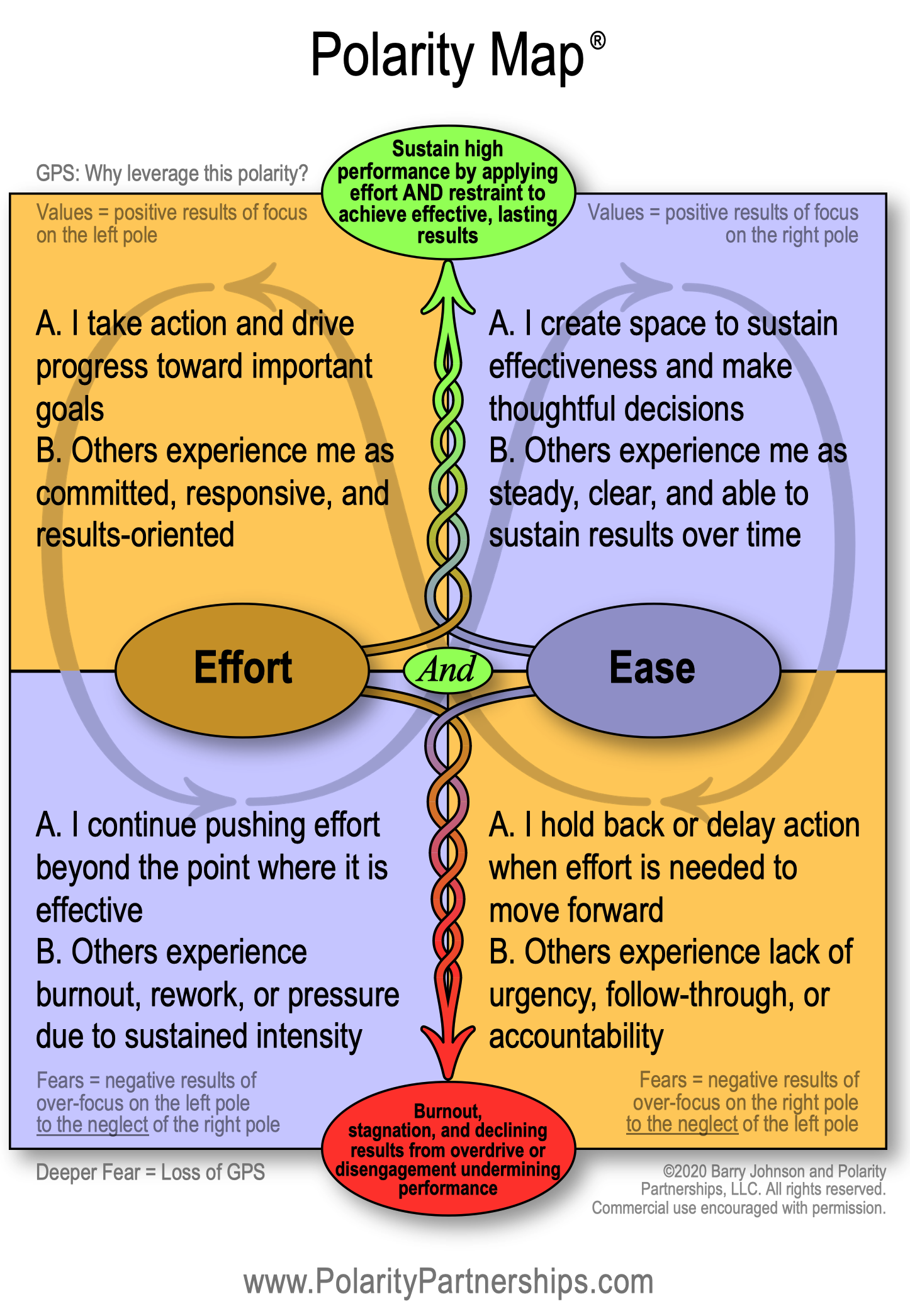
Ease to the neglect of Effort creates drift just as surely as Effort to the neglect of Ease creates burnout.
Both poles matter.
Always both.
Daniel Kahneman’s work in Thinking, Fast and Slow helps illuminate part of what is happening here. Human beings rely heavily on fast thinking because it conserves energy. Quick reactions, emotional judgments, certainty signals, pattern recognition, and mental shortcuts help us move through the world efficiently.
Though modern systems increasingly stimulate fast thinking while weakening the conditions slower thinking requires.
Space.
Time to reflect.
Time to question assumptions.
Time to absorb complexity without immediately collapsing it into certainty.
Time to recognize emotional activation before acting from it.
Democracy depends upon those slower capacities too.
Shared governance is slower than domination.
Listening is slower than reacting.
Self-correction is slower than certainty performance.
Trust develops slowly.
Wisdom develops slowly.
Human beings do too.
Yuval Noah Harari points toward another dimension of this tension that feels increasingly important in the age of AI. Human beings are organic creatures governed by rhythms:
day and night,
activity and rest,
growth and recovery,
engagement and retreat.
Organic life moves cyclically.
AI does not.
Algorithms do not sleep.
Digital systems do not require emotional recovery.
Financial systems do not pause for reflection.
Information systems do not tire.
AI remains perpetually “on.”
Harari describes the emerging tension almost like a tug of war between organic life and inorganic systems. The danger is not merely that AI becomes more capable. The danger is that human beings gradually reorganize themselves around rhythms no biological organism was designed to sustain.
That concern feels profoundly relevant now.
As AI increasingly shapes communication, media, work, politics, finance, and attention itself, human beings face growing pressure to remain continuously activated simply to avoid falling behind in systems never requiring rest.
That is not a small adjustment.
It is a civilizational pressure toward biological exhaustion.
Human nervous systems still require recovery.
Relationships still require time.
Trust still develops slowly.
Wisdom still matures slowly.
Democracy still moves slowly.
Meaning-making still moves slowly.
Human beings do too.
AI is accelerating all of this dramatically.
I remain simultaneously amazed by AI and increasingly cautious about what happens when acceleration itself becomes the unquestioned cultural value. AI can summarize, generate, organize, automate, analyze, and scale at speeds human beings cannot remotely match.
What it cannot reliably recognize is when more output is gradually degrading the larger system producing it.
Human beings struggle with that too.
Especially when systems reward short-term gains while delaying visibility of long-term consequences.
I increasingly watch organizations generate Effort at AI speed while still requiring human nervous systems to metabolize the consequences at biological speed.
That gap matters.
A great deal.
And there is another danger here that concerns me equally.
AI can also enable Ease to the neglect of Effort in ways eroding discernment itself.
I described a version of this in Chapter 9 when a team jokingly asked, “Should we just ask ChatGPT?” during a difficult conversation. That team stayed with the struggle long enough for deeper insight to emerge collectively.
Other groups increasingly do not.
“Let’s see what AI says” can easily become a way of bypassing the effortful thinking difficult situations actually require. Algorithmic recommendations gradually replace judgment. Fast answers replace discernment. System 1 gets relief. System 2 never fully engages.
That is not wisdom.
That is cognitive outsourcing disguised as efficiency.
The people I know navigating AI integration most wisely are rarely the people trying to maximize every possible efficiency. They are usually asking different questions:
Where does this create space for better work?
Where does it gradually increase pressure for more work?
Where does automation support human discernment?
Where does it slowly replace it?
Where does Ease restore sustainability?
Where does Ease become disengagement from necessary effort?
Those are polarity questions.
And maturity questions.
The older I get, the less impressed I become by relentless forcing.
I have watched people force relationships until they broke.
Force organizations until they burned out.
Force movements until they fragmented.
Force certainty until they stopped learning.
Force productivity until their bodies intervened for them.
The compensations eventually arrive.
Sometimes gently.
Sometimes catastrophically.
I have also watched people disappear into the opposite pole:
withdrawing from conflict,
avoiding necessary responsibility,
mistaking disengagement for wisdom,
and gradually eroding their own capacity to contribute meaningfully where contribution was still needed.
That compensation arrives too.
At some point I began noticing that many of the wisest people I know carry themselves differently. They still work hard. Still act decisively. Still carry responsibility seriously. Though there is usually less franticness underneath the movement. Less compulsion. Less identity fused with output itself.
The energy feels steadier.
More grounded.
Almost spacious.
The movement becomes less about proving worth and more about participating skillfully.
That distinction changed a great deal for me.
Including how I think about leadership.
The leaders I increasingly trust are rarely the loudest, fastest, most reactive, or most performative people in the room. They are usually the people capable of remaining grounded while others become emotionally flooded. They can act decisively without becoming consumed by urgency itself. They can pause without drifting into passivity. They can question themselves without collapsing into indecision.
That kind of steadiness feels increasingly rare now.
And increasingly necessary.
Especially because modern systems reward the opposite so aggressively.
At this point in life, I suspect one of the deepest forms of maturity involves loosening attachment to the version of ourselves built entirely around force.
Loosening the grip enough to recover.
Enough to listen.
Enough to reflect.
Enough to notice when more force is no longer creating wiser participation.
Enough to stop treating exhaustion like proof of virtue.
Maybe that is part of what Lao Tzu was pointing toward in Chapter 48 all along.
Less forcing.
More flow.
Less unnecessary struggle added by identities terrified of letting go.
Here’s a Polarity Map to help see the pattern:
INVITATIONS:
If you want to take a quick self-assessment for Effort And Ease: CLICK HERE
NOTE: the results include Leveraging Action Steps and Early Warnings (to support maximizing upside benefits and minimizing downside limitations).
How is Effort And Ease showing up for you in your life or work now?
Try the AI-trained Chat w/AI Cliff for support for Step 1, Seeing Polarities
Ready for the Polarity Advantage? Check out our online self-directed Basics, Credentialing, or in-person training with Barry Johnson and me at Kayser Ridge! Certifications and Courses
Check out the Cliff’sNOTE focused on the Law of Least Effort that provides additional support for Effort And Ease

![]()