
(This Cliff’sNOTE was inspired by the book, The Righteous Mind by Jonathan Haidt)
Let me start with a confession.
I fall into these traps all the time.
Despite knowing the theory. Despite teaching this work. Despite having Polarity Thinking™ tattooed on my professional soul. I still catch myself sliding into moral certainty, reacting before reflecting, assuming my intuition is obviously correct and that this time I don’t need to slow down. Other days, I swing the other way—overthinking, over-contextualizing, empathizing myself right into paralysis while something that actually matters goes unchallenged.
If you’re exhausted by this moment we’re living in, you’re not alone—and you’re not broken.
I hear it constantly from leaders, coaches, and OD practitioners: “I’m so tired of trying to be reasonable in an unreasonable environment.” The emotional load is relentless. The moral noise is deafening. And the pressure to either pick a side (or pretend there are no sides at all) is crushing. This is the field in which The Righteous Mind helps illuminate.
Haidt’s core insight is both relieving and destabilizing: we don’t reason our way into our moral positions—we intuit them. Our moral intuitions fire fast and they feel right and come pre-loaded with biases and convictions. Reason shows up only later and often it’s used to justify the conclusion we’ve already reached. Social media “bumper-sticker wisdom” and memes help (sarcastic use of help) do less thinking and more PR-ing. Familiar? Welcome to the current state of the human-inhumane race.
Haidt also shows that people rely on different moral foundations—care, fairness, loyalty, authority, sanctity, liberty—and that these differences are real, durable, and value-based. Not misunderstandings. Not stupidity. Not bad faith. The problem isn’t that we hold moral convictions. The problem is that we routinely confuse our partial moral truth with the whole moral landscape—and then act shocked, become outraged when others don’t naturally fall in line.
Seen through a polarity lens, Haidt isn’t describing a flaw in human nature. He’s describing the pair dynamic we keep mis-diagnosing as an either/or and then mis-managing (again, with help – of algorithms…)
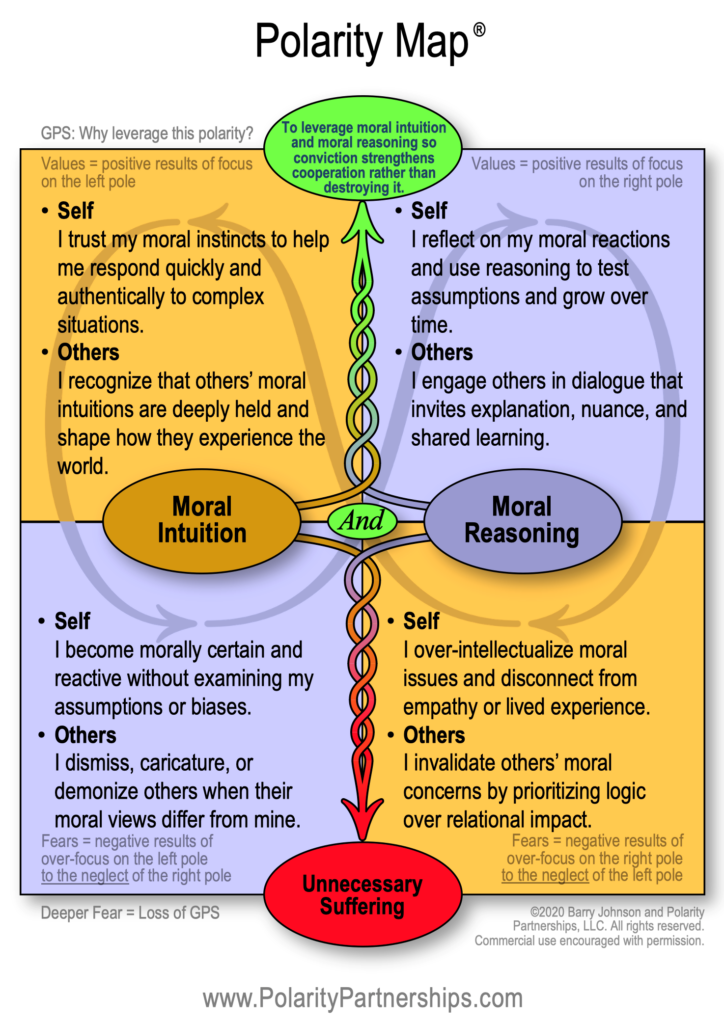
The implicit polarity at play he’s pointing to is something like Moral Intuition AND Moral Reasoning – see the Polarity MapÒ at the end of this note. The Intuition part gives us speed, meaning, and moral energy. The Reason part gives us reflection, humility, and the ability to learn. When Intuition runs amok without Reason, we get outrage, certainty, and moral overreach. When Reason runs amok without Intuition, we get detachment, technocratic tone-deafness, and moral anemia. I know both states well. Most of us do. The exhaustion comes from living inside this oscillation without a way to work it deliberately.
There’s also an implicit focus on Belonging AND Truth-Seeking. We are wired for Belonging -not much debate in the literature there. At the same time, Truth-Seeking requires curiosity, discomfort, and the willingness to be wrong. When Belonging overly dominates (often fueled by misinformation — and yes, outright lies) we get echo chambers and moral conformity. When Truth-Seeking dominates without regard for Belonging, we get righteous isolation and scorched-earth conversations. Neither sustains human systems or a quality culture. Is any of this feeling familiar right now?
What Polarity Thinking™ adds—and this matters—is not a call to be “nice” or endlessly accommodating. This work is not about moral mushiness. It’s not about avoiding hard conversations. And it’s definitely not about pretending that everything is relative or negotiable.
Some things matter deeply. Some lines need to be held. Some behaviors are not okay. Period.
Polarity Thinking™ AND Practice is about disciplined courage—the ability to take firm stands without collapsing into moral overreach, and to stay open without surrendering what you stand for. I find myself increasingly less shy about this. There are values I’m willing to be uncomfortable for. There are lines I’m willing to draw without apology. And if I’m honest, there are things I’m increasingly willing to put my comfort—and yes, even my life—on the line for if it comes to that.
The polarity lens doesn’t weaken moral conviction. It strengthens it by keeping conviction from becoming destructive.
Instead of asking, “How do I win this argument?” the more useful question becomes: “Which value am I overusing right now—and which one am I neglecting?” That question doesn’t make the world sane again. But it does make it more workable. And right now, workable might be the most radical thing we can aim for.
All of this, in my view, ties directly to what a healthy culture—and a healthy democracy—looks and sounds like.
Democracy focus — recent Cliff’sNotes:
Cross-walking Democracy with Bill Benet and Yuval Noah Harari
Democracy Cross-walk: Tao-of And Polarities-of”