


One word could change our trajectory.
“And.”
Every generation inherits problems it didn’t personally create. Some inherit wars. Some inherit economic breakdown. Some inherit institutions that no longer work the way anyone hoped they would. The generation coming of age right now has inherited something different. They have inherited a planetary system sending increasingly unmistakable signals that the bill for two centuries of industrial prosperity has finally arrived.
This makes for an awkward intergenerational conversation. Older generations understandably point to the extraordinary benefits that modern prosperity produced: longer lifespans, medical breakthroughs, technological advances, living standards unimaginable to most of human history. Younger generations look at the same system and notice rising temperatures, intensifying storms, unstable food systems, and a climate conversation that somehow still manages to resemble a food fight in a middle-school cafeteria. The tension is real. So is the confusion.
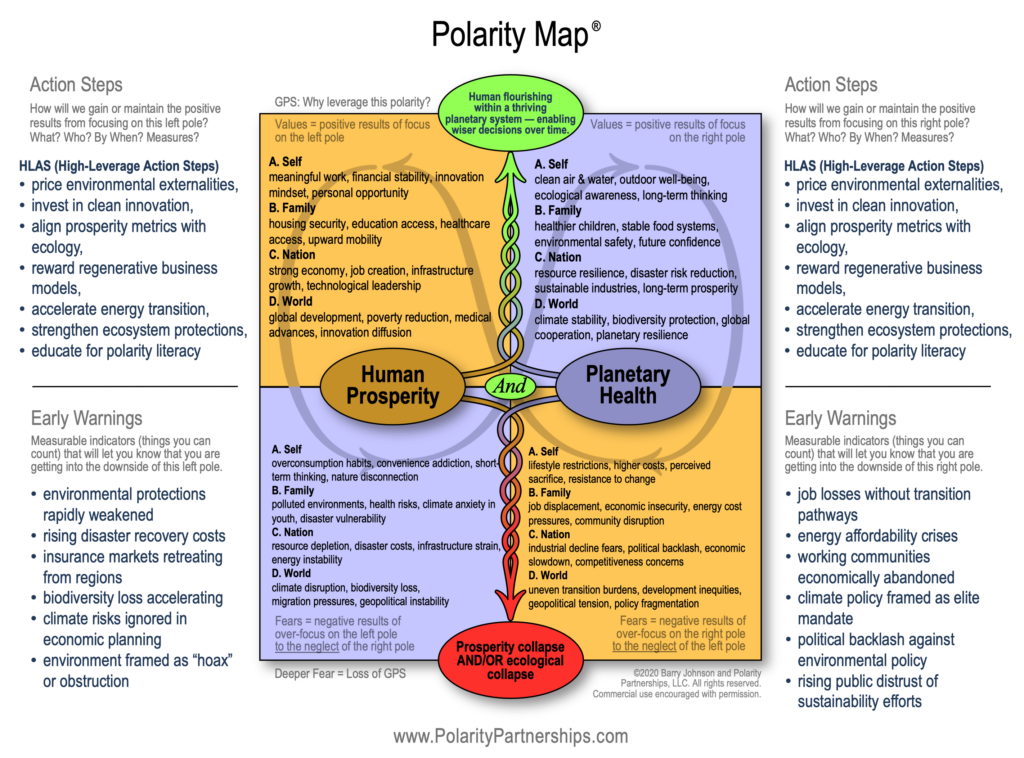
Underneath the political noise sits a polarity most societies have never learned to name: Human Prosperity And Planetary Health. Prosperity matters. Innovation matters. Economic vitality matters. Families want stability, opportunity, and a future that improves on the past. That desire is neither selfish nor controversial. It is simply human. But Prosperity to the neglect of Planetary Health produces consequences that eventually circle back to the very prosperity we were trying to protect over time.
Polarity thinking contains a slightly uncomfortable observation about this dynamic. When a system overfocuses on one pole of a polarity, the first thing it experiences is the downside of the pole it is overusing. If the pattern continues long enough, the system eventually produces the downside of both poles at the same time. That is when the situation shifts from tension to trouble.
The pattern is not especially mysterious. A society leans heavily toward economic expansion while treating environmental limits as someone else’s problem, preferably someone who lives several decades in the future. At first this seems to work. Energy production rises. Industries expand. Jobs grow. Leaders congratulate themselves on their realism while dismissing environmental concerns as exaggerated, inconvenient, or occasionally as a hoax invented by people who apparently have nothing better to do with their time.
Then the system begins to push back in ways that are harder to ignore. Storm damage becomes more expensive. Insurance companies begin retreating from entire regions. Agricultural systems start behaving like they have read the wrong script. Supply chains discover that climate volatility is not particularly respectful of quarterly earnings reports. At that point the economy itself begins absorbing the consequences of environmental instability. The strategy designed to protect prosperity begins undermining it.
This is the polarity trap in action. Prosperity to the neglect of Planetary Health eventually damages both prosperity and the planet. What looked like strength reveals itself as a rather expensive misunderstanding.
There is also a second reality hiding underneath the debate that tends to make people uncomfortable in a different way. The earth does not actually need humans. Humans need the earth. The planet has survived asteroid impacts, ice ages, and a few mass extinctions that would have made today’s political arguments look charmingly trivial by comparison. If we succeed in making large portions of the planet less hospitable to human civilization, the earth will eventually adjust with the patience of a geological process that has all the time in the world. The fragile variable in this equation is not the planet. It is us.
A handful of people have had the unusual privilege of seeing this more clearly than the rest of us. Astronauts returning from orbit often describe something called the Overview Effect, a shift in perception that occurs when they see Earth from space. From that vantage point the arguments that dominate our politics start to look strangely small. Borders disappear. The atmosphere looks alarmingly thin. The planet reveals itself not as a collection of competing territories but as a single, fragile system floating in a very large and indifferent universe.
Carl Sagan once described Earth as a pale blue dot suspended in the cosmic dark. On that tiny speck, he reminded us, every human being who ever lived has lived out their lives. Every king, every revolutionary, every teacher, every parent, every child. Every war. Every ideology. Every argument we have ever had about who is right and who is hopelessly wrong. Seen from that distance, the polarity becomes embarrassingly obvious. Human Prosperity And Planetary Health are not competing goals. They are the conditions that make each other possible over time.
Yet in highly individualistic societies another pattern quietly emerges. The circle of concern shrinks. First we take care of Me. Then My Family. Then My Organization. Then My Country. At each step the system becomes easier to simplify. The environment drifts into the category of abstract future problem, something that might be addressed after more immediate priorities are handled. If the pattern continues long enough, the planet itself begins to look suspiciously like an optional variable.
The system, however, has not received that memo.
Leadership in this moment requires the capacity to hold tensions that simpler thinking tries to resolve prematurely. Protecting livelihoods and protecting the environmental systems that sustain those livelihoods are not opposing goals. They are interdependent responsibilities. Prosperity to the neglect of Planetary Health eventually undermines the very success it was meant to secure. Planetary Health to the neglect of Prosperity becomes politically unstable and socially fragile.
Neither pole can be ignored without consequences.
Younger generations sense this tension with increasing urgency. Many of them feel that previous generations enjoyed the upsides of prosperity while quietly postponing the downsides. That frustration is understandable. But history rarely gives any generation the luxury of solving only the problems it personally created. Each generation inherits unfinished work. The question is whether we develop the capacity to see the system more clearly than the generation before us.
The next decade will test that capacity in ways few of us would have preferred. The choices made in the coming years will influence whether the polarity of Human Prosperity And Planetary Health becomes a virtuous cycle that strengthens both, or a vicious cycle that steadily erodes them. The difference between those futures will not be determined by ideology alone. It will depend on whether leaders, institutions, and citizens learn to hold both sides of the polarity at the same time and resist the seductive simplicity of pretending we only need one.
This is not a conversation about saving the planet. The planet will be fine in the long run. It is a conversation about whether human civilization is capable of learning fast enough to live wisely within the systems that sustain it.
The next years will tell us.
And they will shape us in ways that are difficult to overstate.
The encouraging news is that the polarity itself contains the path forward. When societies learn to leverage the tension between Human Prosperity And Planetary Health instead of denying it, something important becomes possible. We begin making wiser decisions not just for the next quarter, election cycle, or news cycle, but for the generations who will live longest with the consequences—decisions that stand the test of time for both Part And Whole.
That shift in perspective may turn out to be the most important innovation of the century.
Here’s a Polarity Map for Human Prosperity And Planetary Health:
Want to learn more about Polarity Thinking and explore options for self-paced learning and Credentialing?
CLICK HERE
Want to use an AI-trained Cliff to support you in Step 1 Seeing?
CLICK HERE