

See the Series Introduction for Just Tao It, Part I: HERE
See the Just Tao It Series Introduction Tao/It on-ramp, PART II: HERE
See Just Tao It, Chapter 1: HERE
From my interpretation of the Tao Te Ching, Chapter 49 (Unpublished):
With open mind,
the wise find
all people
worthy of care.
Those who live nobly,
are treated well.
Those lost from themselves,
are treated well also.
Trust rises
where trust is given.
To those who live trustfully,
trust is offered freely.
To those unable to trust,
the wise remain trustworthy still.
In this way,
wisdom keeps
childlike simplicity.
Unhardened by fear.
Unbroken by doubt.
—
Kayser Ridge is one of the places where I learned this—not in a classroom, but through the sometimes-brutal teacher of experience. I trusted my courage to pull off something big on a shoestring. I trusted the strength of the mission and vision, and the energy that gathers when people believe something worthwhile can be built. I let that trust run too far ahead of Margin and Money—the practical and financial realities that needed to be moving alongside it.
The vision and courage carried real value. I had also asked them to carry more than they could hold. Trust in one side had moved ahead of the discernment offered by the other. I treated that discernment as though it might weaken the dream, when it could have helped carry the dream more soundly.
There is an irony in that realization. For years, it used to set me off when I heard senior executives dismiss the relational capacities that build trust as “soft skills”—as though they were secondary or optional, something added after the serious business of strategy, execution, finance, and results was already underway. I had seen too clearly what happens when leaders trust the so-called Hard Skills while neglecting the human relationships on which every result ultimately depends.
At Kayser Ridge, I encountered the inverse danger. I could over-trust vision, courage, relationship, and possibility while failing to give enough authority to numbers, limits, patterns, and consequences. The experience complicated the hierarchy I had been resisting. Hard Skills belonged inside the mission, just as the relational capacities I had spent years defending belonged there. Each carried something the other could not provide. Either one, trusted alone, could distort the whole.
That is part of what Chapter 49 brings alive for me. I hear an invitation to hold an open heart and clear eyes together—to remain open without becoming blind, and discerning without becoming hardened.
Chapter 49 leaves plenty of room for mystery. Polarity Thinking helps me notice recurring patterns within it. Their relationship has become reciprocal in my life: the Tao protects the mystery from being reduced to a model, while the polarity lens offers language for tensions I can feel before I can fully name them. The map helps me enter the terrain; the terrain continues to correct the map.
Trust rises
where trust is given.
That line can feel almost dangerous in a culture where distrust often passes for intelligence—cynicism as wisdom, detachment as sophistication, suspicion as strength. In my experience, trust has never been window dressing in a human system. It is closer to part of the structure itself. As trust erodes, people manage appearances, conceal uncertainty, withhold information, and protect themselves from one another. Meetings become performances instead of conversations. By the time leaders realize they are receiving only filtered information, decline may already be underway.
Jack Gibb devoted much of his work to the conditions that make openness, learning, and interdependence possible. His influence reached me through his mentee, Barry Johnson, and through a phrase Barry carried forward from Jack: seeing is loving.
I have come to hear that phrase as more demanding than sentimental. Seeing someone—or a situation—asks more of us than projecting what we hope to find. It includes noticing strengths and limits, promises and patterns, intentions and consequences. It leaves room for reality to correct us. At Kayser Ridge, loving the vision more wisely would have required seeing more of the reality surrounding it.
Other trust frameworks point toward the same wholeness. Stephen Covey described Character AND Competence. Charles Feltman describes Care AND Reliability. Good character without competence eventually disappoints; competence without character eventually harms. Care without reliability cannot carry what it promises; reliability without care may produce results while damaging the people involved. Trust weakens whenever one side consistently outruns the other.
Feltman’s definition remains one of the strongest I know: trust is choosing to risk making something you value vulnerable to another person’s actions. Trust therefore always involves uncertainty. It asks us to place something meaningful into relationship without complete control over the outcome.
Vulnerability and discernment need one another. I do not experience trust as a requirement to ignore evidence, surrender boundaries, or repeat a pattern simply because I wish it were different. This is where the next lines of the chapter become especially important for me:
To those unable to trust,
the wise remain trustworthy still.
There is a profound difference between remaining trustworthy and becoming endlessly trusting. Remaining trustworthy means refusing to let another person’s fear, betrayal, manipulation, or distrust determine the quality of our own character. Becoming endlessly trusting means abandoning the boundaries and pattern-recognition that wisdom requires. To my ear, the Tao holds openness together with sight.
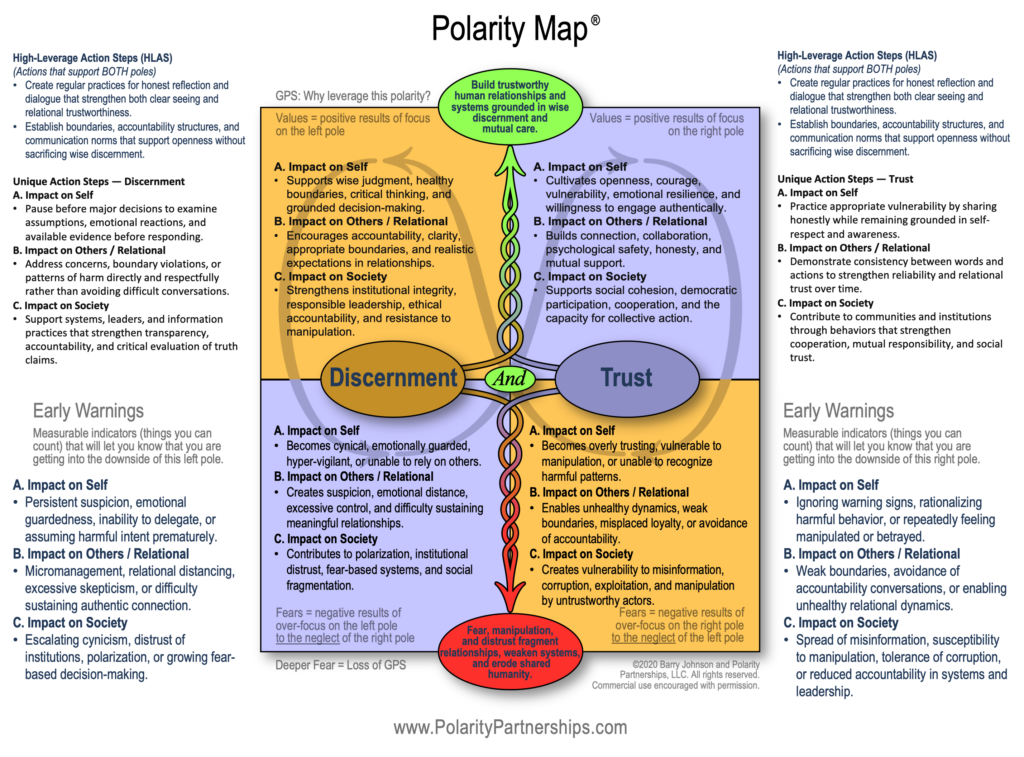
You may see or name the underlying tensions in this chapter differently. Through a polarity lens, what I hear between the lines is Discernment AND Trust sitting near the center. When Discernment is overemphasized to the neglect of Trust, we move toward suspicion, isolation, and the conviction that nothing—or no one—is safe enough to risk. When Trust is overemphasized to the neglect of Discernment, we become vulnerable to wishful thinking, manipulation, and avoidable harm. As I experience them, one pole helps us see what is happening. The other helps keep what is happening from becoming the only thing we can see.
This tension matters far beyond a single project. Once distrust becomes the organizing force in an organization, a family, or a society, even clear evidence gets filtered through suspicion. People stop encountering one another and begin reacting to categories, projections, and fears. Discernment can help us recognize the risks and histories shaping a wise response. Trust helps us continue to see the person beneath them.
In this way,
wisdom keeps
childlike simplicity.
Unhardened by fear.
Unbroken by doubt.
That may be one of the harder invitations in the Tao Te Ching. Remaining open after betrayal, disappointment, or failure takes courage. So does admitting that our own trust may have outrun what reality could support. I do not hear childlike simplicity as naivete. I hear the possibility of remaining receptive after experience has given us ample reason to close.
Kayser Ridge changed my relationship with trust itself. I carried forward a fuller trust in vision, one accompanied by greater respect for what the vision would ask of Margin and Money. Vision seems better served when Discernment walks beside Trust—when practical limits can inform the mission without becoming the whole meaning of it.
With open mind,
the wise find
all people
worthy of care.
For me, seeing people as worthy of care can coexist with recognizing harm and withholding trust where trustworthiness has not been demonstrated. Discernment may guide the boundary without having the final word about another human being. Fear need not have the final word about what remains possible.
I am still learning what it asks of me to keep clear eyes and an open heart—to see what is true, protect what matters, and remain unhardened. What becomes possible when Discernment walks beside Trust, and both remain in service of what is worthy of care?
Here’s a Polarity Map for Discernment AND Trust:
INVITATIONS:
Take a custom Polarity Assessment based on this Chapter’s Polarity HERE.
To use an “AI-trained Chat w/Cliff for Step 1, Seeing” CLICK HERE.
Ready for the Polarity Advantage? Go deeper into Polarity Thinking, see our online self-directed Credentialing and Introduction to Polarity Practice or in-person training with Barry Johnson and me at Kayser Ridge by CLICKING HERE.