
(Part I, “HOPE! Strong Floor, No Ceiling” preceded this Part II.)
There is an oft-repeated phrase in the global community of Polarity Thinkers:
“Simple, not easy.”
Strong Floor AND No Ceiling is a simple idea. It is clear. It is compelling. It resonates across differences in a way that most policy ideas do not. It offers a path that does not force a choice between stability and opportunity, between dignity and contribution, between fairness and growth. It reframes “Reinvigorating the American Dream” as something that depends on holding both over time.
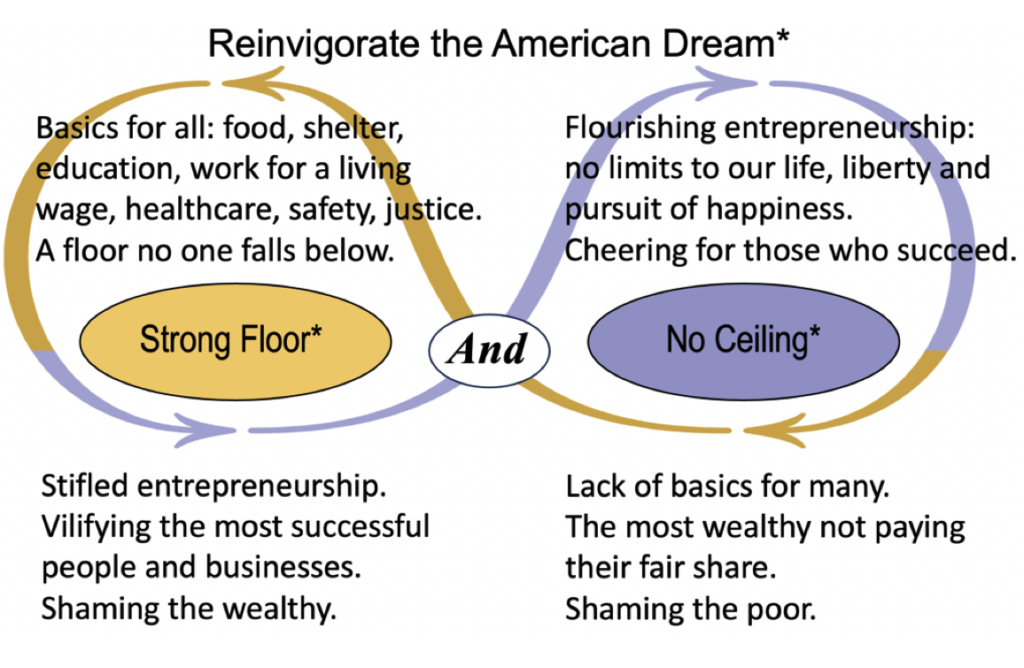
*Based on Strong Floor, No Ceiling by Oliver Libby
What is not simple is making that real. That requires We the People to think and act differently than we are currently. There are days I question that possibility. Then I remember the people I look to as heroes found a way to stand up to challenges in their time that felt just as daunting. They held Reality AND Hope.
Hope is not a strategy. Agreement is not a strategy. Even good policy is not a strategy if the system it enters cannot hold the tension it creates. The risk is not that the idea is wrong. The risk is that it will be pulled into the same dynamics that have shaped so many other efforts. Each side will emphasize the part it values most. Each will see the downside of the other. Each will respond by pushing harder. The system swings, and over time, the original Both/And framing erodes into an Either/Or contest.
That is not a theory. It is what happens when interdependent tensions are treated like problems to solve. Strong Floor AND No Ceiling is not a problem. It is a polarity. It requires a different kind of discipline.
This is the work.
If something like this is going to scale, it has to move from “interesting idea” to actual practice. Not a workshop. Not a program. Not a campaign. It has to become a way of working with tensions that does not depend on a single leader, a single moment, or a single policy win. This may sound self-serving, but there is a discipline that cuts across all of this:
Start with S.M.A.L.L. to go BIG — Seeing, Mapping, Assessing, Learning, and Leveraging.
The sequence is simple. Living it consistently is not.
Seeing comes first. We have to recognize when we are dealing with a polarity rather than a problem. Problems require choosing the right answer. Polarities require working both sides over time. When we fail to make that distinction, we apply solution logic to systemic tensions and then wonder why the system pushes back. Seeing interrupts that pattern. It allows us to name interdependence instead of collapsing it into a choice.
Mapping makes that interdependence visible. Strong Floor AND No Ceiling can be described in language, but it becomes more actionable when we can see what we are trying to gain from each side and what happens when either side is overemphasized. A strong floor without attention to opportunity drifts toward stagnation and dependency. No ceiling without a strong floor drifts toward instability and widening gaps. Neither outcome is the intent. Both are predictable when the poles are separated. Mapping clarifies that the goal is not to pick one. It is to strengthen both in service of a shared purpose.
Assessing brings reality into the conversation. It is one thing to agree with a Both/And framing. It is another to see how well we are actually living it. Where are we over-focusing? Where are we under-investing? What are the early signals that we are moving toward a downside? Without some form of assessment, we default to opinion and ideology. With it, we have a way to learn from what is happening.
Learning is where adjustment happens. Not as a reaction to failure, but as an ongoing response to feedback. Polarities do not get solved. They get worked. Movement toward a downside is not evidence that the idea is flawed. It is a signal that attention needs to shift. That is a different mindset. It replaces blame with responsibility and rigidity with responsiveness.
Leveraging is the discipline of acting in ways that strengthen both poles over time. This is where the work becomes concrete. What are we doing to ensure the floor is strong enough that people can stand with dignity? What are we doing to ensure there is no artificial ceiling on what people can contribute and achieve? How do those efforts reinforce each other rather than compete? This is where the idea becomes operational.
This is not only about the one polarity of Strong Floor AND No Ceiling. That polarity sits within a broader set of tensions that every democracy has to navigate. The Polarities of Democracy Institute has named five that show up consistently: Freedom AND Authority, Justice AND Due Process, Diversity AND Equality, Participation AND Representation, and what they describe as Human Rights AND Communal Obligations. These are not Libby’s terms, but they help make visible the environment in which his idea will operate. When these tensions are well leveraged, they reinforce each other. When they are not, they amplify breakdown. Look around.
We can see the strain. Justice AND Due Process is not well held. There is a push for accountability, and there is a need for fairness and consistency. When one is emphasized at the expense of the other, trust erodes. Participation AND Representation is under pressure. There is a demand for voice and inclusion, and there is a need for coherent decision-making. When those are not held together, we get fragmentation on one side and disconnection on the other. These are not failures of intent. They are signs of polarities being worked with an Either/Or mindset.
That context matters. Because if we do not strengthen our capacity to work with these tensions, even the most well-framed Both/And idea will be pulled into the same patterns. Strong Floor will be interpreted through one lens. No Ceiling through another. The conversation narrows. The Radical Middle contracts. Not because the idea is weak, but because the system is not yet equipped to hold it.
This is why the work cannot stop at messaging. It has to include capability. The “Radical Middle” Libby points to is not a demographic. It is not a midpoint. It is a capability — the ability to hold two valid concerns at the same time and work them over time without turning them into a fight. That capability does not emerge by accident, especially in a system that rewards certainty and speed. It has to be developed. Systems do not change. People do. We the people are the system.
One practical question is how to make that development accessible. Not everyone will go through a workshop or a formal program. If this is going to scale, people need ways to begin where they are. That is where tools can help, as long as we are clear about their role. I recently created an AI-supported conversation to support Step 1: Seeing. I have no idea whether it will make an impact, but if someone wants to explore polarizing issues — immigration, abortion, Russia/Ukraine, Israel/Palestine, or even how we label each other — it may help supplement Either/Or thinking with Both/And. It is not a replacement for human coaching, judgment, or relationship. It is an entry point. The responsibility for decisions and action remains human.
None of this guarantees success. It does not eliminate disagreement. It does not remove tension. It changes how we work with what is already there. Over time, that can change the quality of decisions, the stability of outcomes, and the level of trust in the system.
Strong Floor AND No Ceiling is a compelling idea with real credibility behind it. It deserves more than hope. It will require discipline. I am not convinced we are ready for that level of discipline. That is why this is simple, not easy.
If we want a different future, it will not come from better ideas, stronger arguments, AI tools, maps, or assessments alone. It will come from our individual and collective ability to work with the tensions that have always been present, in a more deliberate way. Strong Floor AND No Ceiling points in that direction.
Just as hope is not a strategy…maps are not territory. The work is building the capacity to follow through.
And, maps can be useful for navigating difficult or unfamiliar terrain…Here’s a Polarity Map for Strong Floor AND No Ceiling focused on three themes for the quadrants:
A. Impact on Self
B. Impact on Others/Relational
C. Impact on System
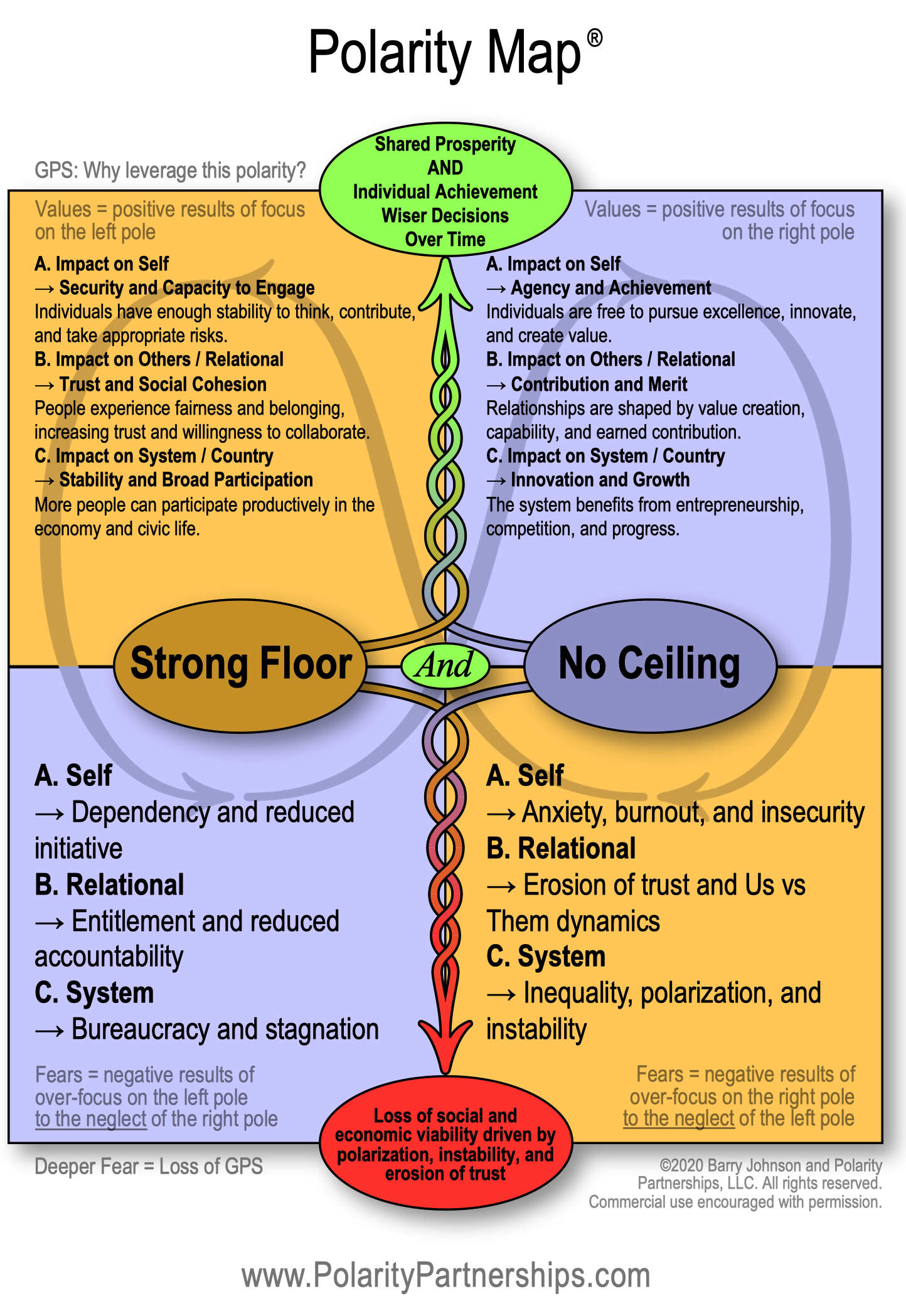
Want to take a Polarity Assessment on this Strong Floor And No Ceiling polarity?
CLICK HERE
Want to learn more about Polarity Thinking and explore options for self-paced learning and Credentialing?
CLICK HERE
Want to use an AI-trained Cliff to support you in Step 1 Seeing?
CLICK HERE