

Some days it’s hard to be hopeful. The scope and scale of polarization and doom-loop thinking about the U.S. and the future can feel like an hourly, daily, monthly assault on the senses.
Then a book like Strong Floor, No Ceiling comes out. My intuition sirens flare and my energy returns. A few differently firing synapses, and my Soul takes back the wheel to sense that things could not just be OK, but maybe better than they’ve ever been.
The author, Oliver Libby, is a social entrepreneur and policy advocate focused on strengthening opportunity and economic mobility in the United States. And he has the platform to scale something many of us have been saying and supporting for decades, which is this.
Most of our toughest challenges are framed as problems to solve. Security or opportunity. Equity or growth. Government or markets. Pick the right answer, implement it well, and things should improve. That logic works when we are dealing with problems. It breaks down when we are dealing with interdependent tensions that don’t go away.
Libby’s core idea in Strong Floor, No Ceiling is that the American Dream depends on two commitments often treated as opposites: a strong floor so no one falls below a basic standard of dignity, and no ceiling so no one is limited in what they can contribute or achieve. These are not competing options. They are an interdependent pair.
When we treat them as a choice, we don’t just get policy disagreements—we get predictable vicious cycles. Each side pushes harder on what it believes is right, experiences the downside, and responds by doubling down or swinging to the other pole. Over time, that cycle feeds polarization, erodes trust, and opens the door to more rigid, controlling responses that promise certainty at the expense of complexity.
That dynamic is being amplified by social media algorithms that reward outrage, by AI and tech systems that accelerate and scale those patterns, and by concentrations of power that benefit from the divide. That’s not a good trajectory. It is what happens when Either/Or thinking dominates where Both/And thinking is required.
Libby’s contribution is to name a different path. Strong Floor and No Ceiling are not trade-offs to manage. They are an engine to leverage. And if we can learn to hold both over time, there is still a path toward wiser decisions and a more sustainable future.
This is where a polarity lens becomes useful. Some challenges are problems to solve and require either/or thinking. Many of the challenges leaders and societies face are not problems. They are polarities to leverage, and they require both/and thinking over time. If we don’t distinguish between the two, we apply the wrong thinking and create avoidable cycles of overcorrection. We push hard on one side, experience the downside, then swing to the other to fix what the first approach created. The result is rework, fatigue, loss of trust, and stalled progress.
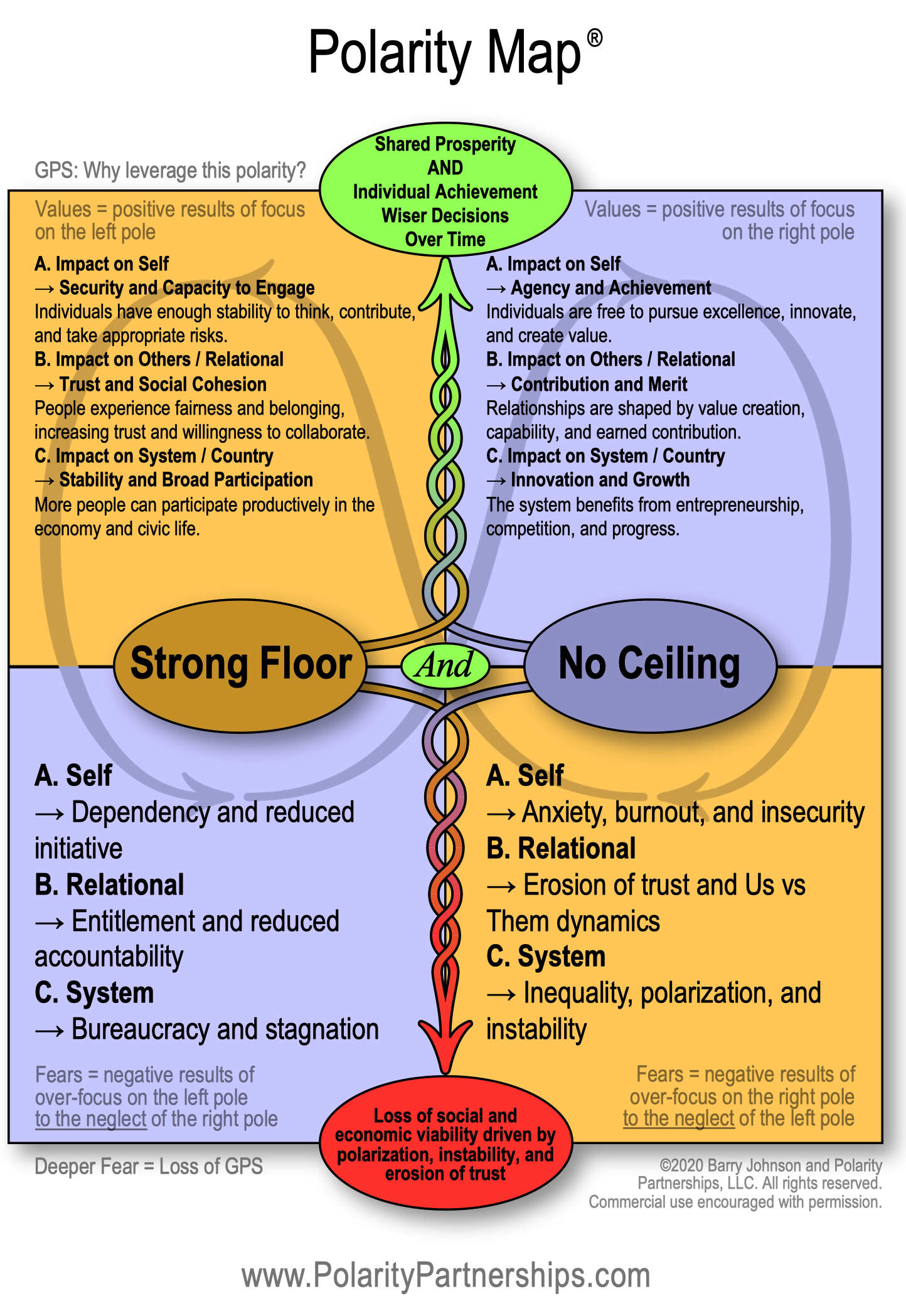
Seen through this lens, Strong Floor and No Ceiling is not a compromise. It is an interdependent system. A strong floor provides the stability people need to take risks. No ceiling provides the opportunity for those risks to pay off. Over-focus on the floor without the ceiling risks stagnation and dependency. Over-focus on the ceiling without the floor risks instability and widening inequality. The goal is not to choose. The goal is to leverage both over time in service of a greater purpose: shared prosperity and individual achievement.
What Libby is describing is what Barry Johnson, Polarity Partnerships, and Dr. Bill Benet’s Polarities of Democracy Institute have been working to make explicit for years. These are polarities. They function like energy systems. The poles remain different, but they depend on each other. The value is in the movement between them. Over-focusing on one pole will always produce its downside, and if we persist, we will eventually experience the downside of the other pole as well. This is not a failure of policy or intent. It is how polarities work.
This also helps explain resistance. Resistance is not simply obstruction. It is often an expression of legitimate concern about the downside of one pole or the other. Some worry a strong floor will reduce initiative. Others worry no ceiling will concentrate opportunity and leave too many behind. Both concerns are real. Both are incomplete. When we treat resistance as a problem to eliminate, we deepen the divide. When we treat it as information about the system, it becomes a resource for managing the tension over time.
Strong Floor and No Ceiling does not sit alone. It is part of a stack of polarities that show up whenever we address complex social issues. In Chapter 29 of And, Volume One, Barry describes how these tensions compound. We want to solve problems, and we also need to leverage polarities. We want to protect “us,” and we also need to protect “them.” We want abundance, and we need to ensure basic needs are met. We want accountability, and we also need to recognize people are more than their worst actions.
When we approach these with either/or thinking, the downsides compound into what he calls a hyper-vicious cycle that drives inequality, polarization, and breakdown. When we supplement either/or thinking with both/and thinking where it is required, those same tensions can reinforce each other in a virtuous cycle that improves outcomes over time.
Both/and thinking is not a solution. It is a process requirement. Without it, even well-funded, well-intended efforts are undermined by predictable dynamics. No amount of effort, alignment, or resources will compensate for using the wrong kind of thinking for the challenge at hand.
This shows up in organizations and public life. Leaders are operating in environments defined by constant change, competing priorities, and ongoing tension. They are not failing because they lack answers. They are struggling to maintain steady judgment under pressure. When tensions are treated as problems, decisions swing, trust erodes, and energy goes into reacting to the latest downside.
What is needed is not more answers. It is a different capability: the ability to recognize interdependent tensions and work with them effectively over time.
In our work, we describe this as building the capacity for steadiness and fluidity. Staying grounded without becoming rigid. Staying adaptive without losing direction. When leaders develop this capacity, decisions don’t swing as much, trust holds, and performance becomes more sustainable. A polarity lens does not remove tension. It helps us navigate it more effectively.
All of this makes Libby’s work particularly relevant right now. As we approach the 2026 mid-term elections and look ahead to 2028, we are seeing the limits of an over-reliance on either/or thinking. The patterns are familiar. Polarization increases. Each side pushes harder. The downsides show up, and the response is to double down or swing in the other direction. We get movement, but not sustained progress.
The question is whether we are ready to see the pattern for what it is. Not as a failure of one side or the other, but as a limitation of the thinking we are using. Could we recognize the downsides of over-focusing on either/or thinking and begin to supplement it with both/and thinking where it is required? Could we begin to see tensions like Strong Floor and No Ceiling not as battles to win, but as interdependent pairs to leverage over time?
I’m hoping so. I’m praying so. Because without that shift, even the best ideas will get pulled into the same cycles we have seen before. And with that shift, we have a chance to turn those same tensions into a source of strength, supporting wiser decisions over time.
Here’s a Polarity Map for Strong Floor AND No Ceiling focused on three themes for the quadrants:
A. Impact on Self
B. Impact on Others/Relational
C. Impact on System
Want to take a Polarity Assessment on this Strong Floor And No Ceiling polarity?
CLICK HERE
Want to learn more about Polarity Thinking and explore options for self-paced learning and Credentialing?
CLICK HERE
Want to use an AI-trained Cliff to support you in Step 1 Seeing?
CLICK HERE
See PART II, HOPE is Not a Strategy.