


See the Series Introduction for Just Tao It, Part I: HERE
See the Just Tao It Series Introduction Tao/It on-ramp, PART II: HERE
See Just Tao It, Chapter 1: HERE
From my interpretation of the Tao Te Ching, Chapter 20 (Unpublished):
Let go
of analyzing
too many things.
Hold on
to the ones
that truly sustain.
All concerns,
can be urgent.
All pursuits,
can be important.
Many will see
this path as folly.
They are bright and see
you as dark.
They are sharp and see
you as dull.
They have purpose and see
you adrift upon the sea.
A strange mystery.
Different in what you value.
Nourished by whatever
truly sustains you.
—
Ever felt off-tempo, misunderstood, or slightly out of step? Like you are present in the room while some deeper part of you is listening for another rhythm? Welcome to Chapter 20.
Most of us spend the early seasons of life learning Belonging. We learn the rules. We absorb expectations. We discover what earns approval and what attracts resistance. We become skilled at reading the room and finding our place inside it. Families depend upon those capacities. Communities depend upon them. Organizations depend upon them.
At least that’s how it was for me.
As a straight, white, male, able-bodied American, I learned Belonging mostly through acceptance and encouragement. I had the luxury of assuming there was a place for me. Many people never receive that gift so easily. Women, people of color, immigrants, LGBTQ+ communities, religious minorities, people living with disabilities, and others often learn Belonging through experiences of exclusion, misunderstanding, and adaptation. They become fluent in the rules because the consequences of not reading the room can be costly. They learn Belonging lessons in ways I was blind to.
Notions of Belonging can nurture and wound. Both teach, just in different ways.
As we learn and grow, things begin to stir. Questions emerge. Old certainties loosen. Priorities shift. The crowd may continue to move with familiar confidence, while part of us needs to slow down, wonder, and question.
Adult development researchers including Jane Loevinger, Robert Kegan, Susanne Cook-Greuter, and Jennifer Garvey Berger have described this journey in different ways. Development involves differentiating and integrating. We step or stand outside the circle we started in. Eventually, we find our way into a wider one. Before we’ve made total sense of it, we may find ourselves doing it all over again.
It can be hard. Learning and growth can create distance long before it creates whatever the resulting new form of Belonging turns out to be.
Friends who lean heavily on certainty may become uncomfortable with questions. Colleagues who prize expertise may become impatient with ambiguity. Family members who know us through familiar roles may struggle when those roles begin to loosen.
Chapter 20 presents the sage as someone who appears strange to others.
They are bright and see
you as dark.
They are sharp and see
you as dull.
They have purpose and see
you adrift upon the sea.
A strange mystery.
From shore, the swimmer often looks lost.
That wisdom is something my friend Riet Portengen and the Polarity Fun Foundation see clearly in children. Children often arrive with remarkable capacities for noticing relationships, asking questions, and imagining possibilities. Life sometimes rewards those gifts and sometimes trains them away. Some of us spend decades recovering what we once knew naturally.
Riet once asked her young niece Marenka what polarity she saw in the world. Adults often search for sophisticated answers. Marenka simply popped out with, “Sun and Moon.” The Sun helps things grow. The Moon brings rest.
She knew intuitively that both are connected. She was just describing what she had noticed—the way children do, before anyone tells them which observations count. Ursula Le Guin wrote that an adult is not a dead child, but a child who survived. Maurice Sendak insisted the child is the best part of the human self. Both understood something Chapter 20 understands: Becoming Yourself isn’t about abandoning wonder, imagination, tenderness, or curiosity. It’s about carrying them forward.
Perhaps wisdom is less about acquiring something new and more about remembering what truly sustains us.
History repeatedly tests how wide we’re willing to draw our circles of concern. Fear has a way of shrinking the circle. And turning Both/And’s into Either/Or’s – when Both/And is required and needed.
Wisdom invites circles and perspectives to widen. Families face this challenge. Communities face it. Democracies face it. Every generation receives the invitation under different conditions.
Our own age provides no shortage of reasons for anxiety. Information arrives endlessly. Technologies evolve faster than cultures can absorb them. Artificial intelligence offers extraordinary possibilities while multiplying distractions and invitations to react. Yet relationships, grief, forgiveness, wonder, and love continue to unfold on human time.
Perhaps that is why democracy remains such a remarkable experiment. It asks unique individuals to practice Belonging Together in tensions. Like: Freedom AND Authority; Justice AND Due Process; Diversity AND Equality; Human Rights AND Communal Obligations; and Participation AND Representation. Those conversations are never finished. Their strength lies in the capacity to learn, repair, and begin again. (See www.PolaritiesofDemocracy.Institute/)
Perhaps democracies themselves are a form of humanity’s attempt to create sanctuary, at scale. As America approaches its 250th anniversary, we inherit both the beauty and burden of that experiment. Through debate, compromise, and extraordinary effort, the founders produced a document they knew was unfinished. They also left future generations a contradiction they could not resolve: equal citizenship living in the shadow of slavery. Ideals and reality occupied the same room. This requires self-correcting mechanisms in which we can embrace and/or confront hard truths, and create trust for Belonging Together.
Generation after generation has inherited the work of narrowing that distance while widening wisdom. The work continues because human beings continue. We the people are finite and unfinished.
Unfinished beings need places where they can gather, disagree, learn, repair, and begin again.
That is exactly what I’ve spent twenty years building on a ridge in West Virginia, mostly without realizing what I was actually building.
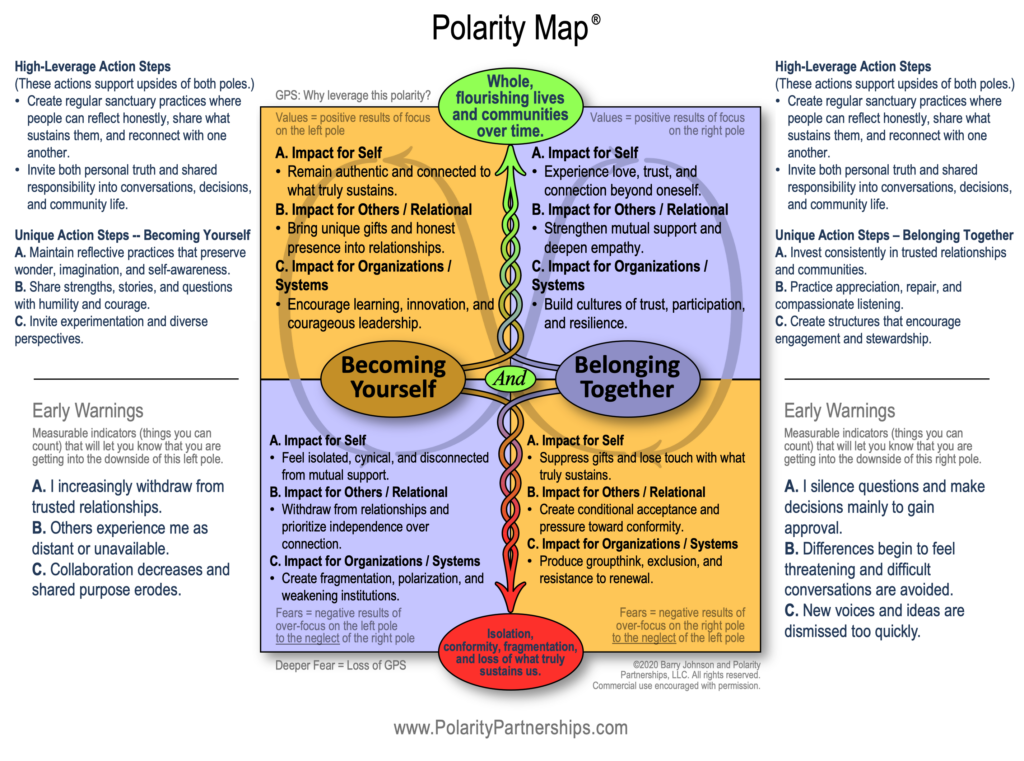
As I prepare for another gathering at Kayser Ridge with my incredible team of sojourners, I realize it has been twenty years since the first retreat there. For most of that time I would have described it as a “retreat center.” Thanks to Chapter 20, I’ve landed on a description that’s closer to the Greater Purpose of Becoming Yourself AND Belonging Together:
Sanctuary.
It’s a home where nobody lives full time. It’s a space built to give room for deeper questions to emerge. A nesting point where people can connect or reconnect to what truly sustains them—and hopefully break bread, laugh, and reset the nervous system. A place to belong in becoming.
Henry David Thoreau sought something similar at Walden Pond. He called it deliberate living. I suspect every generation rediscovers the need for sanctuaries. Families, whether inherited or chosen, can become sanctuaries. Friendships can become sanctuaries. Communities can become sanctuaries.
If you’ve ever felt slightly off-tempo walking through life—too much yourself for one room, not enough yourself for another—I hope you find or build a sanctuary.
You deserve it.
We all do.
Many will see
this path as folly.
They are bright and see
you as dark.
They are sharp and see
you as dull.
They have purpose and see
you adrift upon the sea.
A strange mystery.
Different in what you value.
Nourished by whatever
truly sustains you.
Here’s a Polarity Map for Becoming Yourself AND Belonging Together:
INVITATIONS:
To use an AI-trained “Chat w/Cliff” for Step 1, Seeing” CLICK HERE.
Ready for the Polarity Advantage? Go deeper into Polarity Thinking, see our online self-directed Credentialing and Introduction to Polarity Practice or in-person training with Barry Johnson and me at Kayser Ridge by CLICKING HERE.