

See the Series Introduction for Just Tao It, Part I: HERE
See the Just Tao It Series Introduction Tao/It on-ramp, PART II: HERE
See Just Tao It, Chapter 1: HERE
From my interpretation of the Tao Te Ching, Chapter 25 (Unpublished):
There is
an is—
infinite.
If a name is preferred,
use “It.”
All that is,
from It.
So, It is Great.
Great is heaven,
earth,
and those within.
Those within follow earth.
Earth follows heaven.
Heaven follows It.
It follows what It is.
—
When I reflect on whatever “God” is—and all the attempts across traditions to name it—I end up in the same place. Whatever this It is, it is what It is. And if you look for It anywhere, you don’t have to look far. It’s here, in what we call nature, and beyond it in ways we can barely comprehend.
The scale alone is enough to unsettle the story we tell about ourselves.
We live inside a system so vast that even our best attempts to describe it don’t really land. They don’t land because they weren’t made to. They exceed us. We need better perspective.
We are not at the center of this. We are not above it. We are not even particularly necessary to it.
We are part of it.
And that distinction changes everything.
There’s a story we like to tell ourselves that we are somehow separate from nature—observers of it, users of it, even masters of it when things are going well. And for a while, that story works. We build. We extract. We scale. We call it progress because it produces results we can see and measure within the span of our own lives. But nature does not organize itself around our timelines. It does not optimize for quarters, election cycles, or ideological wins. It organizes for continuity over time, whether we understand that or not.
And here is the part that matters more than most of what we argue about: we need nature, and nature does not need us. That’s not a moral judgment or a political stance. It’s how the system works. If we degrade the conditions that sustain life, those conditions will adjust. Not to punish us. Not to save us. Just to continue.
We are not outside that adjustment.
We are inside it.
Part AND Whole, whether we acknowledge it or not.
The longer I’ve lived at Kayser Ridge, the less convincing the illusion of separation has become. Standing on that land long enough, it gets harder to imagine we exist outside the systems that sustain us.
Where this begins to break down is in how we use power. When we forget that we are part of what sustains us, we start to act as if the system itself is expendable. That’s Power to the neglect of Stewardship.
It shows up in small ways and large ones—short-term gain to the neglect of long-term viability, certainty to the neglect of curiosity when the data becomes inconvenient, loyalty to tribe to the neglect of responsibility to the Whole.
None of this requires bad intent.
It only requires partial awareness.
And now we’ve built systems that scale that pattern.
AI doesn’t introduce bias into the system; it accelerates what we give it. It reflects our preferences, our fears, our blind spots, and then amplifies them with speed and reach we’ve never had before. That’s Efficiency to the neglect of Wisdom. When that imbalance grows, Truth begins to erode—not all at once, but enough that shared reality becomes harder to maintain. And when Truth erodes, Trust follows. Without Trust, cooperation at scale becomes fragile at best, impossible at worst.
This is why the climate conversation keeps missing itself. We get pulled into debates about causes as if agreement is required before responsibility. It isn’t. You don’t need alignment on causation to recognize dependence. You don’t need ideological agreement to understand that degrading the system you rely on is a losing strategy.
There’s a reason we don’t poison our own water or foul our own beds. That’s not political.
That’s awareness.
The Sustainable Development Goals were an attempt to organize action at the level of the Whole. The emergence of the Inner Development Goals reflects a growing recognition that external ambition repeatedly outruns internal development. That’s Acting to the neglect of Being. We push for external change without developing the internal capability required to sustain it, and then we’re surprised when progress stalls or reverses under pressure.
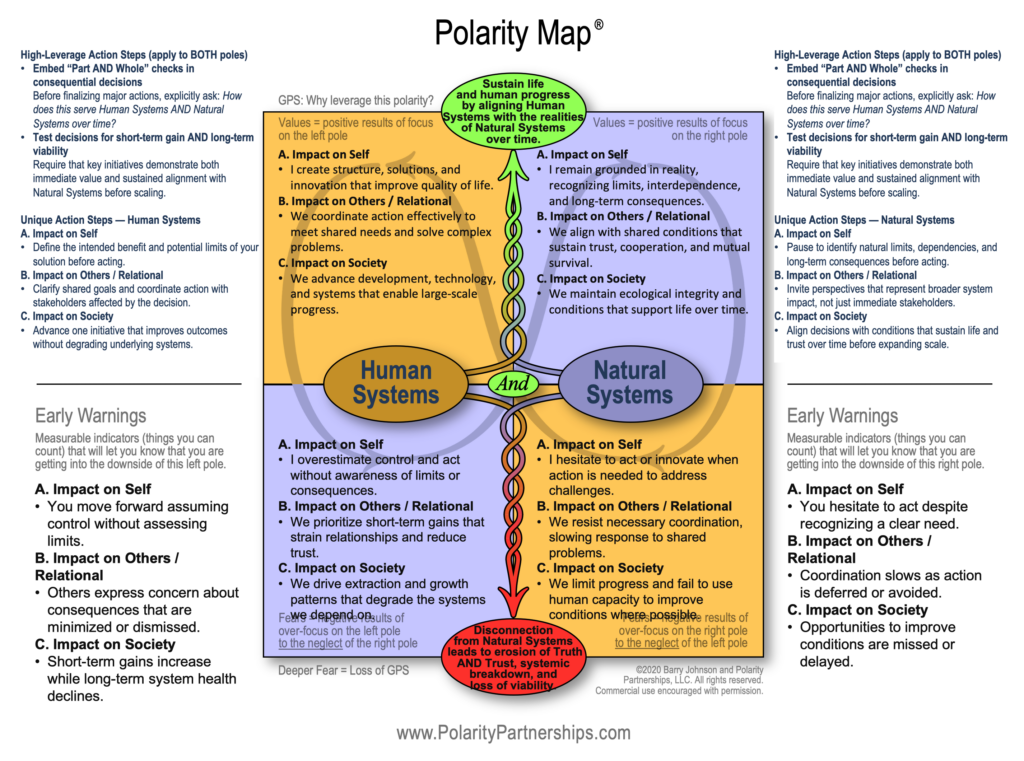
Acting AND Being. (See Chapter 38) Human Systems AND Natural Systems. Part AND Whole.
These are not ideals.
They are requirements for anything that works over time.
Nature doesn’t struggle with this. It doesn’t debate whether to integrate. It integrates or it eliminates. That’s not harsh. It’s consistent. And consistency over time is what sustains systems that last.
So this isn’t ultimately about climate, or politics, or even technology. It’s about whether we can remember that we are part of what sustains us and act accordingly. Not once. Not when it’s convenient. Over time, when the tradeoffs are real and the pressure is high.
We are part of nature, which makes us capable of participating in something much larger than ourselves. The question is whether we will use that capacity with enough awareness to sustain what sustains us.
Here’s a Polarity Map for Human Systems And Natural Systems:
INVITATIONS:
To use an AI-trained “Chat w/Cliff” for Step 1, Seeing” CLICK HERE.
Ready for the Polarity Advantage? Go deeper into Polarity Thinking, see our online self-directed Credentialing and Introduction to Polarity Practice or in-person training with Barry Johnson and me at Kayser Ridge by CLICKING HERE.