


See the Series Introduction for Just Tao It, Part I: HERE
See the Just Tao It Series Introduction Tao/It on-ramp, PART II: HERE
See Just Tao It, Chapter 1: HERE
From my interpretation of the Tao Te Ching, Chapters 26 (Unpublished):
Heavy roots light.
Unmoved sources movement.
Daily,
hold on,
to enough
for the journey
ocean to ocean.
With each step,
intention
in motion.
—
I’ve been practicing Tai Chi for about forty years now, which may sound cool or fun until you’ve spent any of those years the way I spent mine: standing in Ma Bu, the horse stance, while a teacher wandered out of the room. Feet two shoulder-widths apart, thighs parallel to the floor, quads screaming, for what felt like fifteen minutes and was probably four. Once I could have sworn he was taking a phone call. Nobody explained why we were doing this. You just did it, because that’s what the person before you did, and eventually your knees stopped asking why.
What that stance was building, I only understood years later. Holding a position that demanding for that long trains tendon, ligament, and joint capsule as much as it trains muscle — the slow stuff, with lousy blood flow, that only remodels itself over years, not workouts. It’s not a fast system. It was never supposed to be. There’s real neuroscience underneath this, if you want it. Proprioceptors in the ankles, knees, and hips flood a beginner’s nervous system with noise, which is why beginners overcorrect and stiffen. Repetition teaches the brain to filter the noise instead of panicking at it. None of that is why I kept showing up, though. I kept showing up because the alternative was admitting defeat to a stance named after a horse.
Most of what I know about neuroscience and the body and why it works, I owe to my friend and colleague Adrienne Penebre, a gifted healer and brain-based movement specialist. She’s spent her career helping people access how the “light” nervous system movements, organizes the heavy movement dimensions. (Her work lives at Moovy Studio.)
That’s the whole first line of Chapter 26: the heavy is the root of the light, the unmoved is the source of all movement. The verse pictures a traveler who goes all day without ever losing sight of the baggage cart — the supplies, the root, the enough. Read plainly, that’s a working description of what a horse stance is for. You get heavy on purpose, for years, so that later you can be light without falling apart.
Not all the heaviness is chosen, though. Over the last decade I’ve become increasingly aware of an emotional heaviness that rarely seems entirely absent. Some mornings it arrives with the news. Some days it comes through physical pain. Other days it shows up as concern for people and places I love — Kayser Ridge, our democracy, the future of work, friends growing older, my own capacity to keep contributing. My spine has become its own teacher — a lifelong conversation between scoliosis, two back surgeries more than twenty years ago, degenerative changes that continue to unfold, and, as if that weren’t enough, a fractured C2 vertebra and vertebral artery dissection from a mountain biking accident. Some of those burdens were given to me. Others I chose, through the way I’ve chosen to meet them. Together they’ve taught me that carrying weight is simply part of being alive.
I used to think my writing was an attempt to make that heaviness disappear. I’ve come to understand something different. Writing hasn’t made any of that weight lighter. It has helped me discover which burdens are mine to carry, which belong to someone else, and which simply belong to life itself. That distinction has become one of the greatest gifts of the practice.
Sailors get a lighter version of the same lesson. A new sailor fights the deck — tenses against every roll and pitch until the fighting itself wears them out. Gaining sea legs means the body finally agrees to stop resisting the boat and start moving with it. Ask any veteran mariner and they’ll tell you the ship stopped being the enemy right around the time their knees quit reporting it as news. AI feels remarkably similar to me. I’ve been getting my sea legs with it the same slow way — locked knees first, trying either to control every wave or surrender to every swell. Neither approach develops sea legs. They arrive through repeated practice, growing discernment, and the humility to learn a different way of standing.
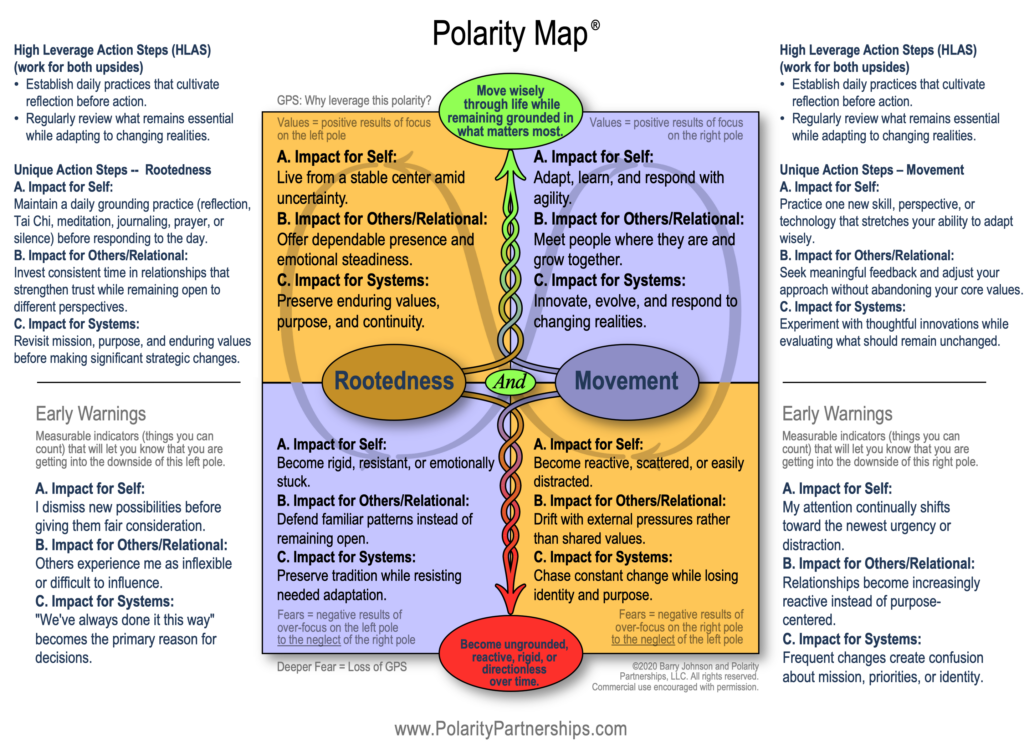
As I lived with Chapter 26, another pattern slowly became visible. The horse stance, my spine, writing, sea legs, and now AI all seem to ask the same question: how do we remain rooted while continuing to move? Barry Johnson would recognize it as another enduring polarity: Rootedness And Movement. Movement is the sailor swaying with the wave, the fighter’s hand arriving before they’ve consciously decided to throw it — light, responsive, unattached to any single plan. Rootedness is the horse stance, the thousands of reps, the years of staying rooted before anyone’s impressed by how loose you look. It’s also the discernment underneath the writing itself: sorting which weight is mine to carry, which belongs to someone else, and which simply belongs to life. Neither pole works alone. Movement without Rootedness is just flailing with good balance. Rootedness without Movement is a beautifully built stance, or a beautifully sorted grief, that never moves anywhere at all.
Artificial intelligence has become another kind of horse stance for me. Every day it offers astonishing movement — ideas arriving in seconds that once took days, conversations stretching across disciplines, patterns I might never have noticed alone. The temptation is to mistake that movement for wisdom. Chapter 26 suggests something different. Powerful movement asks for equally deep rootedness. Without practices that cultivate discernment, AI can amplify distraction just as easily as insight. Like sea legs, those capacities aren’t downloaded. They develop through repetition, reflection, correction, and time. Sea legs, like wisdom, can’t be borrowed. They have to be earned.
The same discipline may become one of the defining challenges of our time. Democracies have always depended on citizens capable of judgment, not just reaction. Artificial intelligence only raises that requirement. The faster information moves, the more valuable rootedness becomes. Speed has never replaced discernment. It has simply made its absence more expensive.
I still find my way into the stance some mornings, knees complaining the way they always have. Nobody skips the standing still. You just get to find out, one ordinary day years later, that it had become movement all on its own. The knees, the spine, the page — they’re all doing the same work: finding out what’s yours to carry, and letting everything else move through you instead.
Heavy roots light.
With each step, intention in motion.
Here’s a Polarity Map for Rootedness AND Movement:
INVITATIONS:
To use an AI-trained “Chat w/Cliff” for Step 1, “Seeing” CLICK HERE.
Ready for the Polarity Advantage? Go deeper into Polarity Thinking, see our online self-directed Credentialing and Introduction to Polarity Practice or in-person training with Barry Johnson and me at Kayser Ridge by CLICKING HERE.