


See the Series Introduction for Just Tao It, Part I: HERE
See the Just Tao It Series Introduction Tao/It on-ramp, PART II: HERE
See Just Tao It, Chapter 1: HERE
From my interpretation of the Tao Te Ching, Chapter 28 (Unpublished):
By being the feminine while doing masculine,
There is natural presence.
It returns,
What is there, inherently.
The innocence,
We’ve had as babies.
Bringing lightness,
To shadowed places.
It returns what’s possible,
And illuminates by example.
Holding complexity,
While keeping simplicity.
It returns receptivity,
To what was there, already.
From the block of wood, come useful tools.
From the wise soul, come useful cascades.
From useful virtue,
It naturally emerges
For all,
From you.
—
A few days ago, my brother Brad posted a short video of my niece Emma. It was only a few seconds long. Emma was doing what children do so naturally. She was completely absorbed in the moment she was living. There was no audience in her mind, no image to manage, no point to prove. She was simply engaged with whatever had captured her attention. I watched it several times and found myself smiling each time. The video offered something increasingly rare in adult life: a brief encounter with uncomplicated joy.
The timing felt appropriate because I had been sitting with what Chapter to focus on next for this series. And there was 28. It was perfect because throughout the Tao Te Ching, Lao Tzu returns repeatedly to the image of the child. He points to the infant as a living expression of flexibility, vitality, receptivity, and wholeness. Reading the chapter while thinking about Emma, I found myself less interested in what children still need to learn and more interested in what they already seem to know. Children move easily between curiosity and wonder. They become fully absorbed in a conversation, a game, a butterfly, a puddle, a question, or a story. Their attention follows life itself.
Years ago, my friend Riet Portengen shared a story about introducing her young niece Marenka to Polarity Thinking. After sharing a few things about polarities—like Inhale AND Exhale—she asked a simple question: “What polarity do you see?” Marenka answered, “Sun And Moon.” Riet asked her why. Marenka explained that the Sun helps things grow and the Moon helps things rest. Flowers need both. Animals need both. People need both. Her answer carried the kind of clarity that arrives without effort. She was describing what she saw.
The story eventually became part of Riet’s ongoing work with children and helped inspire what would later become the Polarity Fun Foundation. The Foundation is rooted in a simple but profound belief: children possess an innate capacity to recognize relationships, interdependence, and possibility, and that capacity deserves encouragement as they grow. In many ways, the Foundation represents the culmination of a lifetime of work. Riet spent decades in child protection and social work in the Netherlands, helping children, families, and communities navigate some of life’s most difficult challenges. Again and again, she saw the importance of belonging, connection, ownership, and community. She also saw what can happen when people become disconnected from those sources of strength.
I suspect Lao Tzu would have appreciated Marenka’s answer and Emma’s video. Children often notice relationships before they learn arguments. They encounter the world as a living whole before they inherit many of the categories that adults use to separate it. The child sees the Sun And Moon. The child sees playing and learning happening together. The child sees belonging and uniqueness happening together. Somewhere along the way, many of us become increasingly skilled at dividing and separating things that only work well together—and don’t work well or at all when separated. I challenge you to choose Inhaling or Exhaling as a solution. Let me know how that works out. Polarities live in us, and we live in them.
A quick word about the Masculine And Feminine opening. Early in my Tao Te Ching journey, I found it a bit strange and somewhat out of place in relation to the rest of the chapter. I wondered whether I had run into a translation wall. Over time, as I settled into some of the acquired tastes that certain chapters offer, the opening began to land differently. It reminded me of a sophisticated wine that reveals itself slowly. In this case, the tasting note was an invitation into wholeness.
Children move among the qualities associated with Masculine And Feminine energies with remarkable ease. They have not yet constructed identities around one side of a tension while distancing themselves from the other. Nor have they spent years absorbing messages from systems that overvalue one dimension to the neglect of another. They simply move more freely among capacities that many adults gradually learn to separate.
This may be one reason the image of the infant appears so often throughout the Tao Te Ching. The child represents a state of participation in life before fragmentation becomes a habit. Lao Tzu is pointing toward a quality of being that remains flexible, alive, and responsive. The child bends easily. The child recovers quickly. The child enters the next moment without carrying every previous moment along for the ride.
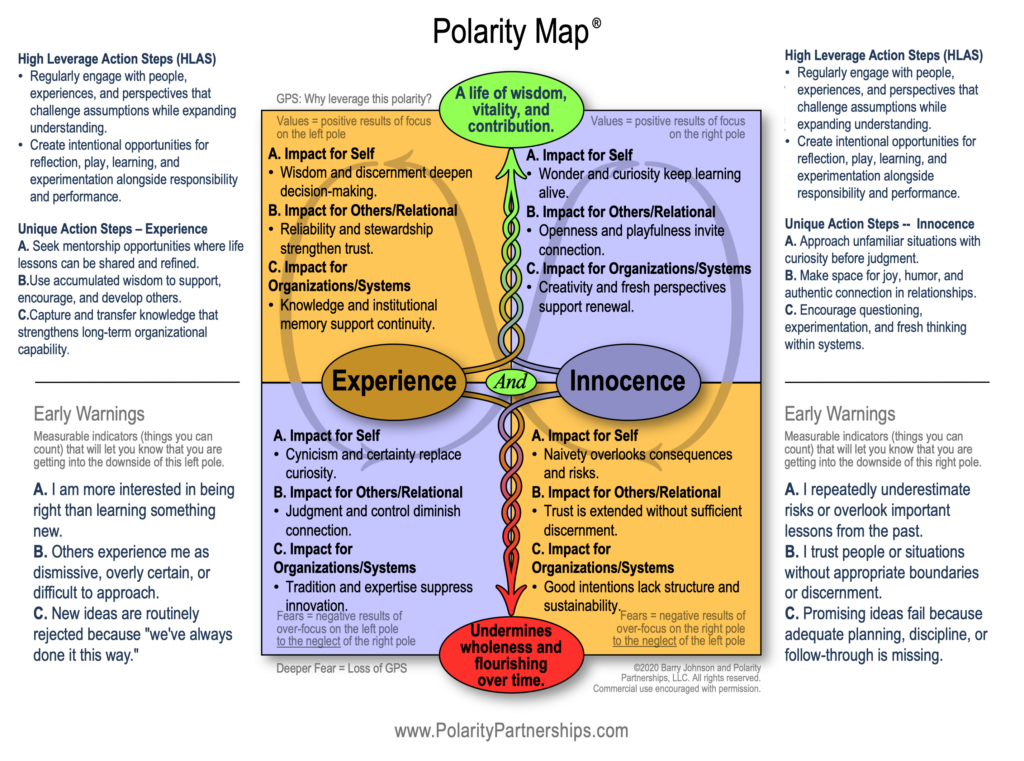
As adults, we gain many things worth celebrating. Experience matters. Responsibility matters. Discernment matters. The capacity to contribute, care for others, and steward something larger than ourselves matters. Chapter 28 does not ask us to leave those gifts behind. It invites us to remember that the qualities we admire in children were never meant to be temporary possessions.
Emerson writes about success being connected to the value of laughing often and much and winning the respect of intelligent people and the affection of children. If we adults could do more of that, I think we might capture something Lao Tzu understood more than two thousand years ago in different, but similarly challenging times. Growing older and growing wiser need not require abandoning wonder. Experience can deepen innocence. Responsibility can coexist with playfulness. Wisdom can retain its sense of curiosity.
If Emma offers a glimpse of innocence in its most unguarded form, Fred Rogers and Riet Portengen spent their lives demonstrating what becomes possible when that innocence survives into adulthood.
Their paths were very different. Rogers worked through television, helping generations of children feel seen, valued, and safe. Riet worked through child protection, social work, families, and communities, helping people discover strength, connection, and belonging in the midst of difficulty. Yet I see something similar in both of them. Neither treated childhood as a phase to outgrow. Both seemed to recognize that children carry forms of wisdom adults need as much as children do.
Rogers reminded children that their feelings mattered. He showed them that kindness and strength could occupy the same space. Riet’s work points in a similar direction. The Polarity Fun Foundation is more than a way to teach children Polarity Thinking. It is an effort to help preserve something many adults spend years trying to recover. The ability to see relationships. The ability to recognize interdependence. The ability to approach life with curiosity, openness, and possibility.
Perhaps that is why Marenka’s answer feels so important. She was not demonstrating expertise. She was describing reality as she experienced it. The Sun helps things grow. The Moon helps things rest. Flowers need both. People need both. In many ways, that answer captures the spirit of Chapter 28 as clearly as anything I have read.
Riet recognized the wisdom in that answer because she has spent a lifetime being Riet, who naturally sees and listens for it.
And, maybe that’s why Emma’s short video stuck with me long enough to make the connection when I sat down to write this Just Tao It piece. Like I experienced when reading the chapter, those few video moments helped soften the hourly noise of Washington, D.C.—and the world. Together, they reminded me that the endless pressure to react, evaluate, compare, and defend can give way to something lighter. A child being herself. A father who thought that was worth sharing. This uncle, who paused from his world-weariness, just long enough to recapture those parts of himself he all-too-often forgets.
So, Chapter 28 feels less like a lesson and more like a remembering of what’s there for all of us, already.
Here’s a Polarity Map for Experience AND Innocence:
INVITATIONS:
To use an AI-trained “Chat w/Cliff” for Step 1, “Seeing” CLICK HERE.
Ready for the Polarity Advantage? Go deeper into Polarity Thinking, see our online self-directed Credentialing and Introduction to Polarity Practice or in-person training with Barry Johnson and me at Kayser Ridge by CLICKING HERE.