

See the Series Introduction for Just Tao It, Part I: HERE
See the Just Tao It Series Introduction Tao/It on-ramp, PART II: HERE
See Just Tao It, Chapter 1: HERE
From my interpretation of the Tao Te Ching, Chapters 31 (Unpublished):
Honor,
with disciplined appreciation,
the instruments of war
and those entrusted
with protection.
In their use,
even with justification,
there are no warrants
for triumphant celebration.
Families suffer.
Generations remember.
—
I don’t believe Chapter 31 asks us to withhold gratitude when tyranny is defeated or innocent lives are protected. Liberation deserves thanksgiving. Peace deserves celebration. Then Chapter 31 asks something harder. Can there be joy over the slaughter of others?
When war itself becomes glorious, when violence becomes a source of pride, or when killing becomes cause for triumph, a line gets crossed that diminishes everyone who crosses it, including the victors. You can watch this distinction play out on the calendar. Nations mark the end of the twentieth century’s worst wars differently, and Lao Tzu gives them a stress test: does this look like a funeral or a triumph? The armistice that ended the First World War became Remembrance Day and Veterans Day within a generation, moments of silence in place of parades. V-E Day and V-J Day lean the same way: relief that the killing stopped. Victory Day in Russia, observed a day later, leans toward tanks and missile launchers in Red Square. All commemorate victory. Only some still look like a funeral.
I’ve trained in the martial arts since I was a teenager. The most recent of that training was under Sifu Abdur-Rahim Muhammad at the Hung Tao Choy Mei Leadership Institute (HTCMLI) in Washington, D.C., a Jow Ga Kung Fu academy built as much around character as combat. Before a new student learns a single technique, they learn the school’s motto: Learn kindness, learn justice, and then learn Kung Fu. Capability comes last. Virtue comes first.
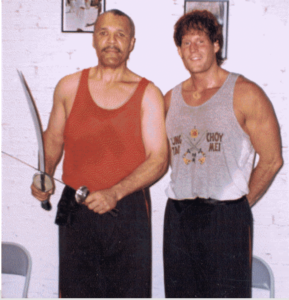
*Sifu Abdur-Rahim Muhammad and me, around 1997
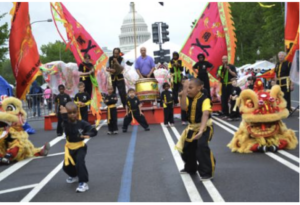
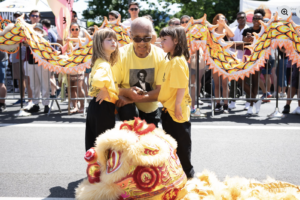
Sifu Abdur-Rahim Muhammad and students i
n action at a recent Lion Dance event in D.C.
HTCMLI exists to keep young people in school and out of the courts, and to build a moral compass alongside physical skill. Sparring is governed by a standing rule: get stronger, but keep control. Underneath it sits a principle every serious martial tradition eventually arrives at: the more capable a person becomes of causing harm, the greater their responsibility becomes to make sure harm never happens. Power without that responsibility is just danger with better technique. Stay with Chapter 31 long enough, and you see that ordering is Lao Tzu’s core message to civilization, at scale.
Weapons, in his account, are not glorious instruments to display. They are tools of last resort, picked up only when nothing else will answer, and set down the moment they’ve done what restraint alone couldn’t. The verse names peace as our natural condition. There are many versions of this chapter that go into more detail, and some even choreograph the aftermath: in battle, soldiers hold the active yang side, fully engaged, while commanders hold the passive yin side, watching. When the fighting ends, the positions reverse. The soldiers who did the killing move to the yin side to grieve. The commanders move to the yang side to hold the rites of victory, even though, the verse says plainly, it is a funeral. That reversal is the whole warning. Too often, those who order the war receive the parade while those who carry it out receive the mourning. The lines I chose for this chapter—Families suffer. Generations remember.—are aimed at closing that gap: a reminder of what defending someone costs, and a refusal to let the people who paid that cost grieve alone while somebody else takes the parade.
That discipline scales up more than it looks. Codes like the Geneva Conventions exist because how a force uses power determines what it becomes while using it. Treating prisoners humanely and distinguishing combatants from civilians are what keep the people wielding force from turning into what they’re fighting. Forces that lose that discipline win battles and lose legitimacy, and legitimacy is what makes any peace after the war worth having.
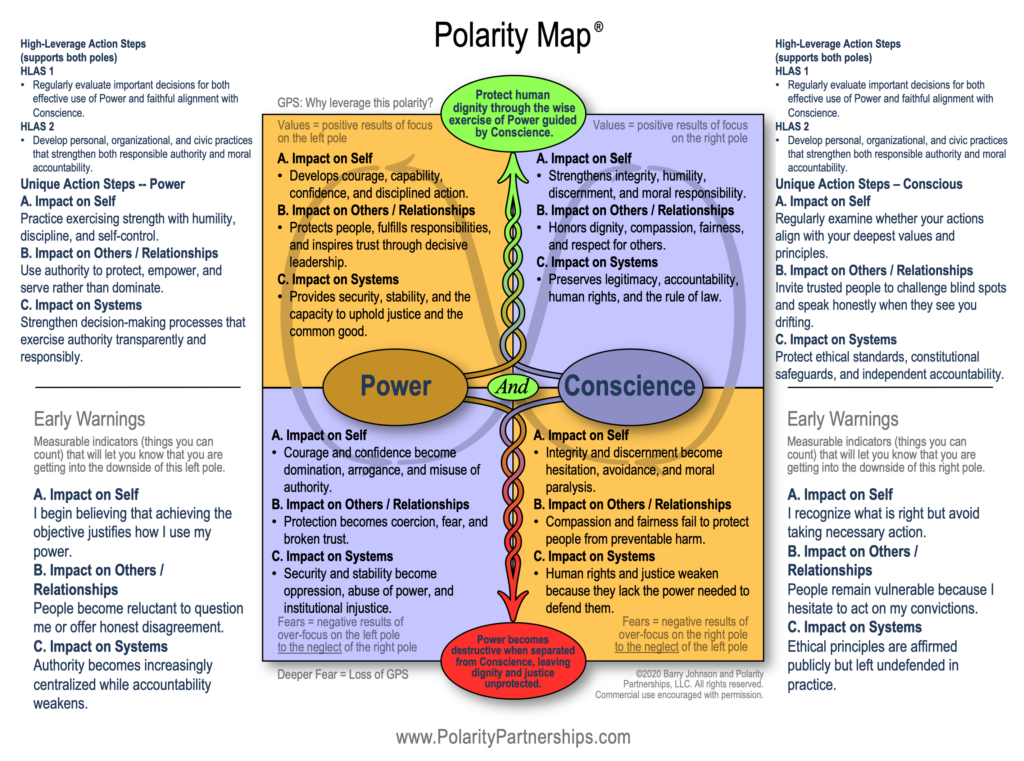
The chapter has its own word for this: yang leans aggressive, yin holds steady. Power And Conscience. Not only did Sifu Raheem use a Both/And approach – he trained one before he let us near the other. Power. Power without Conscience is exactly what he was guarding against in the ordering. Once there, it’s easier and better to deal with Conscience without Power, which doesn’t protect yourself or anyone. Watching him live that principle has taught me as much as learning the martial arts themselves.
Danger with better technique has a name at civilizational scale: Riane Eisler called it the Domination Model, distinguished from the Partnership Model built on shared power and fluid roles. Power stays healthy as long as it keeps answering to something outside its own momentum, and turns dangerous the moment it stops answering to anything at all.
Because I’m writing this in July of 2026, this section may read differently by the time anyone else reads it. That said, a few days ago, a U.S. Air Force major named Jason Watson stood on the Capitol steps in uniform and was arrested for calling for the president’s impeachment, citing what he called unconstitutional military actions abroad and the sidelining of Congress. He did this knowing it could end a seventeen-year career.
Watson is standing in a line that runs back further than the Constitution he cited. In 1849, Henry David Thoreau argued that conscience outranks the law, that a person can’t hand it over to a legislature and call it citizenship. He said plainly: if a law makes you an agent of injustice toward another person, you break it, and if the government’s answer is prison, prison is where a just person belongs. Thoreau spent a night there himself, for refusing to pay a tax that funded slavery and a war he considered unjust. Gandhi later credited him with proving that one person could refuse an empire and win. King read Thoreau at Morehouse and came away convinced that nonviolent resistance to segregation was a moral obligation.
Today, that same conscience sits at the center of the argument over what Watson did. Months earlier, a group of lawmakers who are themselves veterans and intelligence professionals released a joint video reminding troops that their oath is to the Constitution, not to any individual, and that they are only obligated to follow lawful orders. The administration and its allies read both moments as an attempt to fracture the chain of command. Watson and the lawmakers read them as the chain of command’s only real safeguard.
Both sides, whatever else divides them, are arguing about the same thing Lao Tzu is: what happens when Power forgets it needs Conscience, and what a person owes their conscience when they conclude that it has. Thoreau, Gandhi, and King all answered that question the same way: with their bodies, willing to accept the consequences of refusing what they believed was wrong. Command structures exist because Power matters: an army functions by answering to a chain of command in the moment. Oaths to a constitution instead of a person exist because Conscience matters too: that chain of command answers to something beyond itself, which is what keeps discipline from becoming only force in a uniform.
The same pattern shows up in the tools we’re building. I’ve watched AI systems hand back confident plans and decisive next steps for problems that first required someone to exercise judgment. That’s Power with no Conscience in the room, moving at machine speed.
None of this asks us to be less capable of protecting what we love. Sifu Raheem’s students don’t skip the fighting. They earn the right to it. What Chapter 31 asks is harder than fighting or refusing to fight: hold the capacity for force and the discipline never to enjoy using it. Win, if winning is required, and then go home and grieve what it cost.
Families suffer.
Generations remember.
* Sifu (師父 or 師傅) is a Cantonese Chinese title that translates literally to
“master-father” or “teacher-mentor.”
Here’s a Polarity Map for Power AND Conscience:
INVITATIONS:
To use an AI-trained “Chat w/Cliff” for Step 1, “Seeing” CLICK HERE.
Ready for the Polarity Advantage? Go deeper into Polarity Thinking, see our online self-directed Credentialing and Introduction to Polarity Practice or in-person training with Barry Johnson and me at Kayser Ridge by CLICKING HERE.