

See the Series Introduction for Just Tao It, Part I: HERE
See the Just Tao It Series Introduction Tao/It on-ramp, PART II: HERE
See Just Tao It, Chapter 1: HERE
From my interpretation of the Tao Te Ching, Chapter 32 (Unpublished):
It can’t be grasped.
It is all,
and smallest.
From It,
the Universe.
When leaders live with It,
others gather easily.
Without command,
things happen—
naturally.
Rain falls—
without design.
It gathers easily—
stream,
river,
lake,
and sea.
Joining,
flowing—
for each,
for many—
naturally.
—
I remember finalizing the above version of Chapter 32 while at Kayser Ridge, my retreat center in Berkeley Springs, West Virginia. It was the spring following what local press nicknamed Snowpocalypse. The thaw finally arrived, and the normally dry riverbed in the valley below the cabin came very suddenly back to life. From inside the cabin, the sound of rushing water pushed through the eleven-inch logs. By evening, the low roar of actual rapids below had replaced the frozen hold winter had kept on the mountain. Chapter 32 speaks of rain. That spring, it was snowmelt doing the gathering.
Nothing assigned the snowmelt its route. The north-facing slopes released water in their own time. The southern exposures followed. Small streams found other streams. The dry riverbed rediscovered the river it had carried before and now carried again. The water followed the direction of the land. Water joins. The sound outside came from countless small joinings. No single stream made the river. Something larger emerged. The river possessed a power that none of the streams could create alone.
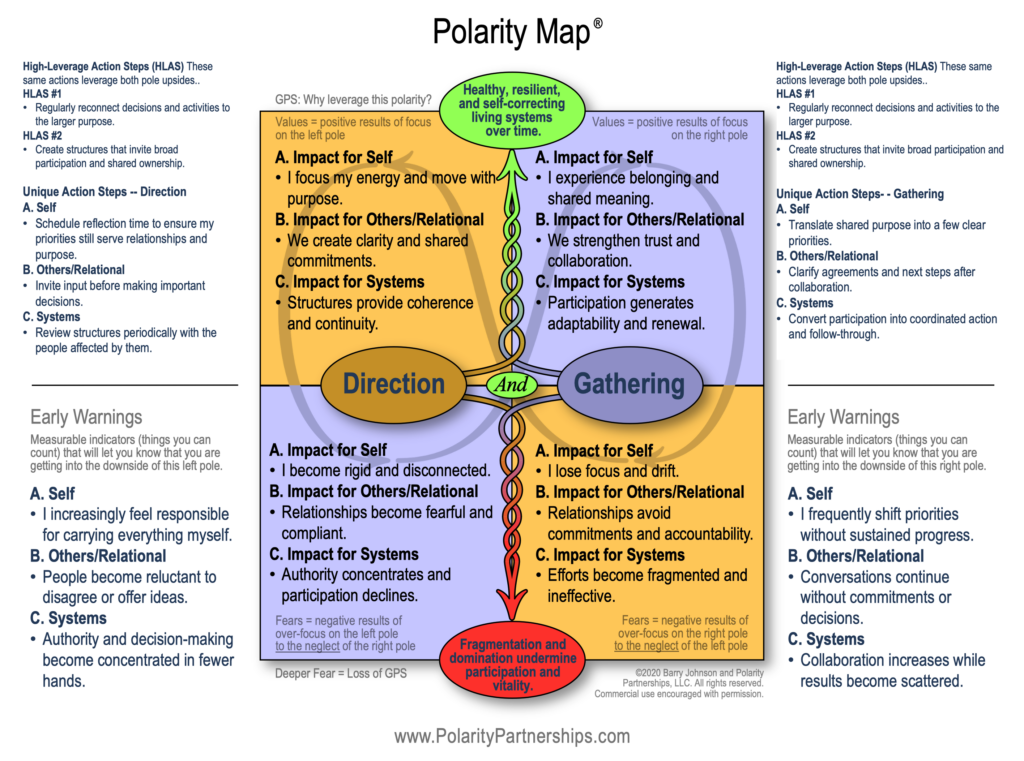
Direction And Gathering is the polarity I hear in Chapter 32. Direction gives movement shape. Gathering gives movement life and power. Direction to the neglect of Gathering hardens into domination. Gathering to the neglect of Direction loses coherence. Leaders who leverage both together help human systems find their way without force.
Human beings have spent centuries experimenting with Direction And Gathering. Families need both. Teams and organizations need both. Nations need both. Twentieth-century fascism and communism promised unity through concentrated authority. For a season, imposed order can resemble power and coherence. Over time, fear narrows information, participation weakens, and people learn to protect themselves inside systems that need their contribution. Force can look powerful for a season. Over time, rigidity weakens from the inside.
Democracy rests on a different wager. Authority and responsibility circulate among millions of imperfect people who argue, cooperate, vote, organize, protest, compromise, and periodically change course. Courts, constitutions, elections, and offices provide Direction. Citizens, communities, associations, movements, and neighborly obligations provide Gathering. Self-correction remains possible because power is continually being claimed and shared. Democracy works best as a living system. Living systems survive through feedback, adaptation, reciprocity, and recalibration. Democracy was never designed to eliminate tension. It creates conditions where tension can become productive rather than destructive. The larger purpose has always been a more perfect union.
Barry Oshry observed similar patterns inside organizations. “Tops” become burdened when too much responsibility gathers upward. “Middles” become torn trying to hold competing demands together. “Bottoms” become oppressed when their intelligence and agency go unused. Customers become alienated when systems forget who they serve. The pattern needs no villain. It only requires enough people responding reflexively to fear, pressure, and fragmentation. Organizations remain healthy when responsibility and participation continue to circulate. (I go deeper into this pattern in And: Volume Two – Applications, Chapter 36, “Polarity Thinking™ and Oshry’s Organic Systems Framework.”)
The Empowerment Dynamic describes a similar movement inside individuals and relationships. Fear narrows attention toward blame, rescue, and helplessness. Creator energy returns when people see current reality, hold a desired outcome, and take the next responsible step. A person finds a way to move, and that movement reconnects with others. (See And: Volume Two – Applications, Chapter 39, “Shifting From Drama to Empowerment.”)
I think about that river whenever I start losing hope about one vote, one voice, one conversation, one act of service, or one neighborly gesture not changing anything. A single patch of snow did not make the river. The river appeared because enough small joinings moved in relationship with the shape of the land.
The evening before I finished this chapter, Michelle Obama spoke at the opening of the Obama Presidential Center. She talked about gardens and playgrounds, cleanup days and birthday parties, making new friends and carrying one another when weary. She described the work of community in ordinary language.
Her words brought to mind parents, grandparents, teachers, volunteers, coaches, neighbors, and citizens who have stitched communities together for generations. They rarely appear in history books. They simply keep showing up. Communities are built through the accumulation of ordinary acts.
My friend and partner, Barry Johnson, often says that relationships themselves possess a power beyond the individuals who create them. One plus one can become three. The relationship itself becomes a source of power. Families, friendships, communities, and democracies all depend upon it. Claiming power and sharing power belong together. Families, friendships, communities, and democracies depend on both. When both are present, something larger becomes possible.
Here’s a Polarity Map for Direction And Gathering:
INVITATIONS:
To use an AI-trained “Chat w/Cliff” for Step 1, Seeing” CLICK HERE.
Ready for the Polarity Advantage? Go deeper into Polarity Thinking, see our online self-directed Credentialing and Introduction to Polarity Practice or in-person training with Barry Johnson and me at Kayser Ridge by CLICKING HERE.