

See the Series Introduction for Just Tao It, Part IHERE
See the Just Tao It Series Introduction Tao/It on-ramp, PART IIHERE
See Just Tao It, Chapter 1HERE

From my interpretation of the Tao Te Ching, Chapter 36 (Unpublished):

Reduction,
relies on expansion.

Illumination,
depends on hidden.

Risen,
comes from ruin.

Taken,
returns as given.

What shows,
is shaped by what is not.

To hold the light,
let go of the fight.

To quickly go,
let in the slow.

To be mighty,
be gently.

Chapter 36 may be one of the most misunderstood leadership chapters in the Tao Te Ching because at first glance it appears to speak in contradictions.

Weakness overcoming strength.
Softness overcoming force.
Slowness influencing speed.
Gentleness carrying greater durability than domination.

Modern systems tend to distrust those ideas immediately because contemporary culture increasingly associates leadership with visibility, certainty, speed, confidence projection, dominance, and control. The louder the performance, the more strength people often assume is present.

Though living systems rarely work that way for long.

The Tao observes something many leaders eventually learn through consequences:
forces pushed too far in one direction eventually generate pressure in the other.

What expands eventually contracts.
What dominates eventually weakens itself.
What attempts total control eventually creates resistance.
What humiliates eventually generates resentment.
What fragments eventually loses relationship with the whole sustaining it.

The pattern appears everywhere:
organizations,
families,
politics,
economies,
religions,
social movements,
and democracies.

Human beings repeatedly confuse domination with power. They are not the same thing.

Domination depends upon control, fear, force, humiliation, dependency, and suppression. Power, in healthier systems, involves the capacity to influence, create, protect, sustain, coordinate, and steward the larger whole.

That distinction matters enormously right now because modern culture increasingly rewards performative dominance while weakening the relational capacities sustainable leadership actually requires.

Public humiliation becomes entertainment.
Certainty becomes identity.
Cruelty becomes confused with toughness.
Volume becomes confused with strength.
Winning becomes disconnected from stewardship.

Systems always compensate, eventually.

And somewhere inside writing this chapter, I finally recognized why the alignment between Tao Te Ching Chapter 36 and Chapter 36 of And: Volume 2 unsettled me so much.

Same chapter number.
Same polarity.
Same underlying warning about what happens when Power separates from Love.

I wish I could claim intentional design. I can’t.

The alignment found itself. And my first reaction was not:
“What an interesting coincidence.” It was: “Of course. This is the one I still haven’t learned.”

Because I have lived both sides of this polarity repeatedly.

Early in my career, I over-identified with Power.

I had frameworks.
I could diagnose systems quickly.
I could see patterns clients could not yet see.
I knew how to move organizations forward.

And I used that capability with the kind of confidence that looked like leadership and felt like effectiveness.

Until I started noticing the cost.

The questions that stopped being asked.
The perspectives no longer offered.
The relationships remaining professional while never deepening into the trust required for real transformation.

I was helping systems move.

I was not always helping them develop the collective capacity to sustain movement after I left.

Later, I overcorrected toward Love.

I became increasingly committed to inclusion, reflection, dialogue, shared ownership, and making certain everyone felt heard. Though over time I also started noticing another pattern emerge:
decisions delayed,
clarity weakened,
conflict avoidance disguised itself as compassion,
and systems slowly lost the capacity for decisive movement.

Both approaches worked temporarily.

Both eroded trust eventually.

Both reflected the same mistake:
trying to solve the polarity by choosing one pole.

That is the deeper insight underneath both Chapter 36 of the Tao Te Ching and Chapter 36 of And: Volume 2.

Power differentiates.
Love integrates.

Power helps systems establish boundaries, accountability, direction, autonomy, specialization, and movement. Love reconnects people back to shared humanity, shared purpose, relationship, interdependence, and stewardship of the larger whole.

Healthy systems require both.

Barry Oshry spent decades helping leaders recognize this pattern in organizations. Martin Luther King Jr. described the same polarity in moral language when he wrote:

“Power without love is reckless and abusive, and love without power is sentimental and anemic.”

That sentence may be one of the clearest modern expressions of Chapter 36 imaginable.

And it feels increasingly important right now because we are watching this polarity destabilize systems at civilizational scale.

When Power runs ahead without Love, differentiation gradually becomes fragmentation.

People stop experiencing themselves as participants in a shared system and begin organizing around territory, ideology, grievance, identity, fear, status, and opposition. Opponents stop looking human. Winning matters more than sustaining the whole.

Systems eventually begin consuming themselves from the inside.

History contains no shortage of examples.

Authoritarian movements often begin by presenting themselves as strength restoring order. Though domination eventually weakens the very systems it claims to protect. Trust erodes. Adaptability shrinks. Fear replaces participation. Loyalty replaces competence. Compliance gets mistaken for commitment.

Power without Love always collapses eventually.

The question is how much damage occurs before the collapse arrives.

Though the companion pattern matters too.

Love without Power destabilizes systems differently.

Necessary accountability weakens.
Boundaries blur.
Conflict avoidance replaces stewardship.
Important decisions stall.
People become so committed to inclusion that they stop interrupting harm.
Reflection drifts into paralysis.

Democracy suffers both ways:
through authoritarian Power without Love,
and through paralyzed Love without Power.

That tension appears everywhere now.

Polarization.
Institutional distrust.
Performative certainty.
Public humiliation.
Identity tribalism.
Algorithmic outrage.
Dehumanization rewarded as political entertainment.

And AI is accelerating much of it.

Artificial intelligence dramatically increases the scale and speed of differentiation:
more information,
more stimulation,
more targeting,
more amplification,
more emotional activation,
more identity reinforcement,
more fragmentation.

What AI does not automatically generate is integration.

Relationship.
Wisdom.
Humility.
Stewardship.
Restraint.
Shared humanity.

Those remain profoundly human responsibilities.

Without sufficient integration, technological power gradually detaches from the relational capacities necessary to sustain civilization itself.

Power without Love scales frighteningly fast in digital systems.

That may be one of the defining leadership challenges of our time.

And it is not merely technological.

It is developmental.

Earlier stages of adult development often experience leadership through certainty, hierarchy, identity protection, domination, opposition, and enemy formation. Complexity gets reduced into categories of allies and enemies, winners and losers, strength and weakness.

More mature development gradually increases capacity for paradox, ambiguity, humility, self-reflection, interdependence, and relationship across difference. Human beings become more capable of exercising power without requiring dehumanization.

That distinction feels increasingly important now because many modern systems continuously reward the opposite capacities:
certainty over curiosity,
reaction over reflection,
dominance over stewardship,
tribal belonging over shared humanity.

The Tao recognizes where that road eventually leads.

Not because it moralizes.

Because it observes patterns.

Living systems cannot sustain themselves indefinitely when differentiation completely severs relationship with the whole.

That applies equally to:
organizations,
families,
political parties,
nations,
and civilizations.

This polarity runs underneath other chapters in this series.

Chapter 9 and Chapter 48:
Effort AND Ease.

Chapter 10:
Power AND Love.

Chapter 22:
Own Your View AND Question Your View.

Chapter 29:
Claiming Power AND Sharing Power.

Chapter 71:
Brilliance AND Patience.

Same underlying struggle.

Different expressions.

Always returning to the same developmental challenge:
how to hold differentiation and integration together without destroying either.

The leaders I increasingly trust are rarely the loudest people in the room.

I trust leaders capable of remaining relational while holding power responsibly.
Leaders capable of exercising authority without humiliation.
Leaders capable of acting decisively without abandoning reflection.
Leaders capable of disagreement without dehumanization.
Leaders capable of protecting differentiation while sustaining integration simultaneously.

That is far more difficult than domination.

And far more durable.

Chapter 36 closes with lines that initially sound almost absurd inside systems rewarding force so aggressively:

To hold the light,
let go of the fight.

To quickly go,
let in the slow.

To be mighty,
be gently.

Those lines are not describing passivity.

They are describing stewardship.

The strongest systems are rarely the ones exerting the most visible force in every moment. The strongest systems are usually the ones capable of sustaining legitimacy, trust, learning, accountability, adaptability, relationship, and shared participation over time.

That requires Power.

That also requires Love.

Both are important and mutually reinforce each other.

Maybe I shouldn’t be surprised Chapter 36 of the Tao Te Ching and Chapter 36 of And: Volume 2 found each other after all. Different centuries. Different language. Same human struggle.

How do we exercise power strongly enough to sustain the whole without severing relationship to the humanity making the whole possible in the first place?

That question feels less philosophical every year.

And more like the central leadership challenge of our time.

Here’s a Polarity Map for Power AND Love:
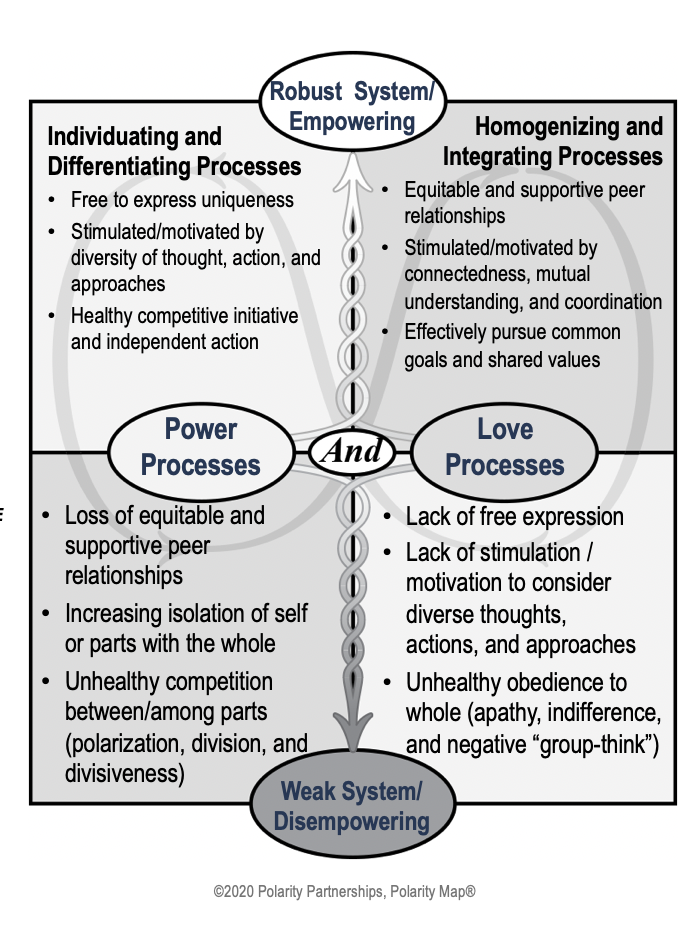
My Chapter written with the support of Barry Oshry in And, Volume 2: Applications: And_V2_PEEK_C36_OSHRY

INVITATIONS:
How is Power And Love showing-up for you in these challenging times? If you want, try the AI-trained “Chat w/Cliff for Step 1, Seeing, CLICK HERE.

Want to go deeper into Polarity Thinking? See our online self-directed Credentialing and Introduction to Polarity Practice, CLICK HERE.