

See the Series Introduction for Just Tao It, Part I: HERE
See the Just Tao It Series Introduction Tao/It on-ramp, PART II: HERE
See Just Tao It, Chapter 1: HERE
From my interpretation of the Tao Te Ching, Chapter 41 (Unpublished):
Approached thoughtfully,
It opens heartfully.
Approached rigidly,
It disappears from view.
Approached carelessly,
It becomes a joke.
Amid jokes or rigidity,
It remains.
Still, It is what It is.
Still, It does what It does.
Experiencing It, heartfully.
The lit way may look shadowed.
The easy way may look difficult.
The true way may look doubtful.
The pure way may look murky.
The orderly way may look messy.
It is the square,
without corner.
It is the vessel,
ever provisional.
It is harmony,
awaiting perceptivity.
It is the being,
that does doing.
Beyond name or depiction,
It remains hidden.
It starts the origination.
It completes the completion.
—
Chapter 41 has always felt to me like it belongs near Chapter 1, perhaps even in the same family.
Chapter 1 introduces the Tao while simultaneously acknowledging the limits of language. It points toward a reality that can be experienced, participated in, and lived, while remaining larger than any description we might create.
Chapter 41 returns to that territory from a different direction. Where Chapter 1 explores what the Tao is, Chapter 41 explores what encountering It often feels like.
I was twenty-seven years old when I first encountered the Tao Te Ching. At the time, I’d been carrying more questions than answers about my career path and “what I wanted to do with my life.” My undergraduate degree was in history.
In hindsight, history was excellent preparation. At its core, it is the study of change. It invites us to observe what changes and why, what endures, and what patterns continue appearing across generations. Technologies evolve. Governments rise and fall. Institutions emerge, flourish, and fade. Human beings continue wrestling with many of the same hopes, fears, ambitions, blind spots, and possibilities. The names change. The settings change. The underlying dynamics often remain recognizable.
That fascination with recurring human patterns eventually led me into the applied behavioral sciences. The consistent thread running through all of it was less about dates and more about understanding change—and how people, organizations, and societies evolve over time.
Then one afternoon, I wandered into a bookstore. When I picked up a copy of the Tao Te Ching, I felt something that remains difficult to explain even now. The word I’ll use is: recognition.
Here was a text that didn’t demand certainty. It didn’t insist on definitive conclusions. It acknowledged complexity without becoming complicated. It offered wisdom without pretending to have captured reality completely.
I remember being struck by how eighty-one short chapters could feel simultaneously simple and profound. They didn’t remove Mystery. They helped me become more comfortable living within it.
The Tao became a companion over the ensuing decades. Some chapters felt immediately accessible. Others revealed themselves gradually. Passages that seemed distant at one stage of life suddenly became relevant years later. The messages shifted with my own experience and growth. It changed me, and in a sense, It changed with me—different encounters with the same words, different meanings emerging from the same text.
Eventually, after decades of reading, reflecting, and living alongside the Tao, I found myself writing my own poetic interpretations—the current versions of which now introduce each chapter in this series.
My relationship with the Tao even influenced the name of my organization: Xperience. The missing “E” was intentional.
Experiential learning has always occupied a central place in my life and work. As Carl Rogers expressed, “Experience is, for me, the highest authority.” Our realities tend to arrive through experience long before explanations or the stories we tell about them. We experience love before we understand it. We experience grief before we understand it. We experience purpose before we can adequately describe it. Life reaches us directly. Understanding follows in its own time.
The Tao seemed to point toward that reality again and again—not as a collection of ideas or strategies, but as an invitation into a particular kind of experience.
Then Barry Johnson came along.
I never know quite how to answer the often-asked question about how I came into Polarity Thinking. Was it the bookstore? Was it Barry?
It was Both/And.
Barry helped me articulate Patterns that I had spent years observing without fully naming. Through Polarity Thinking, he offered language, maps, principles, and practices that helped explain recurring dynamics I had encountered throughout history, organizations, leadership, relationships, and life itself. Most of all, he helped me experience firsthand the rare integrity of someone whose teaching and living are difficult to distinguish.
What the Tao had nurtured through Mystery, Barry helped illuminate through Patterns.
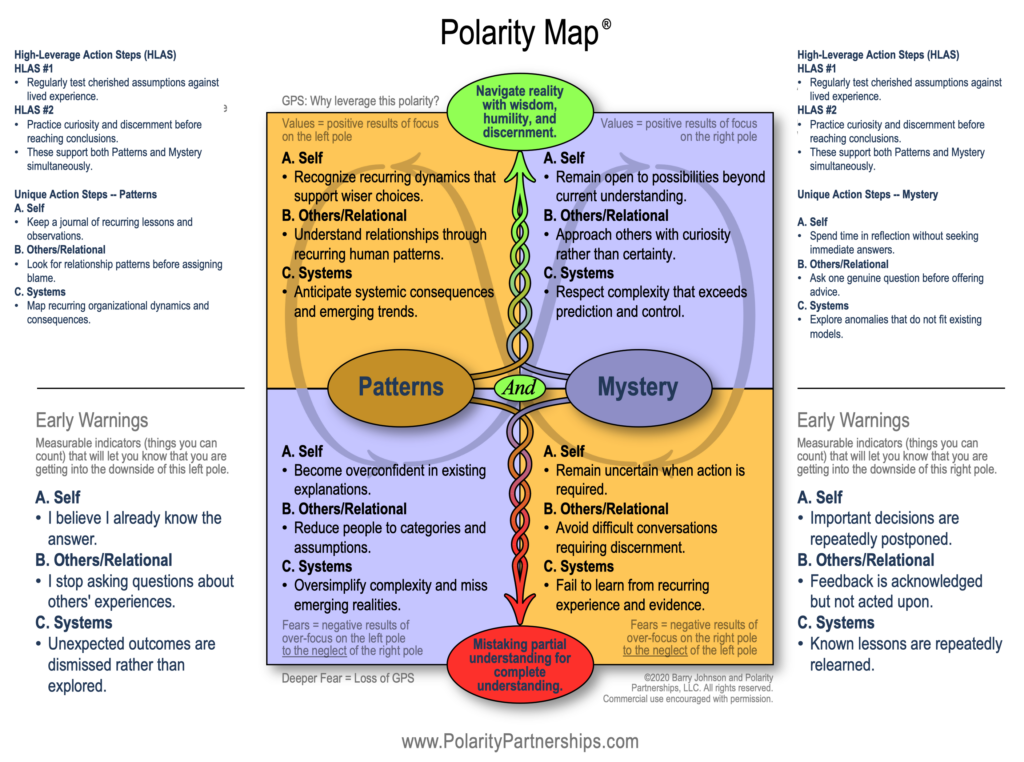
Eventually, I came to realize that Patterns And Mystery were never competitors.
Mystery reminds us that reality exceeds our ability to fully explain it. Patterns help us participate more skillfully in the realities we encounter. Mystery encourages humility. Patterns support discernment. Mystery prevents certainty from becoming arrogance. Patterns prevent uncertainty from becoming paralysis.
Together they create a way of seeing that has shaped much of my life and work.
“It is the being
that does doing…”
That may be the most compressed polarity in the entire Tao and one reason Chapter 41 moves me so deeply.
Its observations feel lived, not argued. The lit way may look shadowed. The easy way may look difficult. The true way may look doubtful. The pure way may look murky. The orderly way may look messy.
Those lines have endured for centuries because they continue describing recognizable human experiences. Wisdom often arrives wearing unfamiliar clothing. Growth frequently feels uncomfortable before it feels developmental. Some of the most meaningful experiences in our lives reveal their significance only after considerable time has passed.
Chapter 41 trusts readers to recognize those experiences for themselves.
That trust is one of the greatest gifts the Tao offers. It doesn’t insist. It invites. It points. It always allows experience to do much of the teaching. Readers discover their own relationship with the text as they bring their own lives to it. This chapter, uniquely, becomes meaningful through experiential participation.
As I reflect on my experience that began with an exploration of history, a bookstore encounter with the Tao, and decades of learning alongside Barry Johnson and countless others, I find myself deeply grateful.
The Tao taught me to trust Mystery.
Barry taught me to see Patterns.
Life has spent the last several decades showing me they belong together.
Chapter 41 feels like a reminder of that enduring partnership. The Tao—whatever “It” is—remains an invitational and experiential companion: never mastered, always revealing, always shaping us through Patterns And Mystery.
Here’s a Polarity Map for Patterns And Mystery:
INVITATIONS:
To use an AI-trained “Chat w/Cliff” for Step 1, Seeing” CLICK HERE.
Ready for the Polarity Advantage? Go deeper into Polarity Thinking, see our online self-directed Credentialing and Introduction to Polarity Practice or in-person training with Barry Johnson and me at Kayser Ridge by CLICKING HERE.