

See the Series Introduction for Just Tao It, Part I: HERE
See the Just Tao It Series Introduction Tao/It on-ramp, PART II: HERE
See Just Tao It, Chapter 1: HERE
From my interpretation of the Tao Te Ching, Chapter 61 (Unpublished):
A great country
is like a fertile valley,
serving from a low place
with humility.
Like a mother,
it nurtures.
From what is low,
it receives.
In receiving,
it holds.
Through what is low,
It gathers.
Great and small—
meeting low,
becoming whole.
—
I’ve spent more time wrestling with Chapter 61 than almost any other chapter in this series. Part of the reason is that it touches a question that has followed me for most of my life. Long before I found organization development, executive coaching, Polarity Thinking, or the Tao Te Ching, I studied history. At the time, neither I nor many of the people around me were entirely sure what practical use that degree might have. History seemed interesting, but not especially useful. It wasn’t preparing me to build bridges, perform surgery, write software, or run a business. Looking back, I smile at that concern because history turned out to be the perfect preparation for the work I eventually chose.
History is often described as the study of the past. Over time, I came to see it differently. History is the study of change. It is the study of how people organize themselves, how ideas spread, how institutions gain strength and lose legitimacy, how leaders influence events, and how societies create conditions that either support human flourishing or undermine it. After enough years studying change, certain patterns become difficult to ignore.
One of those patterns is humanity’s enduring fascination with power. We are drawn to what stands above us. We admire visibility. We reward certainty. We celebrate winners. We build monuments to success and write biographies about dominance. We seem remarkably committed to the belief that greatness resides somewhere near the top of the mountain. The Height.
2500 years ago, Lao Tzu looked at the chaotic world he inhabited and ran with a metaphor for Chapter 61 — the Valley. I have a hunch change may have played a part in his choice. And, why that chapter remains so painfully relevant in the world we inhabit today.
A valley occupies a low place. Water flows toward it. Rivers gather there. Communities form there. Crops grow there. Life accumulates there. The valley does not demand attention. It does not compete with the mountain. It does not advertise its importance. Yet without valleys, rivers do not gather, communities do not flourish, and civilizations struggle to endure. The valley supports life precisely because of what it is willing to receive.
We’re living in a world that seems to confuse intelligence with wisdom. I love the work of historian Yuval Noah Harari because he so clearly points out that intelligence and wisdom are not the same thing. Human beings possess extraordinary intelligence. We have split the atom, mapped the genome, landed on the moon, connected billions of people through digital networks, and created technologies capable of generating ideas, images, and decisions at astonishing speed. We can build machines that imitate conversation, diagnose disease, and compose music. We can also spend an afternoon arguing with strangers while convinced that our certainty is evidence of our wisdom.
As so often is the case, history suggests otherwise.
Intelligence helps us solve problems. Wisdom helps us understand which problems are worth solving, what consequences our solutions may create, and how power should be used once we acquire it. History contains no shortage of intelligent leaders. Wisdom appears much less frequently.
One of the recurring lessons of history is that human beings become trapped in false choices. Strength or humility. Confidence or receptivity. Individual or community. Leadership or service. Many of the capacities required to address our most important challenges emerge through the integration of what appear to be competing values. The deeper question is rarely which side wins. The deeper question is what becomes possible when both are brought into relationship.
The longer I have worked with leaders, the more convinced I have become that wisdom begins with the capacity to receive. Leaders receive feedback. They receive criticism. They receive new information. They receive perspectives that challenge their assumptions. They receive reality, especially when reality refuses to cooperate with their preferred narrative. The inability to receive often looks like strength in the short term. It can appear decisive, confident, and unwavering. Over time, however, individuals, organizations, and nations that lose the ability to receive also lose the ability to learn.
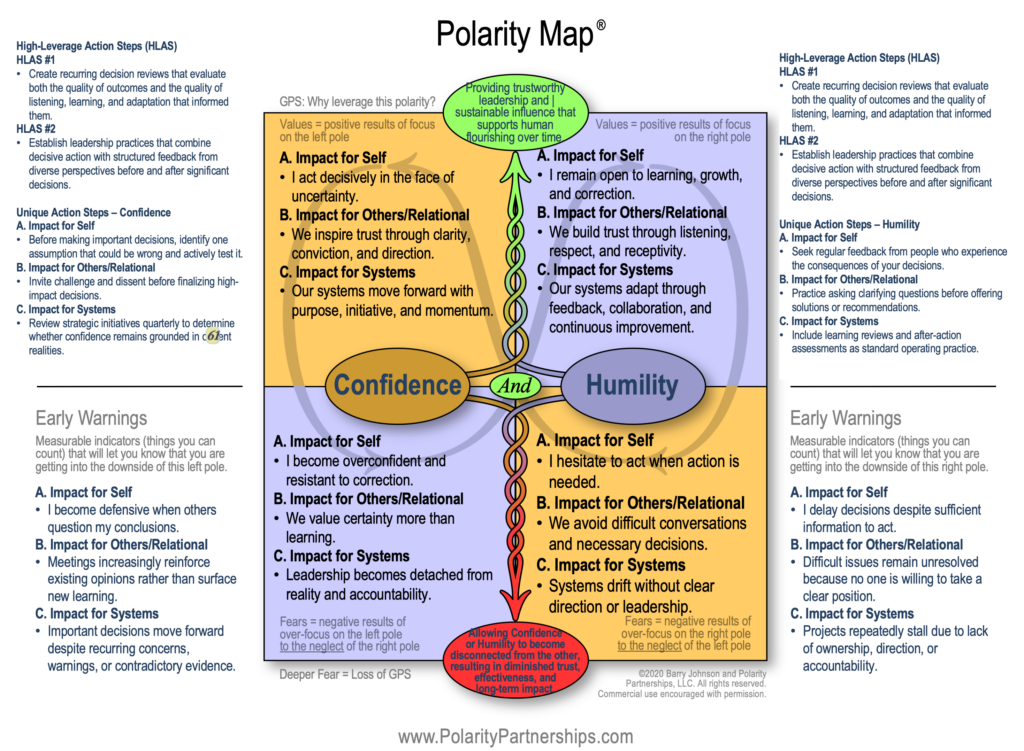
Jim Collins discovered a similar pattern in his research on organizations that made the leap from good to great. The leaders who produced the most enduring results combined extraordinary resolve with unusual humility. Their ambition remained connected to a purpose larger than themselves. They were capable of acting decisively without becoming captive to their own certainty. They understood something that Chapter 61 expresses through the image of a valley: enduring strength depends upon remaining teachable. Essentially: Confidence (Height) AND Humility (Valley).
That observation reaches beyond leadership. It applies to families, organizations, communities, and countries. A democracy depends upon citizens and institutions capable of receiving information that challenges their assumptions. Scientific progress depends upon the willingness to revise conclusions when new evidence emerges. Healthy relationships depend upon the ability to hear something difficult without immediately becoming defensive. The pattern repeats at every scale because larger systems eventually reflect the capacities practiced by the people inside them.
Perhaps this is why the chapter reaches for maternal imagery. A healthy mother receives, nurtures, protects, teaches, adapts, and serves. None of those capacities suggest weakness. They require strength, responsibility, discernment, and commitment. They represent a form of power that many cultures overlook because it rarely arrives with fanfare. Yet every one of us entered the world dependent upon that form of power.
The longer I have reflected on this chapter, the more I have come to believe that many of our greatest challenges are not primarily technological, political, or economic. They are developmental. We continue investing enormous energy in expanding our intelligence while paying far less attention to cultivating the wisdom required to guide it. The Inner Development Goals ask who we must become. Humanity’s shared commitments around poverty, health, education, peace, sustainability, and human flourishing ask what we must accomplish through massive challenges like the UN’s 17 Sustainability Goals. The relationship between those questions may be one of the defining leadership challenges of our time.
We cannot build a wiser world with capacities we have not developed. We cannot accomplish what the future requires if we neglect the qualities that make cooperation, learning, discernment, stewardship, and trust possible. The work of inner development and the work of creating a flourishing world are deeply connected.
Perhaps that is why Chapter 61 has stayed with me through all these years of studying change. It offers a definition of greatness that runs against many of our instincts. Greatness is not measured by how high we stand above others. Greatness is revealed by what we can receive, what we can hold, what we can nurture, and what we can help flourish. The valley serves because it receives. It gathers because it remains open. It becomes indispensable because it creates conditions in which life can thrive.
A great country is like a fertile valley.
The question that lingers for me is whether we still recognize the strength required to become one.
Here’s a Polarity Map for Confidence And Humility:
INVITATIONS:
To use an AI-trained “Chat w/Cliff” for Step 1, Seeing” CLICK HERE.
Ready for the Polarity Advantage? Go deeper into Polarity Thinking, see our online self-directed Credentialing and Introduction to Polarity Practice or in-person training with Barry Johnson and me at Kayser Ridge by CLICKING HERE.