

See the Series Introduction for Just Tao It, Part I: HERE
See the Just Tao It Series Introduction Tao/It on-ramp, PART II: HERE
See Just Tao It, Chapter 1: HERE
From my interpretation of the Tao Te Ching, Chapter 43 (Unpublished):
In this world,
the gentle, the pliable
overcomes
the hard, the immovable.
The formless
moves
through form.
Presence
moves
in space between.
Non-action
still acts.
Unspoken—
still known and seen.
With It,
trust flows.
—
I spent my undergraduate years studying history because I wasn’t entirely sure what else to study. However, this was not universally viewed as a brilliant career strategy.
History interested me. I enjoyed reading. I enjoyed stories. I enjoyed trying to understand why people and societies made the choices they made. What I enjoyed considerably less was answering the occasional question about what exactly one planned to do with a history degree after graduation.
It was a fair question because at the time, I just wasn’t sure. What I couldn’t see then was how well history was preparing me for the work I would eventually do.
A few years ago, I heard the historian Yuval Noah Harari describe history in a way that immediately connected dots of my life and work. History, he suggested, is not primarily the study of the past. History is the study of change.
What I heard, I couldn’t unhear.
The rise and fall of nations. The spread of ideas. The emergence of religions. The development of economies. The evolution of cultures. History records events, but beneath those events sits a larger question: What moves human beings from one reality into another?
Looking back, I know that question was following me everywhere. It probably led me to the field of Human Resources, then Organization Development and Change. And Executive Coaching. It was all systems thinking and Polarity Thinking. Different disciplines and methods, all with the same underlying question:
What creates meaningful and lasting change?
History offers plenty of evidence that human beings are remarkably capable of creating both progress and suffering. We build systems that generate prosperity and systems that generate misery. We create institutions that elevate humanity and institutions that diminish it. Future generations inherit the results and wonder what their predecessors were thinking.
A student of history develops a certain appreciation for recurring patterns. Fear, ambition, and the need for certainty keep showing up. And eventually, the blind spots show up with unintended consequences. While the details change, human nature remains surprisingly recognizable. I’ll share that this realization is somewhat discouraging and even depressing at times. The supernatural ability humans possess to repeat avoidable mistakes is demoralizing.
Then, in 2006, I met Barry Johnson.
Polarity Thinking gave me a language for something I had been observing for years with the Tao, but could not fully or well articulate. Intelligent people with good intentions often create outcomes they never intended. Strengths become vulnerabilities. Solutions create new problems. Progress in one direction generates consequences in another. Many of the challenges that frustrate us most are not problems waiting to be solved once and for all. They are ongoing interdependencies that require participation, awareness, and learning over time.
Suddenly, patterns that once felt overwhelming became easier to understand.
I began noticing them everywhere. In organizations. In families. In politics. In religion. In leadership. In myself.
The complexity did not disappear; it just became somewhat more understandable.
Having spent decades exploring the Tao Te Ching, the wisdom behind the Tao and human systems was so ‘hand in glove” for describing realities and possibilities I was seeing, that it gave me real hope for us humans. And Chapter 43 is a beautiful example:
The gentle overcomes the hard.
The formless moves through form.
Presence moves through space.
The chapter seems fascinated by forms of influence that are easy to overlook. The forces that create the deepest change are often present long before anyone notices the movement they eventually produce.
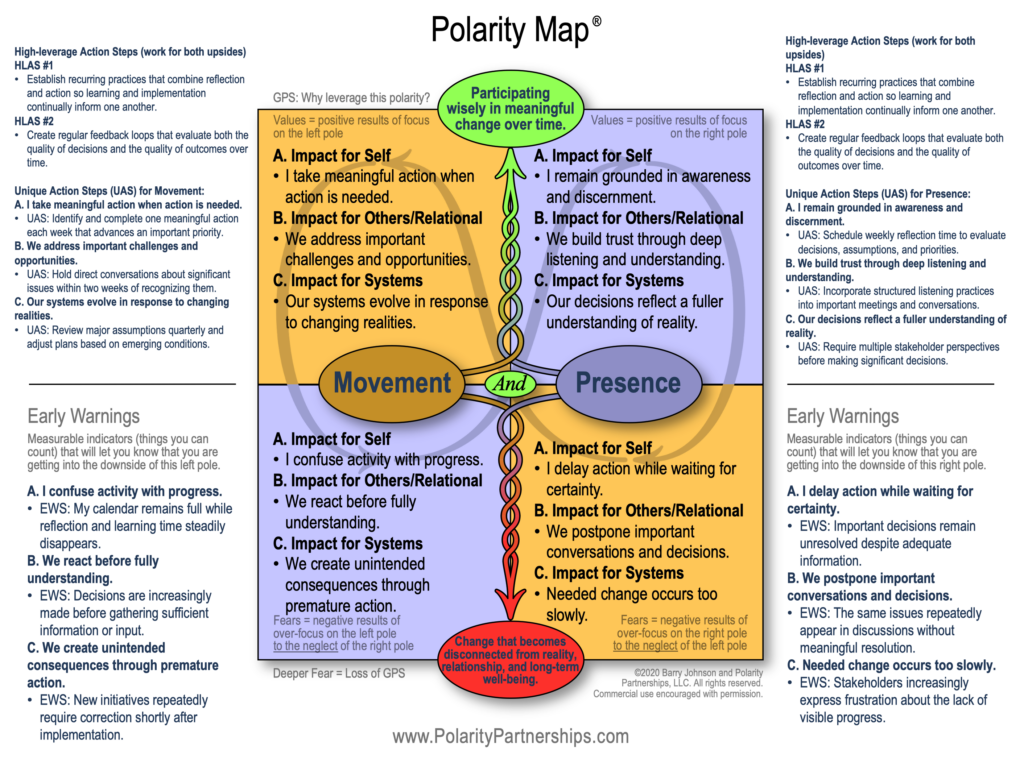
Movement And Presence.
Movement contributes action, progress, adaptation, innovation, and change. Presence contributes awareness, discernment, relationship, patience, and perspective. Movement without Presence can lead to activity disconnected from reality. Presence without Movement can lead to insight that never leaves the room.
Together they create something far more powerful that can stand the test of time.
That observation feels especially relevant today.
Artificial intelligence is reshaping entire industries. Democracies are wrestling with polarization and distrust. Climate challenges continue to accumulate. Technologies emerge faster than cultures can adapt to them. Information moves around the globe almost instantly.
The temptation is to assume that greater movement requires greater force.
History suggests something that is perhaps even more interesting. That is, many of the most significant transformations begin before they become visible. An assumption changes. A worldview shifts. A relationship evolves. A question emerges that can no longer be ignored. Something formless begins taking shape.
Movement follows.
One reason I find the Inner Development Goals initiative so compelling is that it begins with a similar recognition. The Sustainable Development Goals identify many of the challenges humanity hopes to address. The IDGs ask a different question: What capacities must human beings develop if we hope to address them wisely?
That feels less like a political question and more like a human one about things that really matter, like:
Awareness. Character. Relationships. Collaboration. Courage. Presence.
The more times I come across Chapter 43, the clearer I am that people just explore different dimensions of these realities. Over, and over.
And, in the process, the most meaningful and sustainable change hardly ever, if ever, begins with force. It begins with presence.
Looking back, my years studying history as an undergrad happened without realizing I was studying change. Then, my profession sought to support leaders, teams and organizations to navigate change. Then, Polarity Thinking helped me understand why and how change processes fail. All of that helped me appreciate the Tao for what it illuminated all along.
The conditions that make meaningful change possible, twenty-five centuries after Lao Tzu wrote Chapter 43, are more relevant than ever. So, it’s worth saying again.
The gentle overcomes the hard.
The formless moves through form.
Presence moves through space.
Meaningful and sustainable change begins with presence, long before the movement is visible.
Here’s a Polarity Map for Movement AND Presence:
INVITATIONS:
To use an AI-trained “Chat w/Cliff” for Step 1, Seeing” CLICK HERE.
Ready for the Polarity Advantage? Go deeper into Polarity Thinking, see our online self-directed Credentialing and Introduction to Polarity Practice or in-person training with Barry Johnson and me at Kayser Ridge by CLICKING HERE.