


See the Series Introduction for Just Tao It, Part I: HERE
See the Just Tao It Series Introduction Tao/It on-ramp, PART II: HERE
See Just Tao It, Chapter 1: HERE
From my interpretation of the Tao Te Ching, Chapter 42 (Unpublished):
From It, one.
From one, two.
From two, three.
From three,
ten thousand arise.
Yin and Yang—
being and doing—
arise together.
Neither first.
Neither last.
When one lifts,
It remains.
When one fades,
It remains.
In their meeting,
It.
In excess,
forgetting.
In remembering,
returning.
We learn,
and learn again.
The ten thousand teach.
It remains.
Teaching.
—
Between 1987 and about 2007, I created my own summary of the 81 chapters of the Tao Te Ching from my favorite translations at the time. It was a contemplative practice more than a scholarly one, although at times it felt like both. Every new version I encountered was compared against my own and I revised and supplemented as needed.
Around 2010, I learned from one of those newer translations that the original Chinese text was written in poetic form. That discovery kicked off the next round of reshaping my cherished version into poetry, one chapter at a time. Much of that process happened at Kayser Ridge, sitting with these chapters in the natural beauty of the place. Those heretofore unpublished chapters now provide the opening to each post in the Just Tao It series.
During that multi-decade process, I noticed a pattern across certain chapters. Like Chapter 1, they seemed to be attempting to describe the very phenomenon that Chapter 1 had already declared indescribable. The Tao that can be named is not the eternal Tao. Then, having said so, Chapter 1 points toward It anyway.
Chapter 42 is one of the clearest examples.
From It, one.
From one, two.
From two, three.
From three, ten thousand arise.
A handful of words tracing the ten thousand things we live among back toward a source. Yin And Yang. Being And Doing. Receptive And Active. Neither first nor last. Arising together.
This dual/non-dual observation appears in many wisdom traditions. The moment unity becomes visible, relationship has already appeared. The moment the One becomes knowable, the Many have already arrived. A saying attributed to the Buddha captures the paradox beautifully:
“Unity can only be manifested by the binary. Unity itself and the idea of Unity are already two.”
Chapter 42 begins precisely there. The movement from unity into multiplicity is presented as the way life unfolds. It is a map that helps us see in both directions. The ten thousand arise from It. They can also return to It—not by ceasing to be Many, but by remembering the One from which they came.
Every glimpse of oneness seems to involve that remembering.
Chapter 1 opens the mystery. Chapter 42 lets us watch the mystery flowering. It offers a way of seeing how unity becomes multiplicity without ever leaving itself. The One does not disappear when the Many appear. The Many are how the One becomes visible. For me, that makes Chapter 42 one of the clearest answers the Tao Te Ching gives to a question it refuses to answer directly.
Most of us humans occupying this modern world live squarely in the ten thousand. We make decisions, tend relationships, work, play, create, contribute, grieve, celebrate, and begin again. The ten thousand are what we call life.
Chapter 42 is a reminder of our interconnectedness and what happens when we forget the One and full immersion in the Many begins carrying a cost. The many can multiply faster than we can make sense of and integrate them.
In our present moment, that multiplication is accelerating at a pace few previous generations have experienced. The information environment generates more input than any individual can reasonably absorb. The narrative self—the internal voice attempting to organize identity, meaning, and belonging across the ten thousand—runs hotter and louder. Fragmentation, overwhelm, and disconnection become easier to experience because contact with the One inside the Many becomes harder to sustain.
In excess,
forgetting.
Some windows, spanning the ancient and the contemporary, illuminate what Chapter 42 is describing.
The first is our relationship with the Earth itself. Across Indigenous traditions worldwide, the Earth is often understood as Mother—not as metaphor alone, but as a living relationship. Respect for land, water, air, ancestors, and future generations is woven into everyday life because survival itself depends upon remembering our place within a larger whole. Harmony with nature is not an abstract philosophy. It is a way of living that recognizes our dependence upon the very systems that sustain us.
I had a fleeting but memorable taste of this while camping on the mountain at Kayser Ridge before building on land first occupied by Adena, Huron, Tuscarora, Shawnee, Delaware, and Iroquois peoples. What followed became a slow occupational and spiritual apprenticeship for this self-described city boy. Living closer to the land deepened my respect for ancient peoples, modern rural communities, and anyone whose daily life remains tied to the rhythms of weather, water, soil, and season.
Other windows converge on this same threshold of interconnectedness.
In 1971, Edgar Mitchell returned from the Moon struck by an instantaneous awareness of connection—the universe, somehow, conscious. Near-death researchers document thousands of accounts sharing a similar quality: the self-boundary dissolves, and something vast and welcoming remains. Long-term meditators describe the Default Mode Network quieting and the anxious narrator loosening its grip. The documentary In Waves and War follows former Navy SEALs through psychedelic-assisted treatment in Mexico, and their accounts of dissolution and return feel unmistakably familiar.
The mechanisms differ. The territory feels remarkably similar.
Moments, ancient and modern, remind us the ten thousand can become transparent to an original source. Different cultures, different practices, different explanations. Yet each seems to point toward the same realization: we are far more interconnected than our ordinary awareness suggests.
In remembering,
returning.
Barry Johnson, in the final chapter of And: Volume One, names the polarity beneath all polarities: our entire world of action, difference-making, and ten thousand things lives within one pole of a deeper relationship. Martin Buber called the two dimensions I–It (experience, difference, action, the ten thousand) and I–You (pre-experience, unity, love—what he called “the pure present”). Buber wrote that “mortal life is by its very nature an oscillation between You and It.”
Each of the the windows above describes that crossing.
“The joy of the differentiation [is] necessary to the fullness of the joy of the unity.”
— Sri Aurobindo, The Life Divine
Chapter 42 does not advocate for the One over the Many. It points to the reality that they arise together. Neither is first. Neither is last.
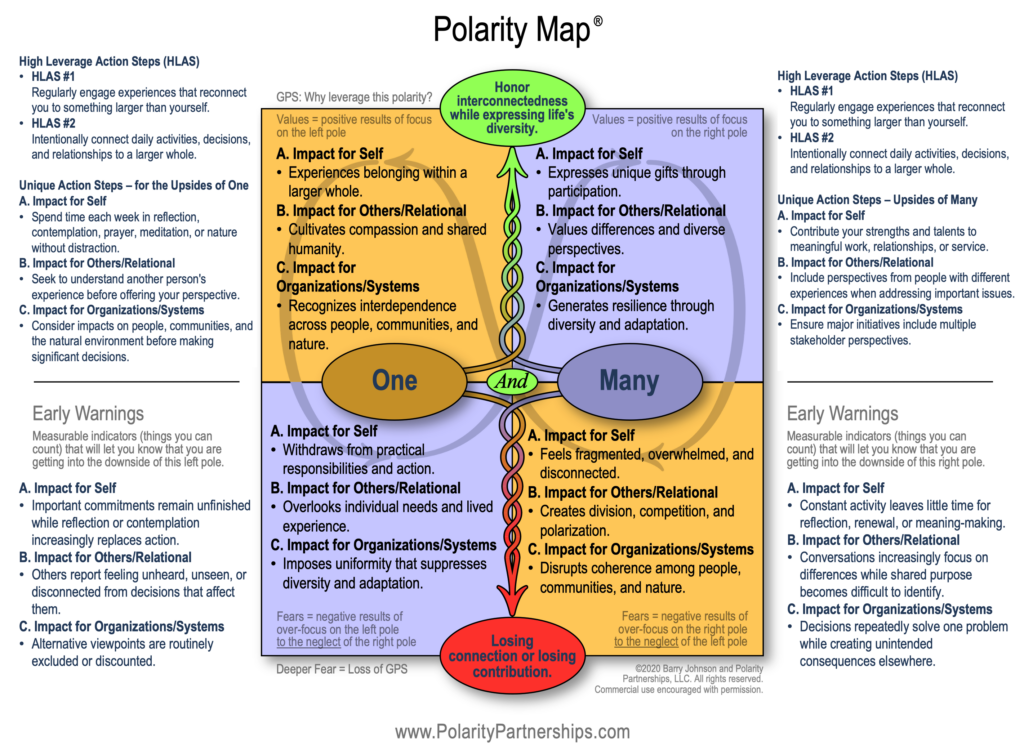
Viewed through a polarity lens, this Both/And relationship becomes strained when we begin overemphasizing one pole to the neglect of the other.
The downside of One to the neglect of Many appears when unity, source, and interior experience lose connection with the actual needs of life. Beautiful insights fail to find expression. The contemplative discovers peace yet leaves important work undone. The leader cultivates awareness yet struggles to make decisions.
The downside of Many to the neglect of One appears when activity, complexity, and endless differentiation sever their relationship with source. Fragmentation grows. Motion accelerates. Direction fades. The leader moves faster and faster while losing connection with what any of it is for.
The wisdom lies in navigating the relationship between them—remaining connected to the One while living fully among the Many. Discovering source within the ten thousand things rather than searching for it somewhere beyond them. Barry calls the reward “the richness, the energy, and the wonder of life and death”—found not in one pole or the other, but in the living oscillation between them.
Here are some questions worth visiting and revisiting, especially during seasons when the ten thousand seem to accelerate:
When have you experienced a glimpse of the One underneath the Many, however brief? What conditions made that experience possible?
What in your daily life pulls you deepest into the ten thousand things, to the point of forgetting the source?
How do you tend the return? What practices, formal or informal, help you remember?
Where in your work, leadership, or relationships has the One AND Many become strained?
None of these paths ask us to leave the ten thousand. The ten thousand are where we live, love, work, find awe, grieve, build, contribute, and belong. They are real. They shape our lives. Yin And Yang—Being And Doing—arise together.
Chapter 42 offers a way of living fully within the Many while remaining connected to the One from which it arises. A way of carrying the ten thousand things without being carried away by them. A way of doing that remains rooted in being.
We learn,
and learn again.
The ten thousand teach.
It remains.
Teaching.
Here’s a Polarity Map for One And Many:
INVITATIONS:
To use an AI-trained “Chat w/Cliff” for Step 1, Seeing” CLICK HERE.
Ready for the Polarity Advantage? Go deeper into Polarity Thinking, see our online self-directed Credentialing and Introduction to Polarity Practice or in-person training with Barry Johnson and me at Kayser Ridge by CLICKING HERE.