

See the Series Introduction for Just Tao It, Part I: HERE
See the Just Tao It Series Introduction Tao/It on-ramp, PART II: HERE
See Just Tao It, Chapter 1: HERE
From my interpretation of the Tao Te Ching, Chapter 47 (Unpublished):
Without passing through an exit,
you can know It.
Without looking through a window,
you can see It.
The farther we go,
the less we know.
Arrive
without leaving.
See
without looking.
Act
without acting.
Some chapters take longer to arrive at than others. This one took me longer than any I’ve written. I finally understood why after I’d already lived it — sitting in a teahouse on Wudang Mountain, across from a man who had lived the life I once imagined for myself.
I was twenty-three when I applied to teach English in China — drawn by an early curiosity about Taoist philosophy, a Tai Chi practice I’d barely begun, a pull toward something I couldn’t yet name. I was accepted. I didn’t go. Life unfolded instead, the way it does, into work and a relationship and years I don’t regret even though I once imagined a different version of them. Then, decades later: Wudang Mountain. Jake. Tea. A blank page in front of me for this very chapter. Recognition. Here we are.
In the final days of a trip to China with my strategic partner, Innovative OD Consulting, my colleague Maria took me to Wudang Mountain after all our work there was done. There, she arranged a meeting with Jake Pinnick, a man who grew up near where I did in Illinois.
In his twenties, Jake followed the same pull I’d felt at that age — martial arts, and the philosophy underneath it, and a growing fascination with Taoist thought. He went to Wudang Mountain, where Tai Chi itself began, to study. He never left. He became fluent in Chinese, became the only American master of an old and rare martial art, married a Chinese woman named Lily, and had a daughter Selina, whom I had the pleasure of meeting.
We sat together in his teahouse and talked about the Tao Te Ching the way two people talk when neither one is performing for the other. At some point I told him about the China I never went to. He listened the way someone listens when they already understand.
I don’t have regrets. I never did, even before that afternoon. But sitting across from Jake, in a teahouse on the mountain where the thing I’d once reached for took root in someone else’s life, I was given something rare: a look at the life I didn’t live, held up next to the one I did, with no verdict attached to either. Only recognition. Only gratitude.
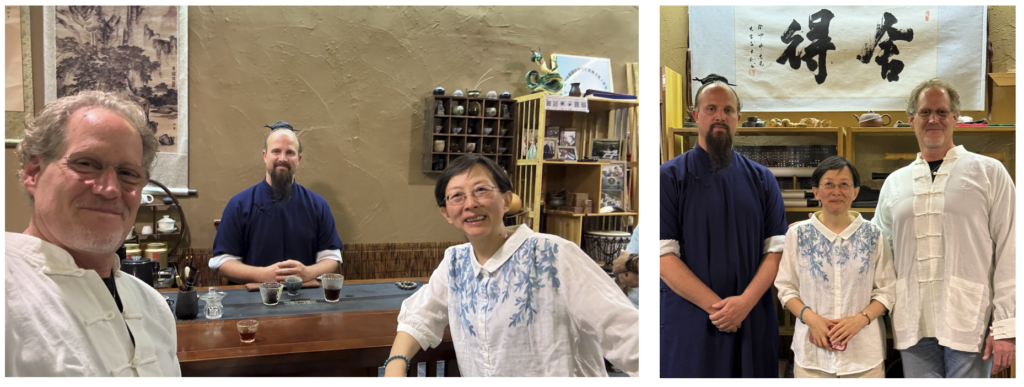
Sitting across from Jake in his teahouse, I was looking at one version of the life I might have lived. He had gone to China. He stayed. He immersed himself in Taoist practice until it became the shape of his life.
I hadn’t.
For years I carried a persistent sense that I’d missed my chance to know the Tao more deeply. Then I met Barry Johnson.
Barry never called himself a Taoist. He built no teahouse on Wudang Mountain. He spent a lifetime working inside organizations, boardrooms, classrooms, and communities — trained as a Gestalt therapist, driven by an activist’s instinct for justice. The moment I encountered his work, I recognized the same thing Lao Tzu had been pointing toward for twenty-five centuries, spoken in a different language. Where the Tao spoke of yin and yang, Barry spoke of polarities. For the twenty years before I met him, the Tao Te Ching had already been asking me to see reality as interdependent. Barry simply gave me a way to stand inside that reality and practice it.
It was as if the Tao had simply taken another path to find me—
through Barry.
Barry’s greatest gift to me and so many others has been his generosity. He spent decades giving away what most people guard: his thinking, his materials, his clients, his stage, his time, and his confidence in people long before they had any confidence in themselves. I know, because I was one of them. More than once he invited me into work I didn’t yet know I was ready for. He steadied me when I stumbled, then handed the controls back so I could keep learning. He lived polarity thinking as much as he taught it — teaching by trusting, leading by sharing, seeing people more completely than they saw themselves until they grew into the possibility he’d already recognized. That was the deepest lesson he ever offered me.
Years later, when we put materials together, he insisted both our names go on the cover — even though the thinking and the decades of experience behind it were almost entirely his. I told him it didn’t seem right. He wouldn’t hear it. That single act told me more than anything he ever said: he saw someone else’s future before they could see it themselves, and made room for it without needing credit.
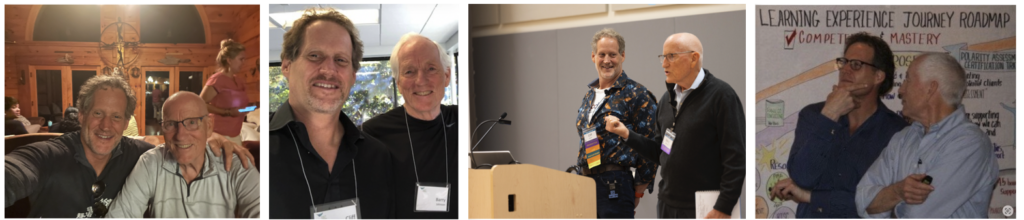
Lao Tzu had given me the compass. Jake had shown me the road I didn’t travel. Barry had shown me I’d never left the path.
Looking back, I no longer see separate chapters in my life. I see one path revealing itself through different landscapes.
Years later, without planning it, another mountain entered my life.
Before I ever met Barry Johnson, I had begun building Kayser Ridge. At the time, I thought I was creating an experiential retreat and learning center, maybe a place to gather family and friends. I had no idea it was preparing to become something else.
Today, leaders, coaches, consultants, and practitioners come there to learn, reflect, wrestle with difficult questions, and practice seeing more completely. Two Mastery Programs have unfolded there. PACT Certifications continue there. Friendships have deepened there. Work has been born there.
I see it differently now. Kayser Ridge became another way the Tao arrived in my life. I had been preparing a home for work I hadn’t yet discovered.
Never have we been able to search farther, faster, or more continuously than we can today. AI expands that reach beyond anything previous generations could imagine. Chapter 47 asks a different question underneath all of it: whether wisdom ever really depended on distance, or on presence — the kind no search engine manufactures. The real work in the AI age is the oldest one there is: remembering how to arrive.
Which is where Walcott’s poem finally makes sense to me: a blessing I didn’t know I’d already received. “You will love again the stranger who was your self… Sit. Feast on your life.” I hadn’t gone looking for that. It found me anyway, the way the Tao tends to.
I looked across the table at Jake. For the first time, I understood. I had not missed my life. I had arrived.
Without passing through an exit,
you can know It.
Without looking through a window,
you can see It.
Arrive
without leaving.
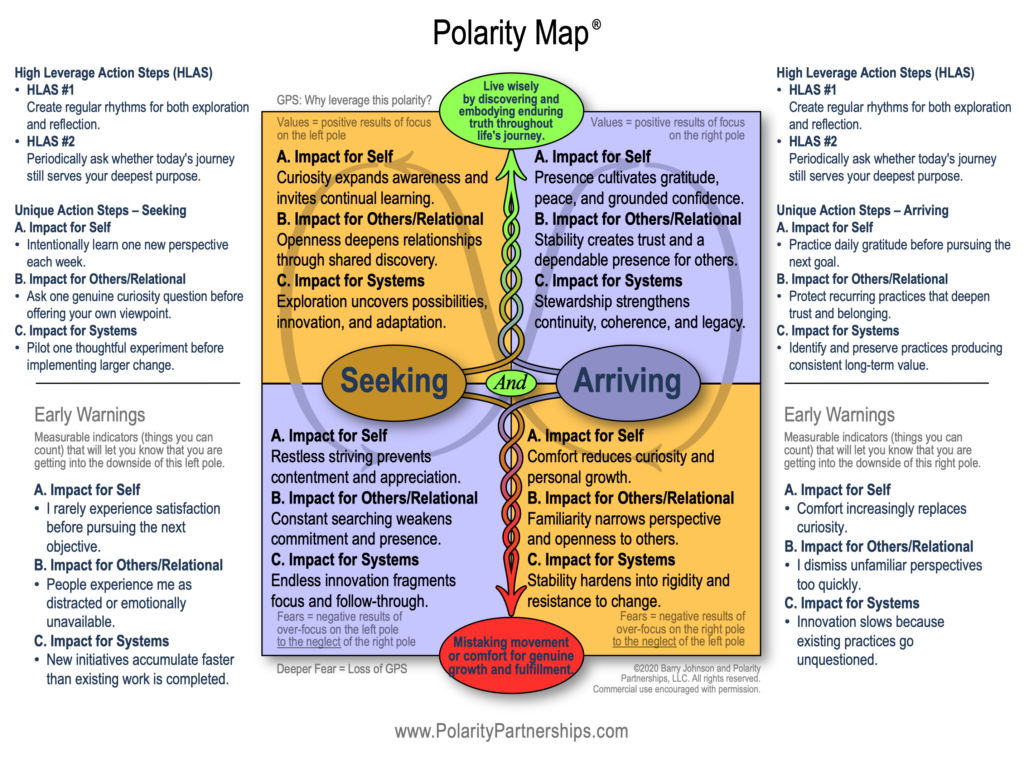
Here’s a Polarity Map for Seeking And Arriving:
INVITATIONS:
To use an AI-trained “Chat w/Cliff” for Step 1, “Seeing” CLICK HERE.
Ready for the Polarity Advantage? Go deeper into Polarity Thinking, see our online self-directed Credentialing and Introduction to Polarity Practice or in-person training with Barry Johnson and me at Kayser Ridge by CLICKING HERE.