

See the Series Introduction for Just Tao It, Part I: HERE
See the Just Tao It Series Introduction Tao/It on-ramp, PART II: HERE
See Just Tao It, Chapter 1: HERE
From my interpretation of the Tao Te Ching, Chapter 48 (Unpublished):
Being in learning each day,
There is accumulation.
Being in It each day,
There is distribution.
In letting go,
More can show.
More is done,
With less begun.
Without interruption
It moves in motion.
Harmony grows,
And the whole thing flows.
Forcing less.
More becomes.
—
This Chapter and Chapter 9 are joined at the hip.
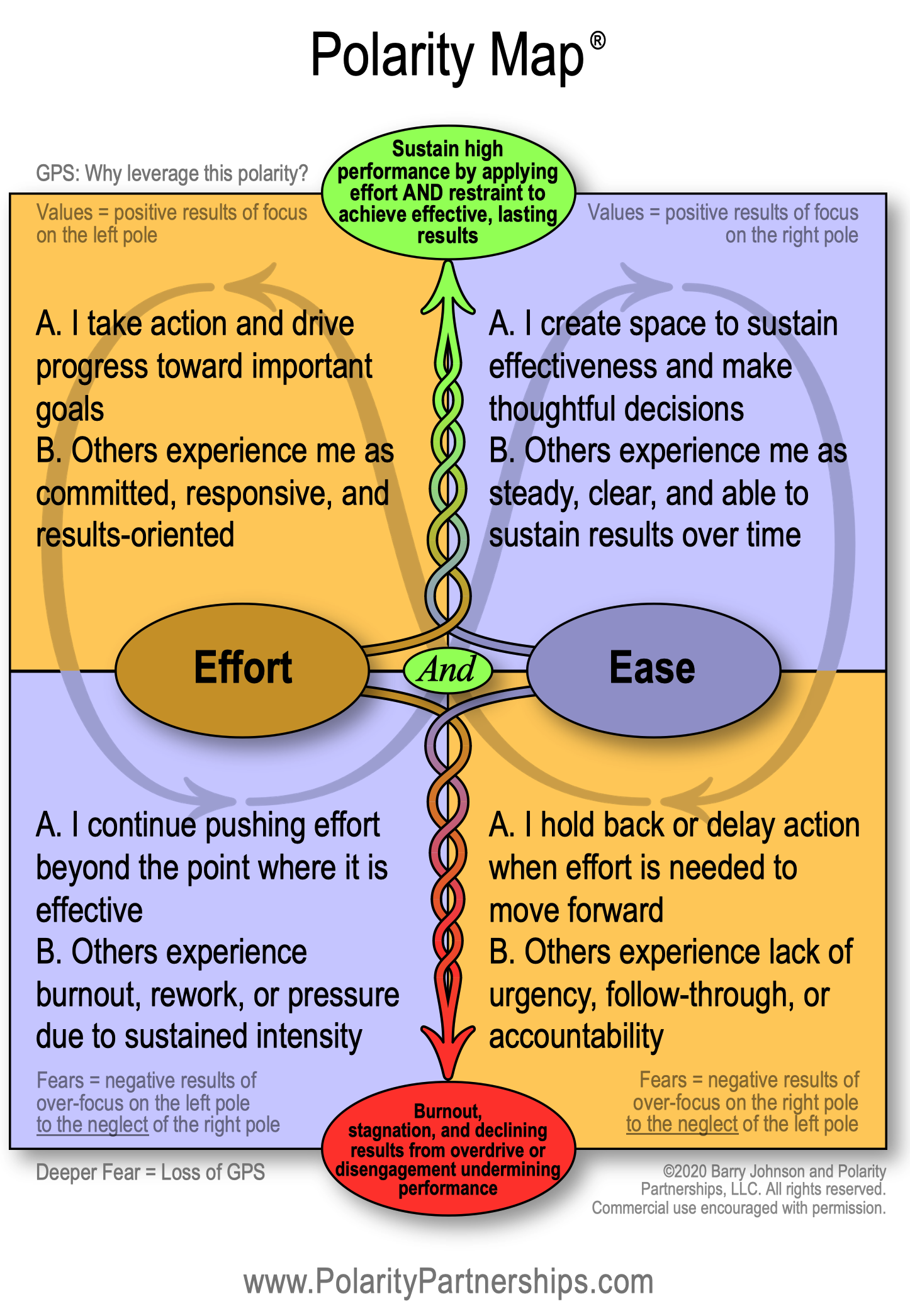
Chapter 9 introduced the polarity directly: Effort AND Ease. Effort creates movement. Ease sustains it. Lean too far into Effort and diminishing returns show up. Lean too far into Ease and momentum fades.
Chapter 9 warns us about the power and costs of overdoing Effort. This Chapter reminds us that Ease carries power and limits just as Effort does.
If you’re wondering which pole of that polarity I’ve historically leaned toward, I once considered naming this series World’s Worst Taoist. Friends intervened. Apparently, that wasn’t the most compelling way to introduce a body of work. For me, that was the point.
The title, if I’d used it, would have been accurate.
Because my default response when something isn’t working has almost always been the same: try harder.
Push more. Work longer. Add effort.
That strategy has produced some meaningful accomplishments in my life.
It has also produced some equally meaningful messes. Some, life-threatening. (See Chapter 1 and Chapter 64.)
Many of the patterns that eventually create strain begin as things that work. A behavior produces results. A habit earns recognition. A rhythm becomes normal.
Until it starts asking more than it gives.
This is where the work of Brené Brown has helped me make sense of something deeper that often sits beneath these patterns. Across books like The Gifts of Imperfection, Daring Greatly, Rising Strong, Braving the Wilderness, and Atlas of the Heart, she describes how shame grows in isolation and loses its grip when it’s brought into the open.
Understanding that dynamic helped me see something important.
Many of the behaviors we continue long after they stop serving us are not sustained by logic.
They’re sustained by identity.
Identity often anchors us to one side of a polarity. When our sense of competence becomes tied to being the person who pushes harder than others, Ease can start to feel less like wisdom and more like failure.
Which is why the work of Robert Kegan and Lisa Lahey in Immunity to Change resonated so strongly with me. Their research shows that when change proves difficult, it’s often because another hidden commitment is protecting something we are afraid to lose. Neuroleadership pioneer and author, David Rock, who improves workplace performance by applying neuroscience, developed a model he calls “SCARF.” You don’t have to look far to see the connection to identity: Status, Certainty, Autonomy, Relatedness, Fairness. The story we tell ourselves about who we are truly matters.
In a chapter I wrote for And, Volume 2 on Polarity-Based Inquiry (See link to .pdf at the end), these tensions show up through four questions that help leaders and teams see what is actually shaping their decisions.
What problems are we trying to move away from?
What opportunities are we trying to attain?
What strengths must we retain?
What risks must we refrain from?
These questions connect the familiar logic of SWOT with the deeper commitments surfaced in Immunity to Change, translating them into a polarity lens—in this case the ongoing tension between Effort AND Ease—that leaders and teams can work with over time.
Once those tensions become visible, something interesting happens.
Instead of trying to overpower the problem, people start noticing where unnecessary effort has entered the system.
Which brings us back to Chapter 48.
The Tao is not suggesting that effort disappears. Effort still matters. Movement still requires energy. What the Tao is pointing to is the relationship between Effort AND Ease.
Effort without Ease creates strain. Ease without Effort creates drift.
Together they create movement that’s sustainable over time.
For leaders, teams, and organizations, learning to work inside the polarity of Effort AND Ease supports something larger than personal productivity. It supports the capacity to make decisions that continue to work—not just in the moment, but when pressure increases, when conditions shift, when what seemed certain becomes uncertain.
Psychologist Carl Rogers, whose work has influenced my thinking for decades—including the naming of my company, Xperience—captured something close to the spirit of this chapter in On Becoming a Person:
“Experience is, for me, the highest authority. The touchstone of validity is my own experience.”
Rogers’ emphasis on experience points toward something Taoist traditions have recognized for centuries—the capacity to trust what is unfolding rather than forcing outcomes prematurely. In polarity terms, experience often teaches what effort alone cannot: where Ease needs to enter the system so that movement can continue without strain.
And here’s where it gets current.
AI dramatically expands what Effort can accomplish—processing at scale, executing with precision, optimizing pathways faster than human capacity allows. It’s relentless. It doesn’t tire. It doesn’t need breaks. Which makes it extraordinarily effective at one pole of this polarity.
What it can’t do—at least not yet, and maybe not ever—is recognize when Ease would serve better than more Effort. When stepping back creates conditions for something better to emerge than pushing forward would. When the system needs regeneration more than it needs output.
I’ve watched this play out in organizations adopting AI tools. The early results look great. Faster turnaround. More throughput. Optimization everywhere. And then, quietly, something starts to fray. People burn out. Trust erodes. The system that was supposed to make things easier starts demanding more—more responsiveness, more availability, more adaptation to what the algorithm requires.
Because when you optimize for Effort alone, even with the best tools, sustainability eventually becomes the cost.
The people I know who are navigating AI integration well aren’t the ones trying to maximize every efficiency. They’re the ones asking: where does this create space for better work, and where does it just create pressure for more work? Where does automation allow us to bring more Ease into the system, and where are we using it to extract more Effort?
That’s not a technical question. That’s a polarity question.
And it matters—personally, organizationally, systemically—because the decisions we make now about how we work with AI will shape whether what we build holds over time or breaks under its own accumulated weight.
Trust builds when people see that the system isn’t just demanding more, faster. Trust builds when there’s evidence that sustainability matters as much as performance. That recovery is valued alongside output. That Ease isn’t treated as weakness, but as a requirement for anything that’s going to last.
And when I say ‘the system,’ I don’t just mean the organization. I mean the individual people inside it, whose capacity to keep showing up depends on whether Inner Development—the ability to stay grounded, aware, adaptive—is supported, not just assumed. And the larger structures—Outer Impact, the work that actually gets done in the world—that depend on those people remaining capable over time, not just productive in the moment.
You can’t sustain one without the other. Inner Development AND Outer Impact. Part AND Whole. Both required. Both over time.
That insight carries an annoyingly loud whisper of challenge.
No matter how many frameworks we learn or books we read, there comes a moment when the adjustment becomes personal.
We see the pattern.
And then we decide whether we are ready to change it.
Which may explain why Chapter 9 and Chapter 48 feel inseparable. They remind us: Effort has limits and power. Ease has limits and power.
And the real work—for leaders, teams, and organizations—is learning to live inside that polarity over time. To make calls that work now and continue to work later. To build systems that perform and sustain. To notice when we’re forcing and when we’re allowing. To trust that sometimes, less effort creates more of what actually matters.
Not because we’ve figured it out.
Because we’re willing to stay with it.
Less forced effort. More ease in becoming.
Here’s a Polarity Map to help see the pattern:
INVITATIONS
For the Polarity Map for Continuity And Transformation from And, Volume 2:
And_V2_PEEK_C38_PBI.
See also:
Chapter 9
If you want to take a quick self-assessment for Effort And Ease: CLICK HERE
NOTE: the results include Leveraging Action Steps and Early Warnings (to support maximizing upside benefits and minimizing downside limitations).
How is Effort And Ease showing up for you in your life or work now?
Try the “AI-trained Chat w/AI Cliff for support for Step 1, Seeing Polarities
Ready for the Polarity Advantage? Check out our online self-directed Basics, Credentialing, or in-person training with Barry Johnson and me at Kayser Ridge! Certifications and Courses
Check out the Cliff’sNOTE focused on the Law of Least Effort that provides additional support for Effort And Ease