

See the Series Introduction for Just Tao It, Part I: HERE
See the Just Tao It Series Introduction Tao/It on-ramp, PART II: HERE
See Just Tao It, Chapter 1: HERE
From my interpretation of the Tao Te Ching, Chapter 64 (Unpublished):
What’s recent
is easily corrected.
What’s brittle
is easily shattered.
What’s little
is easily scattered.
Attend early.
The tallest tree
started
in a small seed.
The tower nine stories
started
in a pile of clay.
The ten-thousand-mile journey
started
in steps one, two, and three.
Grasping—loss.
Forcing—failure.
With less desire,
less is lost.
—
Most of what eventually becomes a problem did not begin looking like one.
It usually began as something small. Slightly off. Easy to feel and just as easy to override. A hesitation in the room. A relationship beginning to thin out. A strange sentence in a meeting that lingers longer than it should. A body sending signals you would prefer to negotiate with later. A system becoming a little more rigid, reactive, or performative than it once was.
Human beings are often remarkably perceptive early. We are just not always very honest with ourselves about what we already know. If we have lived long enough, many of those signals are not mysterious anymore. They are pattern recognition. Experience speaking before the spreadsheet arrives. The body noticing what the mind has not fully admitted yet.
Most of us do not lack the signal. We override it.
Sometimes because the timing feels inconvenient. Sometimes because attending early may require a difficult conversation, a boundary, a course correction, or an admission we are not yet ready to make. And sometimes because human beings have an extraordinary capacity to normalize what should probably interrupt us.
I have spent most of my life doing extreme sports. Still do. As I approach a point in life where I probably have more years behind me than in front of me, I carried a certain pride in saying I could still do what I did in my teens. That pride came with a few receipts: multiple back surgeries, broken bones, and enough stories to make orthopedic surgeons financially optimistic.
What I was slower to recognize was that something had changed. My body was different. My recovery was different. The rider I had become was different. Pride has a way of talking over signals.
Eventually that caught up with me: one ride, one corner, one moment of coming in too hot and too fast. The tree I crashed into remains burnished in memory along with the sound of impact. The years afterward taught me both downsides at once: regret and incapacitation.
It was never really about whether I should continue mountain biking. It was about whether I was willing to attend early enough to the realities of the rider I had become before reality attended to them for me.
That distinction matters because once people begin recognizing the importance of attending early, another distortion often appears almost immediately: intervening too early on everything.
Especially when you are competent. Especially when you are rewarded for solving problems. Especially when people depend on you.
Some things absolutely require intervention. And some things are already organizing themselves without your interference. Some tensions require participation. Others require space. Some patterns need response immediately. Others need time to reveal what they actually are before force enters the system unnecessarily.
Which is where the second movement of this chapter enters:
Let It Work.
Easy to say. Harder to live when uncertainty is involved.
Because letting things work often feels emotionally riskier than intervening. Action creates the temporary comfort of feeling useful, decisive, proactive, or in control. Space requires trust. Patience. Discernment. The willingness to remain present long enough for reality to disclose more of itself before forcing resolution prematurely.
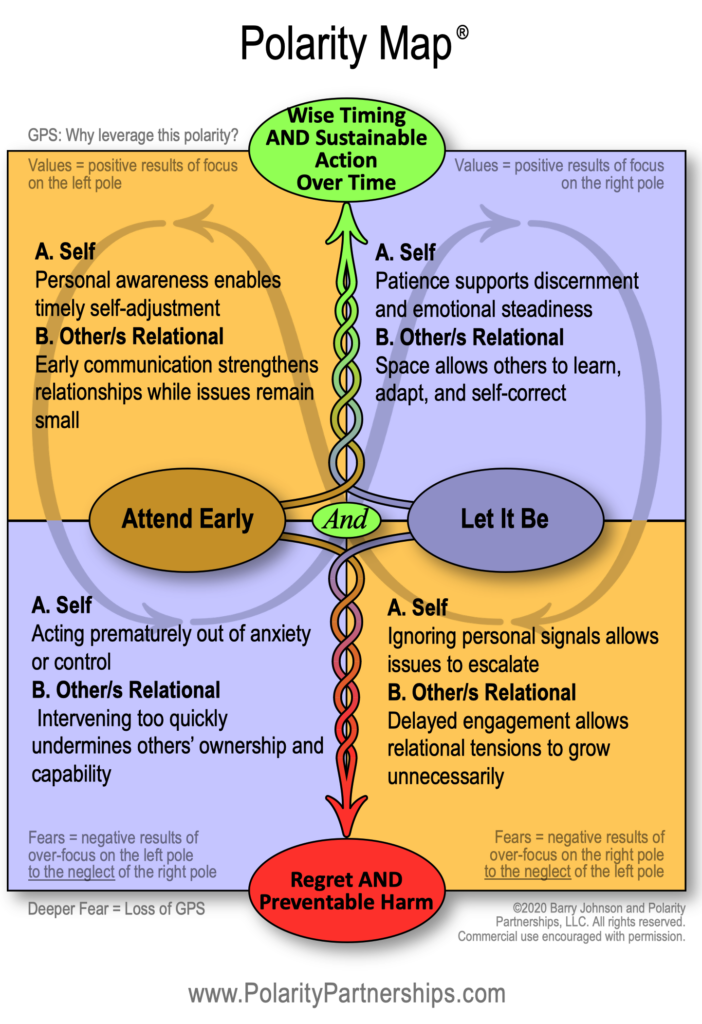
That tension—Attend Early AND Let It Work—shows up almost everywhere human beings try to live together: leadership, parenting, coaching, democracy, organizations, relationships, even in the relationship human beings are now developing with artificial intelligence itself.
When systems overfocus on Attend Early to the neglect of Let It Work, they gradually tighten. Every signal demands intervention. Every ambiguity triggers correction. Human beings slowly lose the capacity to self-organize because someone is always stepping in too soon. When systems drift too far toward Let It Work to the neglect of Attend Early, signals accumulate. Difficult realities remain unnamed long enough that eventually force becomes necessary simply because timely responsiveness never occurred earlier when the cost was still small.
That may be one of the deepest truths inside this chapter:
forcing often begins after delayed attention.
Most human beings prefer small truths emotionally postponed over larger truths eventually imposed.
The Tao seems far less interested in whether we appear proactive or patient than whether we are developing the discernment required to recognize which movement the moment is actually asking for.
That discernment feels increasingly important right now because modern life is becoming extraordinarily optimized for Attend Early while steadily losing capacity for Let It Work.
Artificial intelligence is accelerating that pattern dramatically. AI excels at detecting signals before human beings notice them: predictive alerts, behavioral monitoring, real-time escalation, optimization loops, constant feedback.
And initially, it feels impressive. Helpful. Responsible.
Until eventually every signal begins triggering another signal.
Organizations start monitoring everything because they suddenly can. Dashboards multiply. Notifications expand. Escalation loops tighten. Systems become hyper-responsive while the people inside them gradually lose confidence in their own discernment. Human judgment slowly starts getting outsourced to perpetual signaling systems that rarely sleep and never fully trust enough to stop scanning for anomalies.
Over time, people stop trusting what they already know. The signal before the spreadsheet gets drowned beneath the spreadsheet itself.
And something profoundly human begins weakening: the ability to sense when reality is already organizing itself without requiring constant intervention.
That pattern is showing up politically too.
Democracies rarely deteriorate all at once. They weaken through normalized signals repeatedly unattended to: attacks on institutions, disinformation, loyalty replacing competence, the erosion of shared facts, the concentration of power around personalities instead of principles.
Most of those signals appear long before systems fully fracture.
The challenge is that attending early often requires discomfort before urgency exists widely enough to force collective response. Human beings are remarkably capable of talking themselves out of what they already feel when the implications become inconvenient. At the same time, systems organized entirely around fear eventually lose discernment too. Constant intervention creates exhaustion. Hypervigilance degrades trust. Overcorrection generates instability of its own.
Healthy systems require both movements: responsiveness early enough to matter, and enough restraint to allow life to remain adaptive instead of perpetually controlled.
That balance is developmental work. It requires emotional maturity, embodied awareness, humility, patience, courage, and the ability to remain present inside uncertainty without reflexively forcing resolution simply to reduce personal discomfort.
The older I get, the more I suspect wisdom has less to do with certainty than with responsiveness. The capacity to notice reality while it is still speaking softly enough that force is not yet required.
That applies to bodies, relationships, organizations, leadership, democracies, technology, and whatever future human beings are currently building while pretending we are merely reacting to events already in motion.
The Tao Te Ching offers no guarantee that attending early prevents difficulty. Bodies still age. Relationships still fracture. Organizations still drift. Societies still move through periods of confusion powerful enough that future generations wonder how the signals remained ignored for so long.
Though the chapter does suggest something important: small timely movements often prevent larger forceful ones later.
And when intervention is no longer required, wisdom sometimes means allowing what is already healthy enough to continue unfolding without unnecessary control.
Attend early.
And when life is already moving well enough on its own, let it work.
The tree I hit is still standing.
I’m grateful I am too.
Here’s the interior portion of a Polarity Map for Attend Early AND Let It Work:
INVITATIONS:
How do Attend Early AND Let It Work show up for you right now?
Try the “AI-trained Chat w/Cliff for Step 1, Seeing, CLICK HERE.
Want to go deeper into Polarity Thinking? See our online self-directed Credentialing and Introduction to Polarity Practice, CLICK HERE.