

See the Series Introduction for Just Tao It, Part I: HERE
See the Just Tao It Series Introduction Tao/It on-ramp, PART II: HERE
See Just Tao It, Chapter 1: HERE
From my interpretation of the Tao Te Ching, Chapters 70 (Unpublished):
This wisdom is easy to see,
Simple to embody.
Yet so few
Know It,
Live It,
Or choose
To follow It.
How can something,
So enduring,
Remain
Outside our living?
To understand It,
To appreciate It,
To live It,
Is to honor It.
—
I grew up in Wheaton, Illinois, home of Wheaton College, one of the most influential evangelical colleges in the United States. During many summers I attended HoneyRock Camp, where wilderness adventures, leadership development, Scripture memory, and Christian discipleship shaped generations of young people, including me.
Looking back, gratitude comes easily.
HoneyRock taught resilience before I knew the word. Canoe trips through the Boundary Waters, nights beneath the stars, friendships, responsibility, leadership, and the beauty of the natural world left gifts I still carry. The camp also invited young people to wrestle with questions of meaning, purpose, service, and faith. Those were good gifts — ones that shaped my path toward outdoor experiential education and eventually toward Xperience, LLC and the sanctuary of Kayser Ridge.
HoneyRock also reflected something larger than itself. Like every enduring religious tradition, it carried remarkable strengths alongside enduring tensions: deep conviction living beside intellectual inquiry, vibrant community alongside the pull of exclusion, shared beliefs that sometimes left less room for honest questions than I now wish they had. None of that makes HoneyRock unusual. It makes it deeply human.
Over the years, Wheaton College has wrestled publicly with many of the same tensions now shaping the United States: tradition and change, authority and freedom, certainty and discovery, identity and belonging, faith and politics. Its history includes inspiring leadership, genuine self-examination, painful failures, and ongoing efforts to confront racism, nationalism, and the relationship between faith and political power. Those tensions belong to no single institution — they arise wherever deeply held beliefs become intertwined with identity, certainty, and power.
A particular memory stands out from my experience. When I was thirteen, one of our assignments was to choose a favorite Bible passage, memorize it, and present it publicly. It became one of my first experiences speaking before a group.
I chose Romans 7.
“I do not understand what I do. For what I want to do I do not do, but what I hate I do.”
I doubt I understood why those words captured me. I simply knew they were true. Fifty years later, they still are.
The distance between what I value and how consistently I live it remains one of life’s great teachers — the pull toward certainty, the temptation to judge others more generously than myself, the ease with which fear disguises itself as conviction, and the remarkable human capacity to recognize wisdom clearly and then choose something that contradicts it. Chapter 70 names all of that without flinching.
Years later I encountered the Tao Te Ching. Its language differed from Paul’s, but its invitation felt remarkably familiar. Lao Tzu wasn’t asking me to become someone else — he kept returning me to the same recognition Paul had already named: that wisdom is surprisingly easy to recognize, and living it asks much more of us.
I don’t think the deepest lesson HoneyRock taught me was about Christianity. I think it taught me something about being human. Every tradition begins with living experience. Over time that experience becomes teaching. Teaching becomes doctrine. Doctrine becomes identity. Identity seeks protection. Protection slowly gathers power. Somewhere along the way, the wisdom that first gave life begins asking to be defended. I’ve watched that happen in religion. I’ve watched it happen in organizations. I’ve watched it happen in myself.
This chapter has accompanied me for nearly forty years, and its opening words have never stopped unsettling me. When I first encountered Chapter 70, I wondered why wisdom seemed so difficult to find. Age slowly changed the question. Today I wonder why living wisdom remains so difficult — wisdom that is neither hidden nor rare, only consistently set aside.
Eventually I stopped seeing religion and politics as separate stories. I started recognizing the same human patterns unfolding in different settings.
For most of my life I thought democracy was primarily a form of government. I understand it differently now. Democracy is a human discipline, and it begins with a simple recognition: none of us sees the whole. That recognition shapes everything else.
The older I become, the less these tensions feel like choices. They feel like companions. Freedom keeps teaching me something about responsibility. Curiosity keeps humbling my convictions. Justice keeps sending me back to mercy. None seems to flourish for very long without the others.
Democracy belongs to the second category of challenges — those that call for stewardship over time. No generation gets to finish it. Every generation inherits it, and every generation decides how faithfully it will be practiced.
The United States is living through one of those moments. I have gradually come to experience our greatest danger in the pattern that emerges whenever certainty becomes more important than truth, winning becomes more important than wisdom, and power begins separating itself from responsibility. Throughout history those patterns have appeared wearing many uniforms, carrying many flags, speaking many languages, and defending many ideologies — their stories differ, but their invitation has remained remarkably consistent: “Trust us. Fear them. Only we can save you.”
Democracy asks something much harder: to think, to question, to listen, to participate, to accept correction, to protect the freedom of people whose conclusions differ from our own, and to remain committed to one another even after the disagreement. That discipline is demanding, and it is also one of humanity’s most remarkable achievements.
When President Donald Trump challenged birthright citizenship through executive order, my attention moved far beyond a constitutional dispute. The Fourteenth Amendment reminded me that enduring institutions often protect more than the specific cases they were designed to address. Thomas Paine understood what was at stake when he wrote, “In America the law is king.” Abraham Lincoln understood it when he called for a reverence for law strong enough to become our nation’s “political religion.” Martin Luther King Jr. understood it when he chose to stand inside the American experiment and demand that its promises be kept. Different centuries, different struggles — the same enduring recognition: there are things that must be stewarded faithfully, and honoring something larger than ourselves is what that stewardship requires.
I wish I could say I always meet that invitation well. I don’t. There have been seasons when I cared more about winning arguments than understanding another human being, moments when my certainty outpaced my curiosity, and times when I reduced people to categories and lost interest in their actual experience. Every one of those moments diminished my own capacity for wisdom before it diminished anyone else’s.
Chapter 70 keeps returning me there — its challenge has become wonderfully personal. The chapter never asks whether wisdom exists. It asks whether I will live it.
Artificial intelligence has made that question even more urgent. Knowledge has become astonishingly accessible, opinions arrive instantly, and certainty has become remarkably inexpensive. Discernment still grows through experience, character still develops through practice, and wisdom still asks something only human beings can choose. How shall we live together?
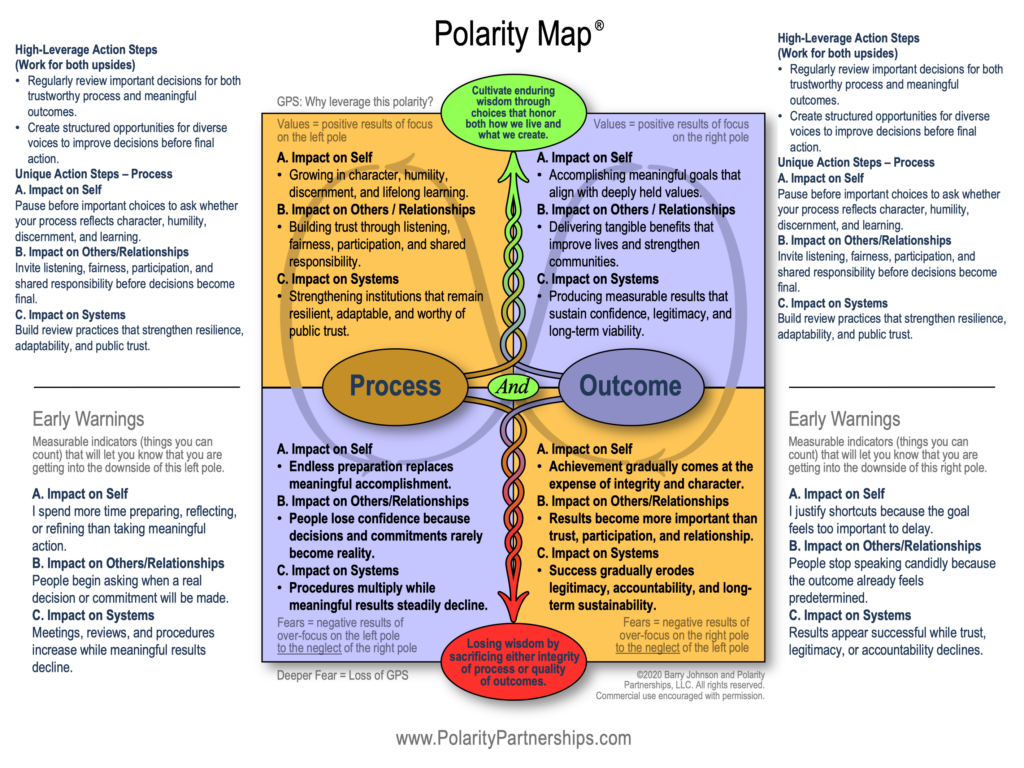
Years later Barry Johnson gave me language for something I had already been living. My life’s work has gradually convinced me that enduring wisdom grows through relationships that strengthen one another over time. That is why the accompanying Polarity Map explores Process AND Outcome — the recognition that healthy democracies, healthy religious traditions, healthy organizations, healthy teams and families, and healthy human beings need both. When process serves outcome, something endures. When outcome overrides process, the win gradually loses what made it worth winning.
Common sense has never been our greatest challenge. What we already know has always been harder to live. Simple, not easy — that is why Chapter 70 has remained one of my closest companions for nearly four decades. Every time I return to it, the words feel familiar. Every time I return to my own life, I discover another place where they are still asking something of me. That feels less like failure than invitation. It also feels like the work of a lifetime.
Here’s a Polarity Map for Process AND Outcome:
 INVITATIONS:
To use an AI-trained “Chat w/Cliff” for Step 1, “Seeing” CLICK HERE.
Ready for the Polarity Advantage? Go deeper into Polarity Thinking, see our online self-directed Credentialing and Introduction to Polarity Practice or in-person training with Barry Johnson and me at Kayser Ridge by CLICKING HERE.