

See the Series Introduction for Just Tao It, Part I: HERE
See the Just Tao It Series Introduction Tao/It on-ramp, PART II: HERE
See Just Tao It, Chapter 1: HERE
From my interpretation of Chapter 71 of the Tao Te Ching (Unpublished):
Seeing that you don’t know
is brilliance.
Not seeing that you don’t know
is blindness.
To know is to see.
To see
is to be.
The way to brilliance
is patient.
—
There was a stretch in my career where I was pretty sure I knew what organizations needed.
Relationships.
Not casually. Not as one factor among many. I had seen enough damage from Task to the neglect of Relationship that it felt obvious where the problem was. People weren’t listening. Trust was thin. Culture was brittle. Decisions were getting made, but they weren’t holding. So I leaned in.
Hard.
I slowed things down. Opened conversations. Made space for voices that weren’t being heard. Pushed for understanding, connection, inclusion. And for a while, it worked. People felt seen. Something in the system opened.
It probably didn’t help that I’m an INFP on the MBTI—one of those personality types wired to value meaning, empathy, and connection, sometimes to the point where the work itself starts to look like a secondary concern. Useful in some moments. Less so in others. And if you’re familiar with the model, you won’t be surprised to hear that more than a few of the people I was locking horns with leaned ESTJ—wired for structure, clarity, and getting things done—sometimes to the point where relationships start to look like a distraction. It wasn’t an accident. It was a polarity playing itself out in real time.
And then something else began to show up.
The work itself started to drift. Decisions took longer. Clarity blurred. What felt like depth to me started to feel like distance to others. The same people who had been frustrated by too much Task began reacting to what looked, to them, like too much Relationship.
They weren’t wrong.
What I couldn’t see at the time was how invested I had become in one side of the tension. Their blindness to the downside of Task without Relationship was probably only matched by my blindness to the downside of Relationship to the neglect of Task. We were reinforcing each other, each of us certain we were correcting the problem.
And it wasn’t just us.
I’ve seen entire systems do the same thing—swinging hard from one side to the other in an effort to self-correct. A Task-focused leader replaces a Relationship-focused one. Then a Relationship-focused leader replaces a Task-focused one. Each shift intended to fix what the last one got wrong.
The only thing that really changes is the scale of the dysfunction—and the level of cynicism that comes with it.
That’s a humbling realization.
And it’s worth remembering something else.
We were doing all of that without AI.
The pace was different. The pressure was different. The number of inputs, the speed of responses, the volume of “answers” available at any given moment—none of it looked like it does now. The tension between Task AND Relationship was already hard to navigate. It required attention, discipline, and a willingness to stay with what didn’t resolve.
That hasn’t gone away.
But it has changed.
Seeing that you don’t know is brilliance.
Not because you suddenly become more capable, but because you begin to notice how your certainty has been shaping what you’re able to see. What you were using to fix the system was also narrowing your view of it.
At some point, the question changes.
Not “What’s the right answer?”
But “What might I be missing?”
That shift doesn’t feel like progress.
It feels like hesitation. Like losing your footing. Like stepping back from something that used to feel clear. You reach for the answer and find yourself pausing instead—not because the answer isn’t there, but because you’re no longer convinced it’s complete.
That takes patience.
Not the kind that waits things out, but the kind that stays engaged while something more complete takes shape. The kind that lets the tension keep working on you instead of rushing to settle it.
That’s harder to do right now.
We’re surrounded by answers.
You don’t have to look far to see it. You ask a question, and something comes back in seconds. It’s clear. Structured. Confident. You feel the pull to use it, to move, to decide. Most of the time, it’s good enough to act on.
That’s the moment.
Not when the answer arrives, but when you decide whether to move with it or stay with it.
Because what’s easy to miss is how quickly speed starts to shape judgment. The faster the answer, the less space there is to question it. The less space there is to ask what might be missing, who might be impacted, what this looks like over time.
And that’s not a technology problem.
It’s a human one.
And it changes the nature of the tensions we’re already living inside.
Task AND Relationship doesn’t go away.
But now Task can accelerate faster than Relationship can absorb. Decisions can be made before they’re understood. Direction can be set before it’s shared. The system can move before people are ready to move with it.
And when that happens, the same pattern returns—just faster, and with more reach.
What used to take months can now happen in days. What used to show up in one team can now ripple across an entire organization. The imbalance doesn’t just repeat. It amplifies.
Which means the familiar tensions aren’t just still here.
They’re under new pressure.
And it’s not just Task AND Relationship.
It’s Speed AND Quality. Efficiency AND Trust. Innovation AND Stability. Individual Insight AND Collective Understanding. Human Judgment AND Machine Capability.
These are not new tensions.
But they are showing up in new ways, in real time.
And they don’t give us the luxury of learning slowly.
Which makes patience more—not less—important.
Speed doesn’t replace seeing.
If anything, it raises the stakes.
Because the work isn’t producing answers. It’s knowing what to do with them. It’s recognizing where they apply, where they don’t, and what they leave out. It’s holding the tension between what is technically possible and what is humanly responsible.
That tension shows up in ways that are hard to ignore.
In how we handle conflict—whether we move through it or try to bypass it. In how we communicate—whether we listen to understand or move too quickly to respond. In the cultures we shape—whether they can hold difference or narrow around certainty. In how we approach change—whether we force movement or work with what is already moving.
It shows up in democracy, where the process is slower, more contested, and often frustrating. It doesn’t move at the speed of certainty. It moves at the speed of people working through differences that don’t go away. The temptation is to replace that process with something faster and more decisive.
But something important is lost when we do.
Not efficiency.
Trust.
It doesn’t break all at once. It shows up in smaller ways first. Conversations get shorter. Questions get fewer. People stop challenging what doesn’t feel right because things are moving too fast to interrupt. What looks like alignment is often just acceleration.
And over time, that becomes something else entirely.
Decisions get made faster.
But they hold less.
The same pattern shows up in the work that matters most.
How we respond to a changing climate. How we build trust across difference. How we make decisions that don’t just work now, but still make sense later. These aren’t problems that improve with faster answers alone. They require staying with questions long enough to understand what’s actually being asked of us.
And that’s where patience becomes less comfortable—and more necessary.
Not just individually, but collectively. Not just in what we know, but in how we come to know it. The kind of learning that strengthens Inner Development AND Outer Impact at the same time. The kind that allows what we build to actually hold, not just in the moment, but over time.
That doesn’t come from having the right answer.
It comes from staying with what we don’t yet understand long enough for something more complete to take shape.
There’s a different kind of confidence that begins to emerge there.
Not certainty. Not speed. Not having the answer first.
Something steadier.
A willingness to stay with what isn’t resolved long enough for something more complete to take shape. To act when it’s time to act, and to pause when pausing is what allows the work to hold.
That’s a different expression of brilliance.
And it takes patience.
More than most of us are used to. More than most systems reward.
But over time, it’s what allows something to hold.
And when it does, the decisions begin to hold with it.
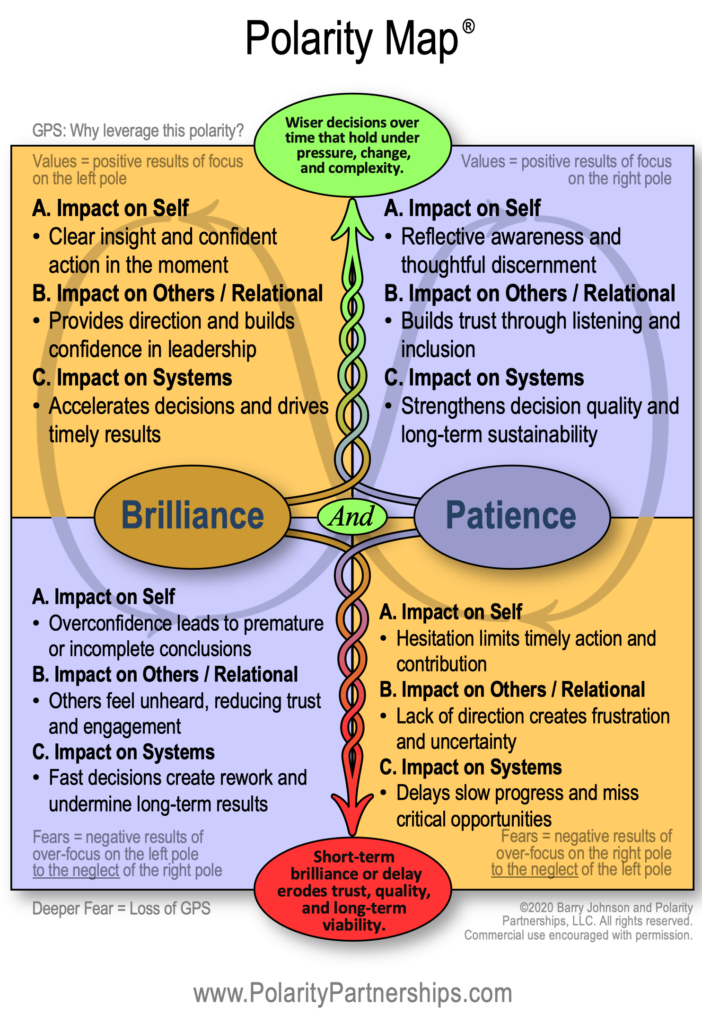
Here’s a Polarity Map of Brilliance And Patience to support seeing the pattern.
INVITATIONS
How do you make decisions under uncertainty, over time? To take a short Polarity Assessment based on the Strength And Flexibility polarity, CLICK HERE
NOTE: the results include Leveraging Action Steps and Early Warnings (to support maximizing upside benefits and minimizing downside limitations).
To use an “AI-trained Chat w/Cliff for Step 1, Seeing” CLICK HERE.
Ready for the Polarity Advantage? Go deeper into Polarity Thinking, see our online self-directed Credentialing and Introduction to Polarity Practice or in-person training with Barry Johnson and me at Kayser Ridge by CLICKING HERE.