

See the Series Introduction for Just Tao It, Part I: HERE
See the Just Tao It Series Introduction Tao/It on-ramp, PART II: HERE
See Just Tao It, Chapter 1: HERE
Chapter 74 — Value Over Fear
When people
will die
for what they value,
threats
have no hold.
When values
yield to fear,
death
takes hold.
Between
value and fear—
choices.
Something lives.
Something dies.
—
From It: Forty Years in Conversation with the Tao Te Ching by Cliff Kayser, an interpretive rendering of the eighty-one chapters. XperienceIT Press, 2026.
—
There are moments in life when no one else can answer for us. Most never become headlines or history. They unfold in ordinary conversations, private disappointments, unexpected opportunities, and decisions no one else even knows we made. Those moments have shaped my life far more than I once recognized.
For many years I thought Chapter 74 was about courage. Living with it gradually changed my understanding. I experience it now as a chapter about choice. Every day asks something of us. A few choices become turning points history remembers. Most become part of the person we are becoming long before we recognize their significance. One question eventually settled more heavily than the others: whether my choices increasingly resembled what I claimed to believe.
At thirteen, many of my convictions came from the people and institutions I trusted. At twenty-three, I searched for mentors, traditions, and books that seemed wiser than I was. By my thirties, experience had begun revealing the distance between what I declared I valued and how I lived in practice. During my forties and fifties, that distance became undeniable. Now, at sixty-three, I find myself returning to a much simpler question:
Who is choosing the life I am living?
That question has become increasingly compelling as our world has grown louder. Every day someone is prepared to tell us what to think, what to fear, what to buy, who to blame, and how to respond. Artificial intelligence has joined that chorus, offering extraordinary access to information while increasing the importance of wisdom and discernment. Information has never been more available. Choosing how to live remains profoundly personal.
I spent much of my adult life looking outside myself for answers. Sometimes I found genuine teachers. Sometimes I simply found people who sounded more certain than I felt. Wisdom can be shared, challenged, encouraged, and refined. Choosing how to live cannot be delegated.
As I lived longer with Chapter 74, I began recognizing that several enduring polarities live within these few lines: Integrity AND Security, Courage AND Prudence, Purpose AND Protection, Power AND Love, and Justice AND Mercy. Each mapped real terrain. One relationship continued drawing me back:
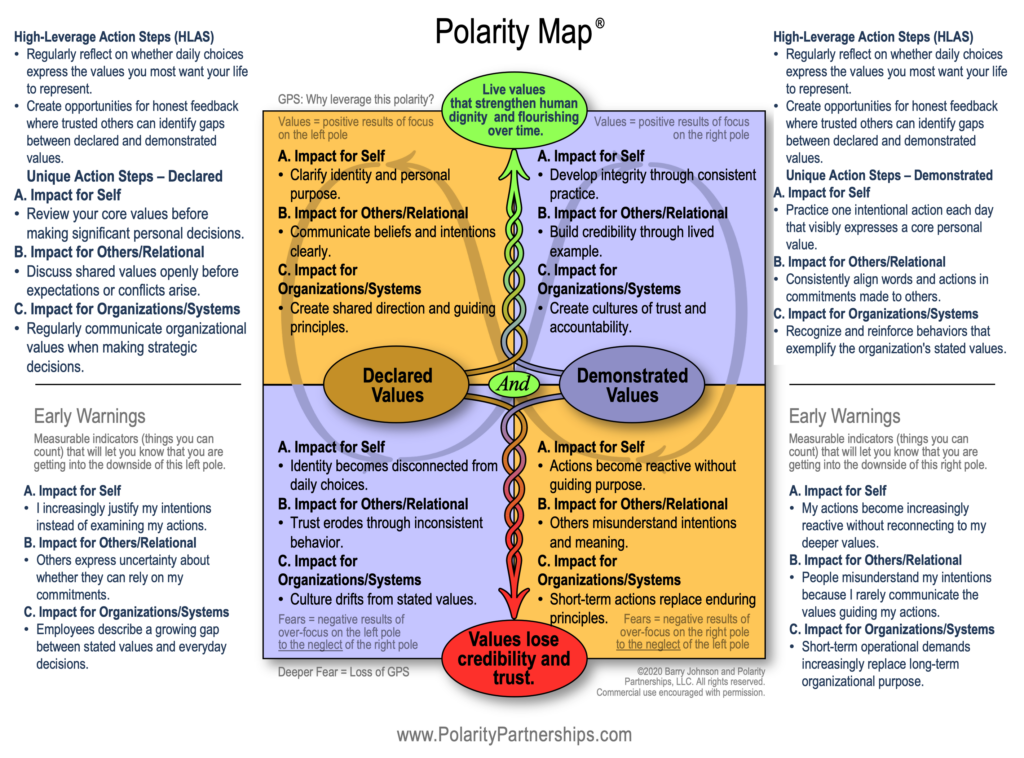
Declared Values AND Demonstrated Values.
The gap does not open all at once. It opens through small choices that feel reasonable in the moment. The hook is almost always the same: we become so attached to who we believe we are that we grow blind to what we are doing. We defend the declared version of ourselves with increasing conviction. We begin projecting the distance onto others. By the time the gap becomes visible, we have often been living with it for years.
The Greater Purpose became clear: to live values that strengthen human dignity and flourishing over time. The Deeper Fear named itself just as clearly: our values lose credibility and trust. Every time my Declared Values and Demonstrated Values grow closer together, something lives. Every time they drift apart, something begins to die.
The night this chapter began finding its way into language, I woke with the feeling that something had been received.
Earlier that day I had been reading a draft of Gemma Jiang’s forthcoming book exploring polarities through life, death, grief, healing, and love. Several days earlier, Nicolas and Vera, the two newest members of the Kayser Ridge community, had invited me into a beautiful weekend ritual honoring the Past/Present AND Present/Future—celebrating the first twenty-five years of Kayser Ridge while preparing for whatever comes next. I went to sleep with Lao Tzu, Gemma’s manuscript, the joy of that weekend, physical pain from surgery, and a lifetime of unfinished questions all moving through me at once. I woke with an experience I can only describe as unconditional love.
I have called that experience by different names at different ages. The names have changed. The experience has deepened.
Chapter 74 gradually became more than metaphor for me. The convergence it describes lives in nature, history, and civic life. It lives equally in the space between my own values and fears, and yours. It is in every relationship, organization, nation, and generation.
The poem’s closing lines started landing differently after that night:
Between
value and fear—
choices.
Something lives.
Something dies.
Every choice feeds something. Dignity or fear. Repair or grievance. Love or resentment. We never feed only ourselves. Every choice participates in the life of something larger.
I live only a few miles from Arlington National Cemetery. Every drive to Kayser Ridge takes me past those fields of white headstones. Each marker represents a story I can never fully know. Together they seem to ask something of anyone willing to pay attention: Were the freedoms that made this possible received faithfully? Are they being returned as responsibility?
History remembers people who faced the question Chapter 74 is asking at a scale most of us will ever encounter. The people I most admire were shaped by that same space between value and fear.
Martin Luther King Jr., Medgar Evers, and Steve Biko held the cause of racial equity when holding it came at mortal cost. Berta Cáceres, Malala Yousafzai, and Farkhunda Malikzada held the dignity of women when those in power would rather they had not. Harvey Milk, Marielle Franco, and David Kato refused to become invisible when visibility carried real danger. Judy Heumann and Brad Lomax occupied the Department of Health, Education, and Welfare in 1977 for twenty-six days because the alternative was accepting that their humanity was negotiable. Maggie Kuhn started a movement when the culture expected her to step back and disappear.
Their lives were larger than the way they died. They were people before they became symbols. They loved. They laughed. They were tired. They made mistakes. They belonged to families, friends, movements, communities, and histories. Their courage mattered because their lives mattered.
Each of them, in their own context, discovered the condition Chapter 74 is describing. Threats lost their hold because something else held more.
Willingness to die for what we value grows from willingness to live for what we value. The willingness gets practiced long before the ultimate circumstance arrives. It is practiced every day in small truths told, difficult conversations, loyalties kept, dignity defended, accountability accepted, forgiveness offered, and moments when fear rises and we still remember who we are.
That is where unconditional love re-entered this chapter for me. Love is the ground from which courage becomes something more than performance. Courage without love can harden. Justice without love can punish beyond repair. Resistance without love can become contempt. Love without courage can turn sentimental and avoid the cost of standing. The people I most trust did more than oppose something. They loved something enough to stand where fear had power.
That recognition also softened something in my own relationship with the language I inherited. God, Jesus, sin, salvation, forgiveness, grace, unconditional love—these words carried different meanings for me at different ages. At sixty-three, I am less interested in defending any particular word and more interested in trying to live faithfully with the truth of experience beneath it. Love that does not require perfection before offering belonging has become more real to me than many explanations I once tried to make work.
Before those words could settle on the page, I knew my own failures belonged in the sentence.
I have caused harm. I have missed moments. I have hidden behind intelligence, urgency, good intentions, and polished language. I have needed forgiveness more often than I have known how to ask for it. Shame can become another form of fear if it takes hold of the whole person. Love makes accountability possible because it gives the self enough ground to face the truth. Forgiveness matters because something can live again after something else has died.
I have asked myself what I would risk for the values I say I hold. That question has become less theoretical with age. My body hurts most days. Some mornings it takes real effort to stand long enough to brush my teeth. Other days I can swim for an hour or do a Tai Chi practice and feel almost astonished by the grace of movement. Pain has made the finite nature of doing life normally harder to ignore. So I write in the window available to me.
I love my life. I love my partner, Tracy. I love Kayser Ridge. I love my friends, colleagues, students, clients, and the many communities that have shaped me. I love the work still unfinished. That love is precisely what makes Chapter 74 demanding. If I claim to love democracy, dignity, truth, and human freedom, the love must eventually become more than sentiment.
Barry Johnson’s life’s work gave me one way to practice what Chapter 74 continues teaching me. The Polarity Map that follows became less an explanation of the chapter and more a discipline for living it.
Every generation inherits democratic institutions built by people who made choices resembling the ones Chapter 74 describes. Those institutions hold when enough people inside them continue choosing truth over convenience, accountability over loyalty to any single figure or faction, and the long preservation of a system over the short protection of an advantage. Democracy is not self-sustaining. Freedom of conscience, equal dignity, due process, and peaceful transfer of power all depend on people willing to receive them as inheritance and return them as responsibility.
The same reality extends into organizations, communities, families, and friendships. Every relationship that has lasted through difficulty has required, at some point, that someone say what was true when silence would have been easier.
Chapter 74 moved from being one I was trying to Cliff-splain into one that ended up splaining me. It asks a great deal about what is governing my life when the cost of integrity becomes real.
Lao Tzu ends with a spare precision I have lived with for forty years without exhausting:
Between
value and fear—
choices.
Something lives.
Something dies.
I do not know what the years ahead will ask of me. I know they will ask something. Chapter 74 has become less a poem I interpret and more a companion returning to the same question whenever value and fear meet. I hope, when that moment comes, to recognize it.
Something lives.
Something dies.
Here’s a Polarity Map for Declared Values AND Demonstrated Values:
INVITATIONS:
To use an AI-trained “Chat w/Cliff” for Step 1, “Seeing” CLICK HERE.
Ready for the Polarity Advantage? Go deeper into Polarity Thinking, see our online self-directed Credentialing and Introduction to Polarity Practice or in-person training with Barry Johnson and me at Kayser Ridge by CLICKING HERE.
NOTES:
This essay is part of Just Tao It, an eighty-one-part series placing the chapters of the Tao Te Ching in conversation with contemporary life and Polarity Thinking.
The complete source text is published in It: Forty Years in Conversation with the Tao Te Ching by Cliff Kayser, the first book from XperienceIT Press. ISBN 978-1-971394-00-8