


See the Series Introduction for Just Tao It, Part I: HERE
See the Just Tao It Series Introduction Tao/It on-ramp, PART II: HERE
See Just Tao It, Chapter 1: HERE
From my interpretation of the Tao Te Ching, Chapter 80 (Unpublished):
The grand country,
Feels tiny.
Weapons are kept.
Unused.
Food
Satisfies.
Clothing
Suffices.
Homes
Hold peace.
Neighbors’ roosters,
crow.
Dogs
bark.
No concerns.
—
In 2012, I had a catwalk built to replace the steep, rocky footpath leading to the upper deck at Kayser Ridge. Most mornings, I make my way across what has become known as the “bridge to the ridge” to greet the sunrise with a Tai Chi practice. I savor each step. As I reach the top, the trees gradually give way to open sky, and just after the sun crests the farthest mountain ridge, a rooster crows. Moments later, a dog answers with a bark, as if the two have their own dawn ritual.
I’ve never seen the rooster. I’ve never met the dog, or the neighbor who lives somewhere down in the valley. I simply know they’re there, beginning their day while I begin mine. Every morning, that exchange brings Chapter 80 to mind…and a smile.
I didn’t arrive at Tai Chi peacefully. Long before Tai Chi, there was Kramer, a bigger kid a few streets over from the neighborhood I usually explored on my bike in Wheaton, Illinois. One afternoon he stopped me, grabbed my handlebars, smiled, and twisted the bike with me on it onto the pavement. Hard. The other kids watched and laughed. Then he picked up my bike, rode off, and deliberately crashed it into a tree.
I rode the mangled bike home in tears. Somewhere along the way, I pulled into the path of an oncoming car. Screeching tires. A blaring horn. I didn’t get hit, but I still ended up hitting the pavement for the second time in less than ten minutes. The young driver sped away letting profanity-laced insults loose out his window.
For a while, my version of justice was Batman. Before the fight scene, I’d build the villain out of couch cushions. Whoever took the beating in that pillow pile, some part of me knew exactly who he was. Kramer wasn’t the last bully I encountered, although he became the face of many. After that, he seemed to show up everywhere and when I least expected.
Then came the martial arts. The first style I studied had a harder edge, shaped for a kid determined that would never happen again. Years later, I found my way to something very different — Tai Chi, moving meditation, the martial art that spends most of its energy learning not to need the rest of it.
Somewhere along that journey, I began smiling. I would catch myself grinning on the walk across the bridge before the sun had cleared the ridge, listening for a rooster I’ll probably never see.
I wrote about the harder edge of this elsewhere in this series — a Kung Fu teacher who trained character before he trained technique, and the rule underneath every serious martial tradition I’ve studied since: the more capable you become of causing harm, the more responsibility you carry for making sure it never happens.
Tai Chi asks for something different. There’s no fight held in reserve. The reserve is the whole practice.
Weapons are kept. Unused. The country in the poem has outgrown the need to prove itself. The same is true of the rooster and the dog. Two households, close enough to hear each other’s mornings, with no need to knock on each other’s doors.
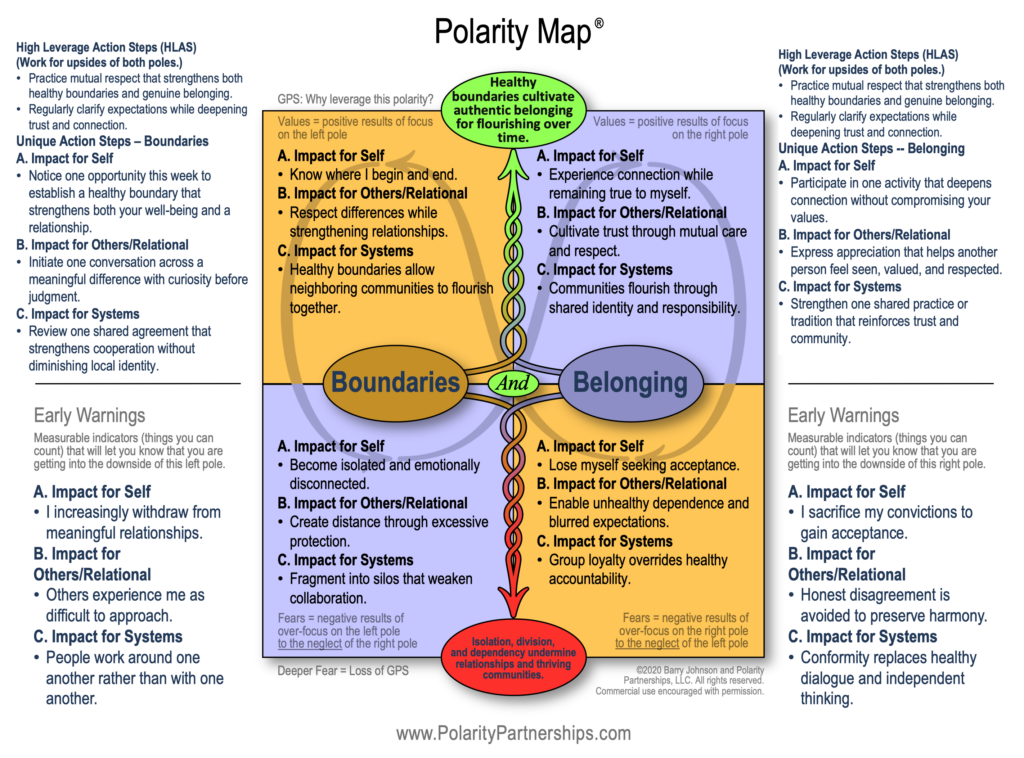
A bully understands none of this. I learned that early, from the wrong side of it. What a bully can’t tolerate is exactly what Chapter 80 protects: another life, close by, that doesn’t need him. Bullying is the absence of belonging, dressed up as dominance. It’s a person, or a country, that has never learned to be content inside its own walls, and so goes looking for someone else’s peace to disturb, just to prove it’s still there. Two things holding each other up, then: Boundary And Belonging. Neither survives long without the other.
The poem’s first line is the one that does the most work: The grand country, feels tiny. A country’s size on a map has never determined whether it can behave like two neighbors within earshot of each other’s rooster — content in its own walls, armed and unbothered about it, in no hurry to cross anyone else’s line. Empires fail that test at every size. So do bullies. So, most days, do I, if I’m honest about it.
Yuval Noah Harari makes a related observation about nations: healthy nationalism extends belonging beyond the people we know personally, and the willingness to support schools, hospitals, and roads used mostly by strangers depends on a shared story larger than any of us. Chapter 80 imagines that same possibility from the other direction — a neighbor learning to hear another neighbor’s rooster without needing it to become his own, long before a nation learns to feel small enough to live peacefully beside another.
A boundary can be the thing that lets two lives belong to the same peace without either one ever needing to prove it. After twenty-five years on that ridge deck, I still don’t know whose rooster that is. Neither of us seems troubled by that.
Here’s a Polarity Map for Boundaries And Belonging:
INVITATIONS:
To use an AI-trained “Chat w/Cliff” for Step 1, “Seeing” CLICK HERE.
Ready for the Polarity Advantage? Go deeper into Polarity Thinking, see our online self-directed Credentialing and Introduction to Polarity Practice or in-person training with Barry Johnson and me at Kayser Ridge by CLICKING HERE.