

See the Series Introduction for Just Tao It, Part I: HERE
See the Just Tao It Series Introduction Tao/It on-ramp, PART II: HERE
See Just Tao It, Chapter 1: HERE
From my interpretation of the Tao Te Ching, Chapter 72:
Leaders who cannot see reality,
lead followers to calamity.
Refusing illusion,
people keep their way.
Learn from many.
Follow no single one.
In learning to know,
make wisdom, not show.
From my interpretation of the Tao Te Ching, Chapter 75:
When burdens become too heavy,
people become hungry.
When a few take from the many,
people grow weary.
Governing people becomes impossible
when power forgets people.
Tend roots.
Trust and respect
bear fruit.
—
I have an active cacophony of inner leader voices that struggle with reality. Some are very confident. Several have advanced degrees. A few possess specialized knowledge and skills. One insists that pushing harder will settle the body’s complaining. Another is convinced that if it can explain things clearly enough, life will automatically cooperate. Oh, and there’s the one who absolutely insists that moral outrage is the same thing as useful contribution. They are all very busy, very important, and very sure of themselves. None scores particularly high on the wisdom scale.
I try to smile at all that noise because I know my inner government operates a lot like the unelected representatives in my personal democracy. Every voice believes it deserves to be heard. None wants to be told what to do—or how to do it.
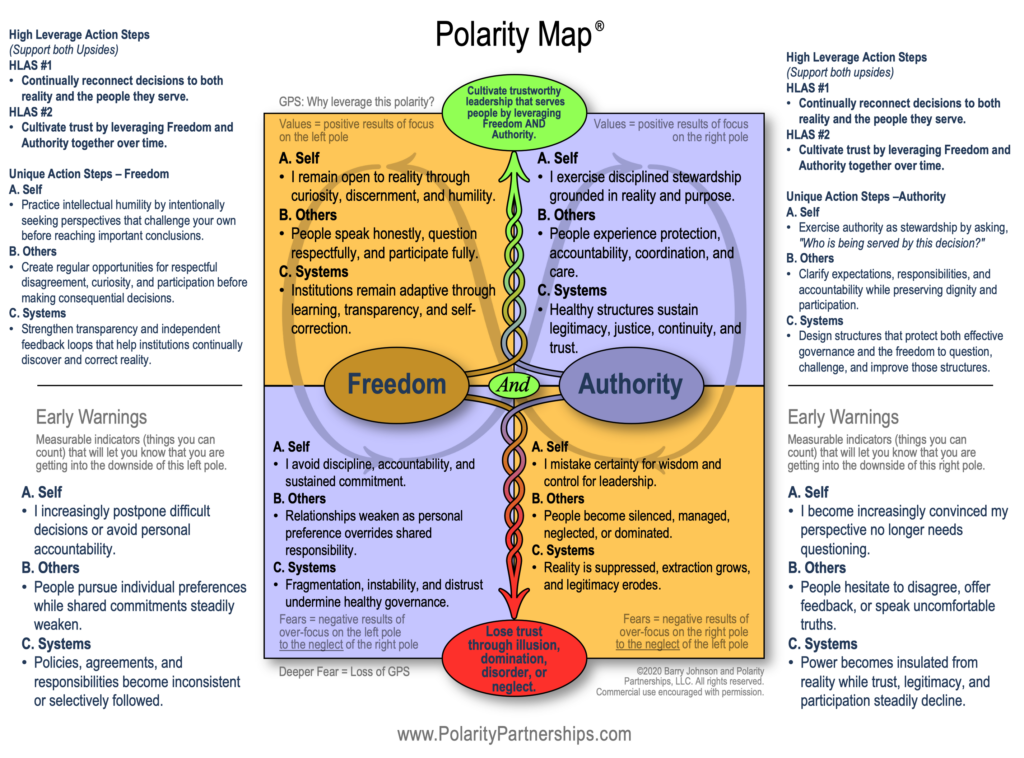
That’s Chapters 72 and 75 before I get anywhere near actual democracies, AI, or anyone else’s failures of leadership. Freedom And Authority live inside me first. Too much inner Authority to the neglect of Freedom becomes rigidity, self-control, repression, and fear of deviation. Too much inner Freedom to the neglect of Authority becomes drift, indulgence, avoidance, and lack of follow-through. A life worth trusting requires both — enough Authority to remain faithful, enough Freedom to remain alive.
I rarely combine two chapters of the Tao Te Ching in one Just Tao It reflection. The last time was Chapters 40 and 34, which seemed to belong together because one revealed the movement of return and the other revealed the unclaimed generosity of It. I feel the same linkage between 72 and 75 — two distinct movements that complete one another.
Chapter 72 begins with reality. Leaders who cannot see reality lead followers to calamity. Refusing illusion, people keep their way. It never mentions rights, votes, or institutions. It starts closer to the bone: can a leader see what’s really there? Can people refuse illusion without becoming self-righteous? Can wisdom grow without becoming a show?
Chapter 75 begins with people, not authority. When burdens become too heavy, the people become hungry. When a few take from the many, people grow weary. It doesn’t open with structures of governance. It opens with what governance is for.
Once I saw that, the whole shape of these two chapters changed for me. Freedom And Authority remained the central polarity, while reality and illusion emerged as lenses through which I began seeing it. Freedom keeps the door open for reality to be questioned, explored, spoken, and corrected. Authority keeps the door open for people to be protected, coordinated, and served. Lose Freedom, and reality becomes managed instead of discovered. Lose Authority, and people become neglected instead of served.
Chapter 72’s caution about wisdom becoming a show has grown more meaningful to me over time.
Learn from many.
Follow no single one.
In learning to know,
make wisdom,
not a show.
Discernment isn’t the same as overblown certainty, and humility isn’t the same as self-doubt. The chapter asks something harder of us: to remain in relationship with reality even when it refuses to fit into simple explanations or tidy conclusions.
Chapter 75 asks something just as unglamorous.
Tend roots.
Trust and respect
bear fruit.
It has no interest in demanding trust or announcing respect. It only tracks what grows, over time, from what’s been tended.
I know this pattern in my own body, not just my own inner-committees. My spine has spent years generating instructions my nervous system couldn’t follow without a fight — decades of scoliosis, on top of two surgeries, and a recent mountain-biking accident that added a fractured vertebra and an arterial dissection to the ledger. For a long time, the authority running that system knew what it wanted and had stopped listening to what it was governing. My own authority had forgotten my own people. It took a body that finally refused to comply for the two to start speaking again.
That feels painfully current, and also much larger than current events. The obvious application is democracy, especially in the United States right now, and I feel that pull — some days in my spine, some days in my gut, some days in whatever part of me still believes grown adults entrusted with public authority should be able to tell the truth, accept reality, care about people, and avoid turning every institution into another weapon in the service of domination. This pattern is older and wider than any single election cycle, though. It lives in governments, corporations, faith communities, families, universities, markets, media systems, and increasingly, AI.
Whenever authority loses relationship with reality, illusion grows. Whenever authority loses relationship with people, legitimacy erodes. Whenever people lose trust that authority serves anything larger than itself, respect cannot be commanded back into existence.
Barry Johnson gave us a disciplined way of seeing Both/And—the recognition that many of life’s enduring challenges aren’t solved once and for all; they are leveraged over time. Bill Benet extended that insight into one of humanity’s oldest and most fragile human experiments. After decades in politics, activism, and doctoral research, Bill concluded that healthy democracy depends on continually leveraging five enduring value pairs: Freedom And Authority, Justice And Due Process, Diversity And Equality, Human Rights And Communal Obligations, and Participation And Representation. Lao Tzu revealed the living pattern nearly twenty-five centuries before either of them gave us language for seeing it. Together, Barry, Bill, and Lao Tzu reveal interdependency itself as one of reality’s enduring gifts.
Those questions matter even more in a world where illusion can now scale at light speed. Yuval Noah Harari has described democracy as an open conversation with self-correcting mechanisms — free press, independent courts, universities, elections, public accountability. None of them perfect; all of them necessary, because they let reality back into the room when illusion starts to win.
Freedom protects reality by keeping dissent, discovery, press, protest, inquiry, conscience, and correction alive. Authority protects people by providing continuity, coordination, law, protection, accountability, and public trust. When either one starts protecting itself instead of what it was meant to protect, both reality and people lose a guardian.
Chapter 75 doesn’t need a long theory of extraction, which is why I think it lands with such simple and profound force. It simply observes what happens when burdens grow too heavy and power forgets the people. People become hungry. People grow weary. Governing becomes impossible.
When power takes more from people than it returns in protection, nourishment, dignity, and possibility, people eventually know, even if they don’t all use the same language and even if they’re persuaded to blame one another for a while. Living systems register extraction — families, workers, communities, nations, all of them, the same way a body knows when it’s being overused. Ignore that long enough and eventually it shuts things down, but I digress.
This is why I see Chapters 72 and 75 as partners. Illusion allows extraction to continue longer than it should; extraction creates the hunger and weariness that make illusion more tempting. Leaders who cannot see reality lead followers to calamity. Power that forgets the people makes governing impossible. The two chapters form a loop, and we are living inside that loop in more places than the obvious one.
In AI, authority is taking a new form, and I think that’s the more accurate way to say it: AI isn’t just becoming a smarter tool — it’s becoming a form of authority. Systems recommend, rank, summarize, predict, persuade, and increasingly act, without needing to hold office to exercise influence, a throne to shape attention, or a uniform to reorganize human behavior. Authority used to require a body — a ruler, a court, a congregation, a boss. This one doesn’t, which is exactly why Chapter 75 stops being ancient the moment you apply it here. Power forgets the people whether it exploits them outright or simply makes them less capable of participating in their own lives, and a system built to serve convenience, profit, speed, surveillance, and scale can forget the people just as thoroughly as any king. And more efficiently.
Can we build forms of authority powerful enough to coordinate large-scale life while preserving enough Freedom for people to remain discerning, responsible, creative, and awake? Harari’s warning about digital dictatorships deserves attention because technology can now make centralization far more efficient than it was for the fascist and communist regimes that lacked sufficient self-correction. Democracy survived the twentieth century partly because distributed conversation, independent institutions, and the freedom to challenge power created better error-correction over time. AI and big data are changing the informational conditions beneath that advantage, which means democracy has to develop. So do we.
None of this is an abstraction in Bill Benet’s frame — these are practices. Freedom isn’t merely doing whatever I want regardless of the cost to anyone else. Authority isn’t merely the power to command because you can. Healthy Freedom protects human dignity, conscience, participation, inquiry, and dissent. Healthy Authority protects order, continuity, accountability, public safety, and shared purpose. Democracy is the only system built explicitly to leverage that tension as an ongoing, both/and practice rather than a one-and-done either/or choice.
Calamity, the way Chapter 72 uses the word, doesn’t always arrive as one spectacular failure. More often, it arrives as a steady accumulation of distrust, a slow inability to tell what’s real, a hunger that is physical for some, emotional for others, spiritual for many, and civic for nearly everyone paying attention, and a weariness that makes people more susceptible to strongmen, simple stories, scapegoats, and the relief of no longer having to think. Looking the other way becomes easier, even when there’s no bottom to the dysfunction.
Naming that costs something. It also loosens something—the same tight, relieved feeling in the gut that comes from finally saying the true thing out loud instead of managing it.
Chapter 72 is clear about the invitation to refuse illusion. Chapter 75 is equally clear about authority remembering, “We the People.” Neither one falls for horsefeathers, flapdoodle, hogwash, or—my grandfather’s favorite—baloney.
If he were alive today, he’d have a lot to say about certain charismatic or showy leaders, even if Lao Tzu and Polarity Thinking were completely off his radar.
We live in a time when performance-influenced “wisdom” travels faster than the real-life lived kind — certainty photographs better than humility, outrage clips better than discernment, and domination often looks more decisive than stewardship. None of that changes what grows roots.
So how do we recognize authority worthy of trust? Does it see reality? Does it remember the people? Does it tend roots, so that trust and respect can bear fruit? Those questions work for a president, CEO, minister, parent, teacher, coach, technologist, judge, journalist, and citizen — and they work in the mirror.
That’s the power of these two chapters together: they don’t let us keep authority “out there.” They return it to the place where participation begins. If I want leaders who see reality, I have to keep practicing reality myself. If I want authority that remembers people, I have to notice where I forget them. If I want Freedom protected, I have to use my freedom in ways that strengthen the conditions for shared life. If I want Authority worthy of trust, I have to stop pretending authority is only dangerous when someone else holds it.
The Tao refuses our favorite exemptions, regardless of the century. It doesn’t flatter rulers, followers, rebels, or the spiritually sophisticated — it just points to the predictable and recurring patterns: Leaders who cannot see reality lead followers to calamity. Governing people becomes impossible when power forgets the people. Tend roots. Trust and respect bear fruit.
Simple. Not easy.
It doesn’t ask us to demand trust or command respect. It asks us to tend roots, and let trust and respect bear fruit as they will. That’s how living systems work. Roots are usually hidden — beneath the visible argument, the campaign, the quarterly report, the institutional statement, the policy announcement, the post, the performance of knowing. Roots live in what is nourished over time:
- Truth
- Care
- Accountability
- Competence
- Humility
- Memory
- Repair
- Participation
- Shared responsibility
No society, organization, family, or person can fake those forever or blame failure on the fake news. The fruit eventually tells the story. When roots are neglected, legitimacy thins. When roots are tended, something sturdier and more human becomes possible: a form of authority that doesn’t fear freedom because freedom helps it see, a form of freedom that doesn’t despise authority because authority helps it serve, a way of living together that remains capable of correction, a way of leading that remembers people, a way of following that refuses illusion, and a way of learning from many while following no single one.
That’s the wisdom Chapter 72 is after — keeping wisdom from becoming a show. And it’s the wisdom Chapter 75 is after — remembering that power, at its best, exists to tend the roots from which trust and respect can bear fruit.
My inner committee is still in session. It probably always will be. The loudest voice still wants certainty. Another wants comfort. Another wants control. Another wants to be admired. Every so often, one voice — never the loudest — asks what’s really true. That’s the one I’m hoping gets elected to chair the meeting: Freedom giving reality room to speak, Authority giving people someone worth trusting. Same pattern, same two chapters, same committee, still meeting.
Here’s a Polarity Map for Freedom AND Authority:
INVITATIONS:
To use an AI-trained “Chat w/Cliff” for Step 1, “Seeing” CLICK HERE.
Ready for the Polarity Advantage? Go deeper into Polarity Thinking, see our online self-directed Credentialing and Introduction to Polarity Practice or in-person training with Barry Johnson and me at Kayser Ridge by CLICKING HERE.