

See the Series Introduction for Just Tao It, Part I: HERE
See the Just Tao It Series Introduction Tao/It on-ramp, PART II: HERE
See Just Tao It, Chapter 1: HERE
From my interpretation of the Tao Te Ching, Chapter 12 (Unpublished):
Blindness for the color,
when too many run together.
Deafness for the notes,
when too many overtake each other.
Tastelessness for the flavor,
when too many at once to savor.
Distress for the being,
in too much doing.
Letting go of great excess,
holds on to what’s experienced.
—
I have an advanced degree from the School of Hard Knocks, with a specialization in holding on too long and letting go too soon.
Life eventually teaches most of us this, whether we volunteer for the curriculum or not.
One of my lessons came from holding on too long to my love of taking risks, and letting go of caution too late. A mountain biking accident during COVID got my attention in a way I would not recommend. It gave me more time than I expected to reflect on how easy it is to push past the point where effort stops serving you.
The trail simply made visible patterns already operating elsewhere.
I had held on too long to consulting relationships that had already run their course, to certainty about frameworks reality was already correcting, to being right when being effective would have served better. I had let go too soon of difficult conversations, accountability, and effort that was just beginning to matter.
Too many colors and you stop seeing. Too much doing and you stop being. That’s most of Chapter 12, once everything starts running together.
At some point, more stops adding and starts taking away.
The trail taught me that before the feeds and the notifications ever did. A body moving too fast to see the root ahead of it isn’t engaged. It’s just fast.
Modern life is organized around exactly that kind of speed — infinite feeds, notifications, outrage cycles, all competing for the same narrow band of attention. We’re taking in extraordinary amounts of information while losing our relationship with discernment. After a while, overload starts feeling normal. People lose the ability to tell what deserves attention from what’s just competing loudest for it.
We hold on to outrage that serves no one, and let go of accountability that does. We hold on to being right, and let go of being effective.
Kahneman’s work on fast and slow thinking explains part of what’s happening cognitively — under overload, the brain defaults to fast, reactive thinking, because slow discernment takes energy that overload has already spent.
AI adds fuel to the same fire. It can generate information faster than any nervous system was built to metabolize. It’s very good at giving you more. It has no way of telling you when you’ve gone two hundred feet past the point where effort turns into obstacle.
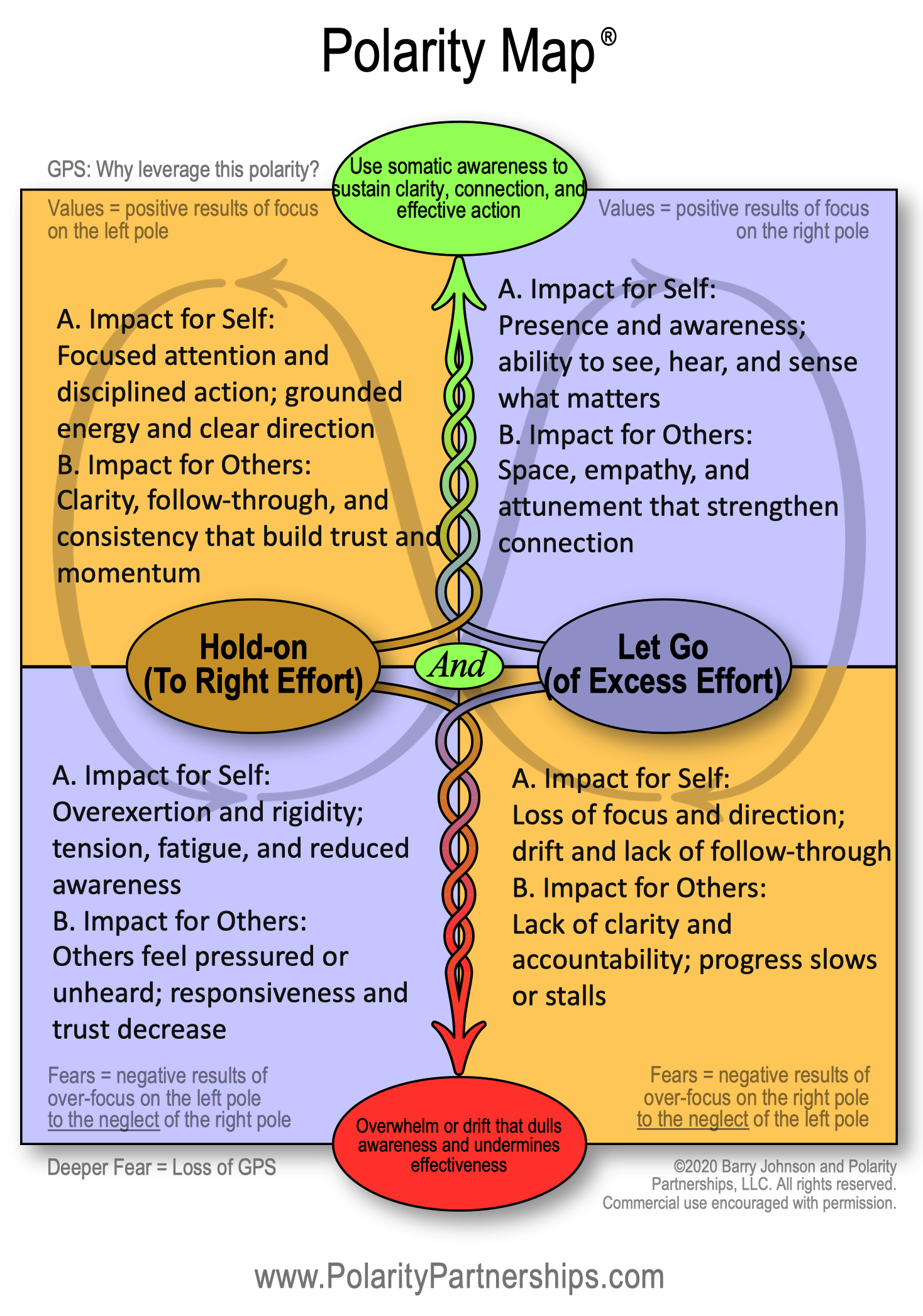
That’s the polarity underneath this chapter: Hold On to Right Effort AND Let Go of Excess Effort. Right Effort stays connected to purpose. Excess Effort starts as commitment and slowly becomes self-consuming — the harder you push, the less clearly you see, until what once served the climb becomes the obstacle on it.
The same choice plays out at a much larger scale than a bike trail. What a culture holds on to, and what it’s willing to let go of, doesn’t stay personal for long.
I still mountain bike. The trail never changed. My relationship with it did. I’ve gotten better at holding on to caution while still appreciating risk. Better at noticing the difference between effort that serves a purpose and effort that only serves itself.
The trail never asked me to become someone different. It simply revealed where I was holding on, and where it was time to let go.
Here’s a Polarity Map for Holding On (to Right Effort) And Letting Go (of Excess Effort)
INVITATIONS:
If you want to take a quick self-assessment for Hold-on And Let Go: CLICK HERE
NOTE: the results include Leveraging Action Steps and Early Warnings (to support maximizing upside benefits and minimizing downside limitations).
Try the AI-trained Chat w/AI Cliff for support for Step 1, Seeing Polarities
Ready for the Polarity Advantage? Check out our online self-directed Basics, Credentialing, or in-person training with Barry Johnson and me at Kayser Ridge! Certifications and Courses