

See the Series Introduction for Just Tao It, Part I: HERE
See the Just Tao It Series Introduction Tao/It on-ramp, PART II: HERE
See Just Tao It, Chapter 1: HERE
From my interpretation of the Tao Te Ching, Chapter 9 (Unpublished):
Brim-fill the teacup,
it spills.
Sharpen incessantly,
the edge dulls.
Overfill the house with possessions,
guarding becomes obsession.
Chase fame and celebrity,
and lose your clarity.
Without extremes—
enough remains.
You’ve heard the story about the cobbler’s children having no shoes.
I’m not immune either. The moment I think more effort will fix what’s not working, I’m usually already past the point where effort helps.
It shows up everywhere. Leaders push harder when results stall, teams add more work when alignment drifts, organizations double down when things feel uncertain — and for a while it works, until the same effort that created progress starts creating strain.
Then burnout shows up, rework increases, and decisions get revisited because things don’t hold. Trust erodes — not because people don’t care, but because they’re working harder without getting the stability they need.
There’s a point where more effort stops improving the outcome, where more refinement starts working against you — and most of us don’t notice that point until we’re already past it.
That’s the tension at the heart of this chapter:
Effort And Ease
Effort creates movement. Ease sustains it. Overfocus on Effort leads to diminishing returns; overfocus on Ease leads to loss of momentum. The work isn’t choosing between them — it’s recognizing when to lean in and when to step back.
Not once. Continuously.
I’ve seen this with my sister, Lori, who gets more done than most people I know. She works hard, takes pride in what she does, and delivers results — despite having about four hours of operative energy per day. The rest is used to get the rest she needs to live with and manage her cancer diagnosis. She’s learned something that took me a lot longer to see. There’s a point where continuing to push doesn’t improve the outcome, and stepping back isn’t quitting — it’s part of getting it right.
The Tao says it directly:
Without extremes—
enough remains.
That’s not about doing less. It’s about recognizing when continued effort starts working against what you’re trying to create.
Across organizations, we keep seeing the same pattern: leaders push harder when results stall, and it often creates more strain, not more progress. What looks like a performance issue is often a capacity issue — the ability to recognize when effort stops helping and to step back without losing forward movement.
That’s the capability we’ve been working to make practical — helping leaders and teams work with Effort And Ease so decisions hold, results sustain, and trust builds over time.
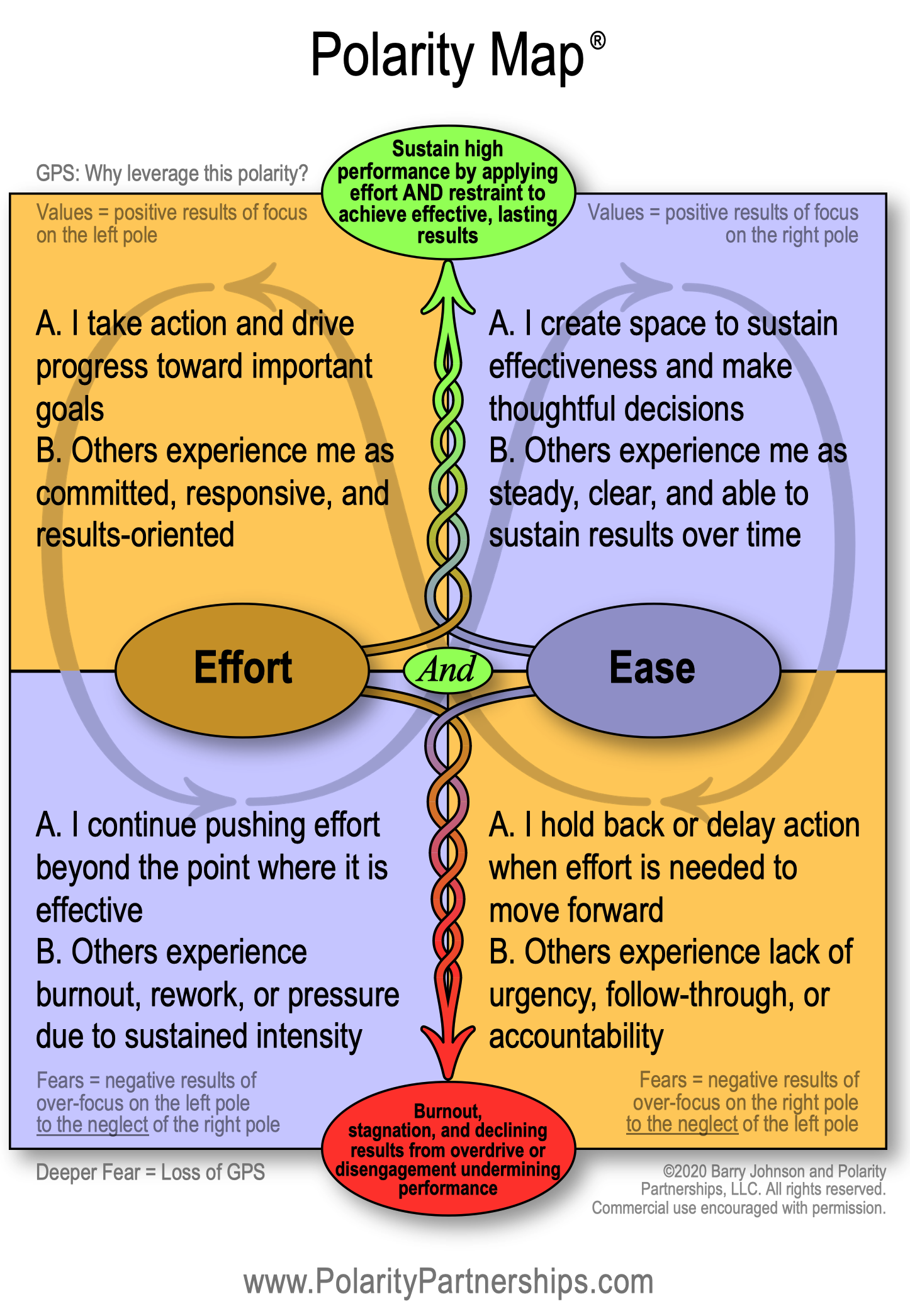
We’ve been seeing this pattern across organizations. Here’s a simple Polarity Map to help see it:
Leaders push harder when results stall, and it often creates more strain, not more progress. What’s needed isn’t more effort. It’s the ability to recognize when effort stops helping. That’s a capability most teams haven’t been given a way to develop.
If this sounds familiar, it might be worth taking a closer look — or at least noticing sooner where you might be adding more when what’s needed is knowing when you’re done.
We’ve been seeing this pattern across organizations.
Here’s a Polarity Map to help see the pattern:
INVITATIONS
If you want to take a quick self-assessment for Effort And Ease: CLICK HERE
NOTE: the results include Leveraging Action Steps and Early Warnings (to support maximizing upside benefits and minimizing downside limitations).
How is Effort And Ease showing up for you in your life or work now?
Try the “AI-trained Chat w/AI Cliff for support for Step 1, Seeing Polarities
Ready for the Polarity Advantage? Check out our online self-directed Basics, Credentialing, or in-person training with Barry Johnson and me at Kayser Ridge! Certifications and Courses
Check out the Cliff’sNOTE focused on the Law of Least Effort that provides additional support for Effort And Ease