
There’s a tendency—especially in leadership circles—to treat trust like a cultural nice-to-have. Something you work on after strategy, after execution, after results. A layer. A tone. A sentiment.
That idea doesn’t hold up very well when you actually look at how systems work.
Jack Gibb saw this clearly long before most of us were paying attention. Trust wasn’t, for him, an outcome of good relationships. It was the condition that made real relationships—and real work—possible in the first place. And it wasn’t static. It developed. It deepened. It either expanded what a system could do…or limited it long before anyone noticed.
Barry Johnson credits Gibb, his mentor, directly in the Polarity Realities—especially the insight that “Seeing is loving.” That’s not poetic language. It’s operational. If you can’t see the whole, you can’t respond to it. And if you can’t respond to it, you start managing parts as if they’re independent.
That’s where things begin to unravel.
Gibb mapped trust as a developmental progression: Trust makes Openness possible. Openness makes real alignment possible. Alignment makes meaningful results possible. And over time, that becomes Interdependence—the thing most organizations say they want but rarely know how to build.
I’ve been teaching leadership and coaching programs at American University and George Mason for years, and what kept showing up—across cohorts, industries, and contexts—was something I couldn’t ignore.
Different models. Different language. Same structure.
At first it looks like variation.
Then it starts to look like convergence.
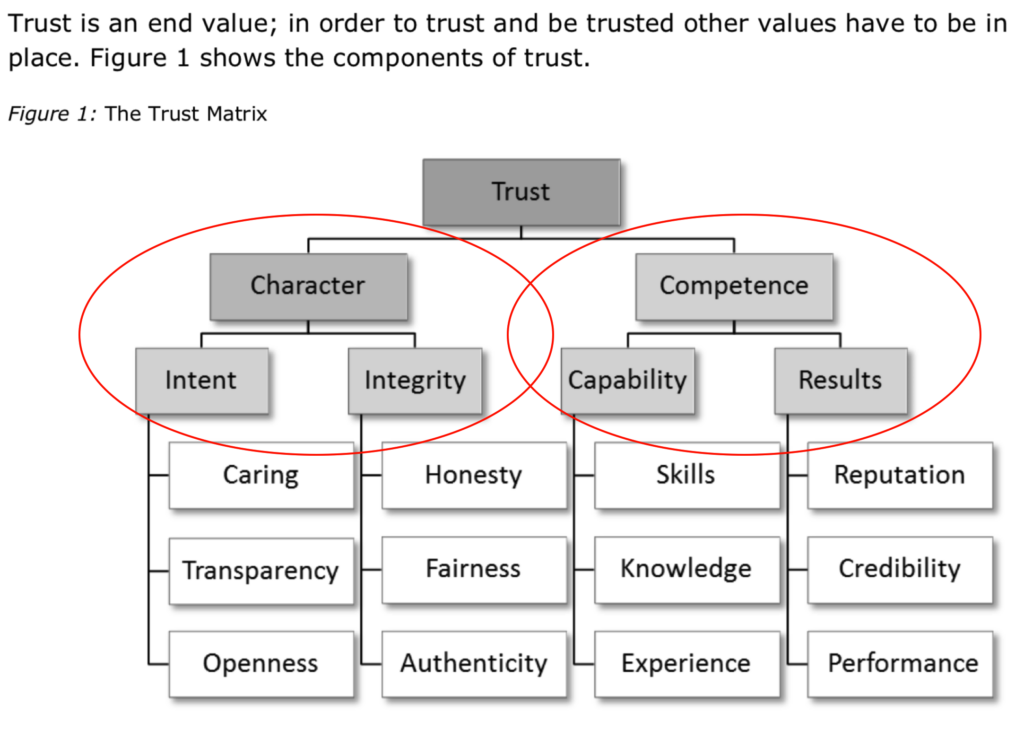
Covey talks about Character AND Competence, and the ripple effect across Self, Relationship, Organizational, Market, and Societal trust.
Feltman breaks trust into Sincerity AND Care, Competence AND Reliability.
Barrett ties trust to values alignment and consciousness development — focusing on Competence And Character is top in the hierarchy.
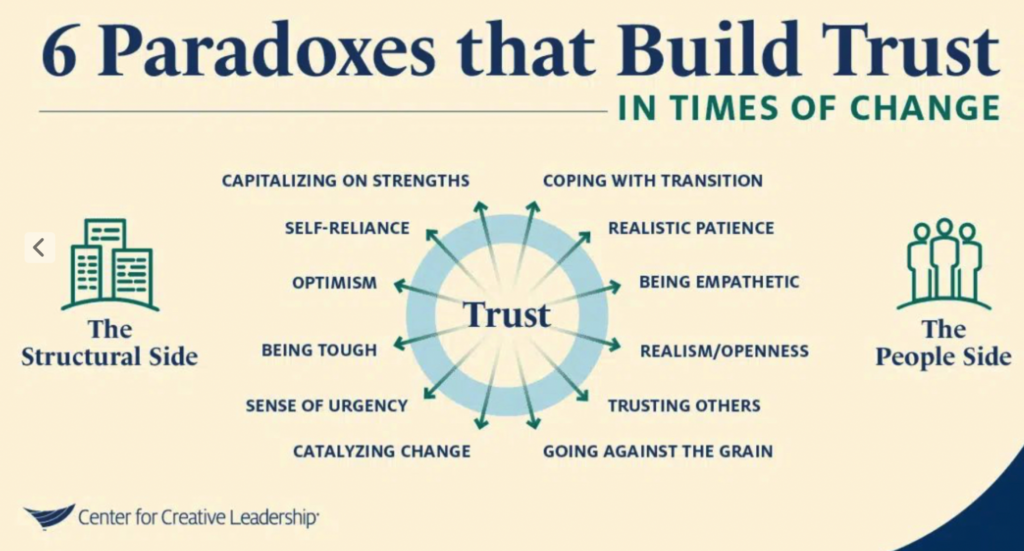
The Center for Creative Leadership (CCL) emphasizes the Structural Side AND People Side, as the umbrella for 6 paradoxes/polarities.
Together, they reveal something more interesting.
They are all describing the same system from different entry points.
And when you look at them through a polarity lens, the pattern sharpens.
What Covey calls Character AND Competence is the same tension Feltman describes as Care AND Reliability.
What Barrett frames as values alignment shows up as congruence between Intention AND Behavior.
What CCL emphasizes in feedback and accountability reflects the tension between Support AND Challenge.
Different maps.
Same terrain.
This is where Gibb becomes the bridge.
He wasn’t offering another model. He was pointing to the underlying developmental sequence that makes all of them work—or not work.
Because trust doesn’t fail in one place.
It degrades across a system when these tensions aren’t leveraged well.
When Character outruns Competence, intentions are good and outcomes don’t follow.
When Competence outruns Character, results show up and relationships erode.
When Care outruns Accountability, standards drift.
When Accountability outruns Care, people disengage.
You can’t fix that by choosing better behaviors.
You have to leverage the polarities that produce trust in the first place.
That’s the shift.
From model selection…to structural understanding.
And once you see it, it’s hard to unsee.
Trust isn’t a variable.
It’s a Multarity—a set of interdependent polarities that operate across levels:
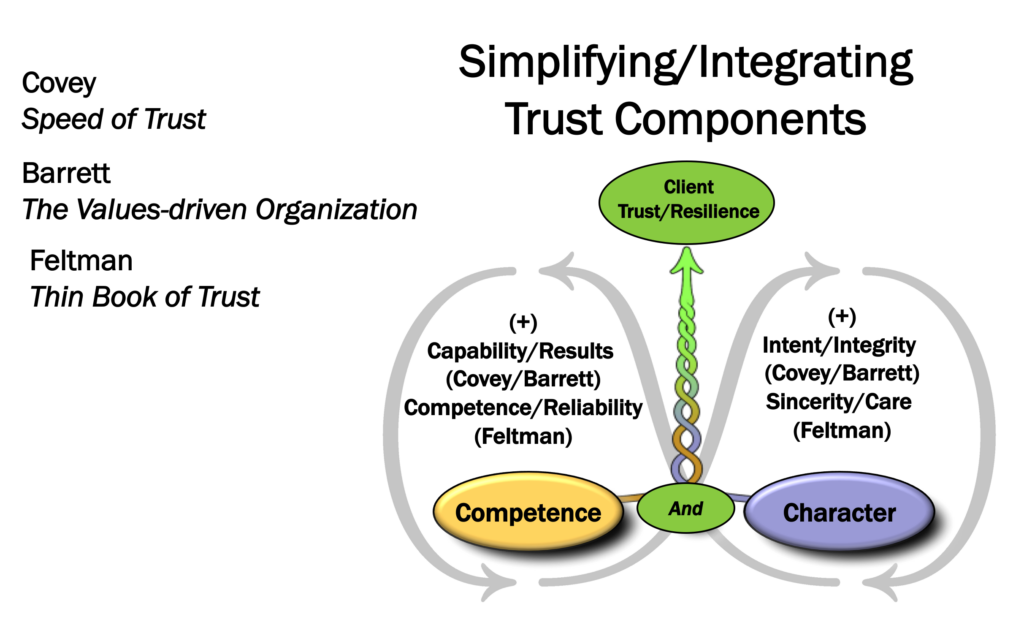
Self Trust AND Relationship Trust AND Organizational Trust AND Societal Trust.
Character AND Competence.
Care AND Accountability.
Support AND Challenge.
Continuity AND Change.
You don’t optimize one.
You leverage all of them, over time.
That’s straight out of the Polarity Realities:
Overfocus on one pole to the neglect of the other—and you don’t just get the downside of the preferred pole. You eventually get the downside of both.
That pattern isn’t theoretical.
You can see it everywhere right now.
Organizations where performance pressure has outrun relationship.
Institutions where authority has outrun accountability.
Societies where competing narratives about truth and identity are pulling further apart.
Which is why this isn’t just about leadership development.
It’s about whether systems can still function.
Yuval Noah Harari has been warning about this from a different angle. His concern isn’t just misinformation—it’s the erosion of shared trust in the structures that allow large-scale coordination. When trust weakens, coordination weakens. And when coordination weakens in an AI-amplified world, the consequences scale quickly.
AI doesn’t create that condition.
It accelerates it.
It increases the speed of information, the reach of influence, and the difficulty of determining what’s reliable. Which means whatever level of trust exists—strong or weak—gets amplified.
If trust is strong, AI expands capability.
If trust is strained, AI amplifies fragmentation.
That’s not a technology problem.
That’s a polarity problem.
Human Consciousness AND Artificial Intelligence.
If one outruns the other, decisions don’t hold.
And this is where everything comes together.
Trust is not just relational.
It is the enabling condition for leveraging interdependence.
Which brings us back to the larger polarity that sits underneath all of this:
Part AND Whole.
Inner Development AND Outer Impact.
You don’t get sustainable system outcomes without the internal capacity to navigate tension, difference, and uncertainty. And you don’t get meaningful impact if development never moves beyond the individual.
Trust lives at that intersection.
Self Trust without System Trust leads to isolation.
System Trust without Self Trust leads to compliance without ownership.
When both are present, something shifts. People can stay in the tension long enough for something better to emerge. They don’t rush to certainty. They don’t turn difference into threat. They don’t confuse speed with progress.
They make decisions that hold.
That’s the point.
Not better conversations. Not better alignment sessions. Not even better leadership.
Wiser Decisions Over Time That Stand the Test of Time—for both Part AND Whole.
Trust is what makes that possible.
Not as a value statement.
Not as a competency model.
As a system that has to be developed, maintained, and leveraged.
And if there’s a place to start, it’s not “build more trust.”
It’s noticing where one side of a tension has taken over at the expense of another.
Because that’s where trust is already being strained—whether anyone is naming it or not.
And once you see that, you’re back where Gibb started.
Seeing isn’t just awareness.
It’s what allows the system to begin working again.
Loving again.
Want to learn more about Polarity Thinking and explore options for self-paced learning and Credentialing?
CLICK HERE
Want to use an AI-trained Cliff to support you in Step 1 Seeing?
CLICK HERE