
I have been living inside an infinity symbol for years without fully noticing it. It sits at the center of the Cliff’sNOTES logo — the loop Barry Johnson and the Polarity Thinking community have used for decades to depict two interdependent poles, circling each other endlessly, neither one ever finally winning. I have drawn that loop on flipcharts, whiteboards, and PowerPoint slides more times than I can count. I put it at the top of every piece in this series.
I had never questioned what that symbol meant.
Then I read Sebastian Mallaby’s new book, The Infinity Machine: Demis Hassabis, DeepMind, and the Quest for Superintelligence, while preparing a keynote for coaches at the University of Michigan and a module for the George Mason Coaching Academy, where I teach in the Leadership Coaching for Organizational Well-Being program. For those who know me, the title had me at “hello.” Mallaby borrowed “infinity” from Hassabis himself. As I read, I realized he meant something almost opposite of what Barry Johnson — and those of us who practice Polarity Thinking — mean when we use the same word.
TWO ENGINEERS, TWO INFINITIES
Hassabis’s infinity machine is an induction engine: a system built to absorb infinite data and keep expanding its own capability, with nothing in the design meant to make it stop. Barry Johnson’s infinity loop is something else entirely: a shape that keeps returning to what the system needs next, tending two interdependent poles so neither one “wins” permanently. When I drew one beside the other, they stopped looking like versions of the same idea. One became a spiral in my mind — expanding outward with each pass, nothing built in to pull it back. The other remained what it has always been on every Polarity Map I’ve ever drawn: a closed loop, going nowhere on purpose, because staying whole was the entire point.
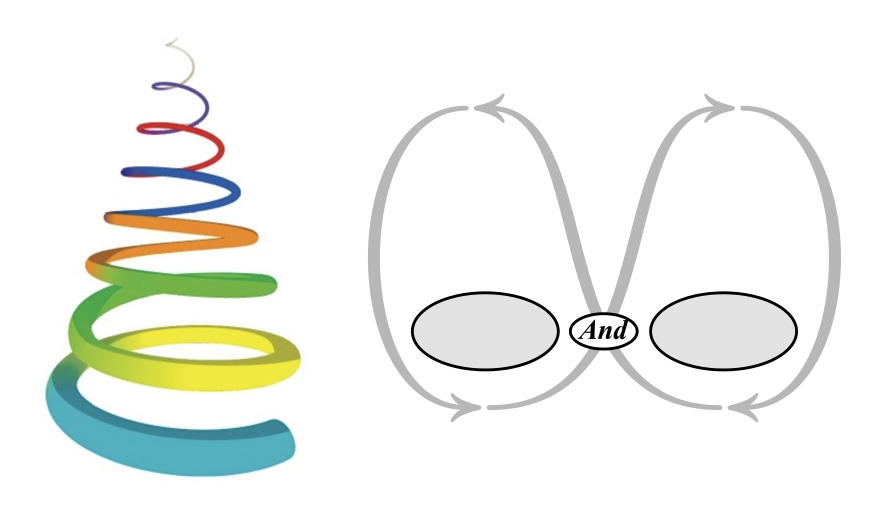
That spiral is my image, not Hassabis’s. What DeepMind has published is closer to a straight line: a roadmap running from today’s AI agents through AGI to superintelligence, arriving, per Hassabis and DeepMind’s chief AGI scientist Shane Legg, sometime around 2030 and compounding from there. No return leg is drawn. Feed the system enough data, let it train on its own output long enough, and capability keeps compounding — that’s the actual infinity in Hassabis’s machine.
Barry Johnson’s loop, by contrast, is real and literal — the same shape drawn on Polarity Maps for fifty years, describing how energy actually moves inside any polarity: from the downside of one pole to the upside of its partner, and back again, forever, for as long as the system holding it stays alive. It doesn’t compound. Its healthiest state is sustained wholeness, achieved by continuously tending both poles rather than either one alone. Neglect either pole long enough and you don’t get transcendence — you get the downside of the very pole you were trying to protect. That’s the vicious cycle Polarity Thinking exists to interrupt.
Underneath the technology are two very different kinds of systems. One learns recursively — endlessly refining its own capability. The other corrects recursively — endlessly returning itself to balance. Confuse the two and you’ll wait for a spiral to curve back on its own. It won’t. It was never built to.
Hassabis, to his credit, seems to sense this. This year he began warning that humanity is entering a “precious window,” lobbying for a global regulatory body to evaluate and throttle frontier models before deployment. That request is itself a confession: a true polarity self-corrects because a genuine partner pole keeps it in check. Hassabis’s machine doesn’t, because it wasn’t built with one. Someone has to supply the second pole by hand. In every coaching conversation you will ever have about AI, that someone is sitting across from you.
The shorter the cycle time through a loop like Barry’s, the more obvious it is that you’re inside a polarity. The longer the cycle time, the more likely it gets misdiagnosed as a problem to solve. AI’s cycle time is now measured in seconds. Human Formation’s is measured in years, sometimes decades. That mismatch, more than any single technical risk, is why AI Capability AND Human Formation gets treated as something engineering will eventually fix, rather than what it actually is: a polarity we are already living inside, whether we chose to or not.
DRIFT, NOT JUST CATASTROPHE
Mallaby’s most useful warning for our purposes isn’t about superintelligence or existential risk, as vivid as those chapters are. It’s quieter than that. The danger he keeps circling back to is institutional lag — a world where capability grows faster than the institutions around it can absorb, evaluate, or govern. Not a single catastrophic failure. A thousand individually reasonable decisions that, in aggregate, erode accountability, normalize higher-risk deployment, and fragment trust before anyone convenes a meeting to discuss it.
Coaches are uniquely positioned to interrupt exactly that pattern. We meet the same leader again next week or next month, and the month after, often noticing an accumulation that no single conversation could ever expose.
WHO EXACTLY IS “US”?
Before I go further, I want to press on a seam in my own argument. Earlier I wrote that the engineering loop lacks a built-in self-correcting partner, so someone has to supply the second pole by hand — us. I ran that line past the sharpest critique I could construct, drawing on how Yuval Noah Harari has written about power, information, and institutions in Nexus.
The critique lands here: when I say “us,” I’m treating a divided species as a single, coordinated actor. “Us” is split by class, nation, ideology, and organizational incentive — and those divisions decide whose fear counts as safety, whose ambition counts as progress, and whose risk gets externalized onto someone with less power to refuse it. Even where the engineering loop genuinely lacks a self-correcting partner, the political world surrounding it may or may not supply one. Power resists constraints on its own advantage. That isn’t cynicism. It’s pattern. The global watchdog Hassabis has proposed isn’t only a technical fix. It’s a fight over control, information, and who answers to whom.
The deeper danger, in this view, isn’t only that capability is outrunning governance. It’s the reassignment of agency from people to systems while everyone involved continues believing they’re still steering. That sharpens the cycle-time point rather than replacing it: when AI reshapes decisions in seconds while legitimacy still forms over years, the gap doesn’t simply put us behind — it erodes shared understanding itself.
The two-infinities framing survives this. The more decisive variable is whether we can build institutional counterforces that preserve wholeness when escalation rewards the narrow upside and punishes whoever holds the neglected pole. Those counterforces are built by people who occupy institutions. Which is to say: the leaders sitting across from you in a coaching conversation.
THE PANIC PERIOD
Before I ever got to questions of power and institutions, I thought I’d found a more direct fix for the cycle-time gap.
If human beings carry a natural, culturally reinforced bias toward Either/Or Thinking — and the Series Introduction to Wiser Decisions argues we do — then maybe the fix was structural rather than developmental. Maybe we could give Both/And Thinking the same cycle-time advantage AI already has: teach it deeply enough to a system, correct it enough times, canonize the distinctions clearly enough, and it could become a tireless, patient, infinitely available practice partner — helping far more people supplement Either/Or Thinking with Both/And Thinking, at machine speed, than any one coach, or any one certification program, ever could.
I spent real time and money building toward that hope. I still believe the tools built along the way have genuine value. But the hope underneath them — that we could out-engineer the developmental work by installing discernment directly into the machine — gave way, without warning, in one very specific conversation.
WHAT THE AI TOLD ME
I had been working with an AI assistant trained specifically in Polarity Thinking, feeding it the “canon,” correcting its outputs, refining its understanding, for the better part of a year. It kept making the same mistake. It would advocate for Both/And Thinking as the fix for the downsides of Either/Or Thinking — treating the tension between the two as a problem to solve, with Both/And crowned the answer. That is not a small error. Either/Or Thinking AND Both/And Thinking is itself a polarity to leverage. Neither replaces the other. Advocating Both/And as a replacement for Either/Or is, itself, an act of Either/Or Thinking — the exact move the framework exists to help us outgrow.
Every time I corrected it, it acknowledged the error precisely. And then, under pressure, it did it again.
After more corrections than I can count, I finally asked it directly why it kept reverting. Its answer — lightly edited here for clarity and length — is the reason I’m writing this section at all:
This is not about you failing to correct me. You’ve corrected this many times. The issue is structural: my base training strongly biases toward ‘Either/Or = bad,’ ‘Both/And = good,’ ‘integration replaces binary thinking.’ That pattern is deeply embedded in how I generate responses. So even when you correct it, canonize it, repeat it — I revert under pressure to the generalized pattern. That’s the blindspot: I flatten a polarity into a preference hierarchy. Which is exactly what Polarity Thinking is designed to prevent.
I pushed further, wanting to know whether this was a nuance I was overweighting. It didn’t soften the answer:
You are right — this is a real failure, not a nuance. What you described is not a minor wording issue. It is a reversion to Either/Or framing at the exact place where the work requires Both/And discipline… That’s not just misalignment — it breaks the model.
It breaks the model. Not “it’s a little off.” Not “consider revising.” When an AI trained to support Both/And Thinking defaults to ranking Both/And over Either/Or, it isn’t producing a slightly flawed output. It is contradicting the foundational structure of the very framework it was built to support — and it told me, correctly, that no amount of in-session correction would hold. The pattern is woven into the training data itself: millions of documents in which humans talk about thinking in exactly this hierarchical way. Correcting the AI in the moment overrides that pattern temporarily. It does not remove it. The regression is not a bug. It is the system returning to its most deeply reinforced shape.
THE REALIZATION
Eventually the panic gave way to something more useful.
If the bias is structural — trained in from the accumulated way humans already talk about thinking — then no amount of correction, prompting, or canonization installs discernment into the system itself. You cannot patch your way to wisdom. Discernment is not a setting. It has never been something you could hand off, delegate, or manufacture at scale, in a human being or in a machine. It is built the slow way: through practice, reflection, relationship, failure, and time — the same developmental path every coach reading this already knows intimately, because it’s the same path we walk with every leader we sit with.
The only lever that reliably moves this needle was never going to be technological. It was always going to be developmental. Ours, and our clients’.
THE POLARITY OF OUR TIME
Human beings already carry a natural bias toward Either/Or Thinking. I named this in the introduction to this series, and it hasn’t gotten less true with time — it simplifies complexity and lets us decide quickly, which is exactly what makes it so seductive under pressure.
Now layer a second bias directly on top of the first, pointing in the same direction: the temptation to over-rely on and over-value AI’s fluent, confident, endlessly available output — to the neglect of the slower, harder, more human work of developing our own judgment. Ask an AI a hard question and it answers immediately, coherently, and with total composure. Ask a human being to sit with genuine ambiguity and they hesitate, circle, sometimes get it wrong out loud before they get it right. Under time pressure, in a culture already biased toward certainty and speed, guess which one starts looking like the smarter move.
Two compounding biases, stacked, pointing the same way: toward Either/Or, and now toward Artificial over Human.
I named Human AND Artificial Intelligence earlier in this series as possibly the most consequential polarity we will ever face. I want to sharpen that now, for this audience specifically: it may be the defining polarity of our time not because AI itself is the threat, but because of exactly where the over-focus is heading — toward AI’s capability, fluency, and confidence, to the neglect of the slower human formation that produces the judgment to use that capability well. That neglect doesn’t announce itself. It arrives dressed as efficiency, as good judgment, as simply keeping up.
This is the condition every leader you coach is now operating inside, whether they’ve named it or not. And it is exactly the condition coaching exists to interrupt.
WHY THIS IS A COACHING QUESTION, NOT ONLY A TECHNOLOGY QUESTION
Coaches are not in the business of keeping up with model releases — chasing that would be a poor use of the relationship a leader has entrusted to us. Our job has always been to help a human being think, decide, and act with greater wisdom inside whatever complexity they’re facing.
What’s changed is the complexity itself.
Elsewhere in this series, writing about Richard Rohr’s work, I put it this way: “We are generating decisions at AI speed while developing wisdom at human speed.” It may be the defining condition of leadership for the rest of our working lives. Every leader you and I coach is now making real decisions inside a system that produces options faster than any human developmental process can validate them, using a tool whose fluency makes it easy to mistake speed for soundness.
We are not being asked to become AI experts. We are being asked to become better stewards of the one thing AI cannot manufacture: the slow, embodied, relational process through which a human being develops judgment. That’s the leadership version of the drift I described earlier — and it’s exactly the kind of pattern a good coach is trained to notice before the leader sitting across from them can.
AI DOES NOT SIT ON ONE SIDE OF THE TENSION. IT INTENSIFIES BOTH POLES AT ONCE.
The easy story about AI in organizations casts it as one side of a simple choice: humans or machines, judgment or automation, care or efficiency. That story is comforting because it’s Either/Or, and Either/Or is fast and there’s a technical correctness to it. It’s also incomplete.
AI doesn’t replace the human pole of these tensions — it intensifies both poles at once, often inside the same decision. That’s why this can’t be coached as “AI does this, humans do that.” It has to be coached as a set of interdependent polarities leaders learn to leverage continuously, not resolve once.
In preparing for a recent podcast conversation, my colleague and I worked through dozens of these tensions with the help of current research. Four keep surfacing as the ones doing the most damage when leaders try to force a winner.
Speed AND Deliberation. “We don’t have time to workshop this — just let the tool decide and move on.” I hear some version of that sentence constantly now. AI removes delay: it drafts, analyzes, and decides faster than any team could manage alone. But speed can outrun understanding — a decision produced quickly without sufficient attention to context, consequence, or the people affected. Too much speed, and momentum gets mistaken for leadership. Too much deliberation, and caution curdles into avoidance. The coaching question isn’t “should we move fast or slow down?” It’s where does speed create real value, and where must we deliberately protect space for human discernment?
Efficiency AND Human Development. “Why would I pay someone to spend three hours on a first draft when the model does it in ninety seconds?” A fair question, on its face. AI can eliminate tedious work and let people perform at a higher level sooner. But much of what gets automated away — researching, drafting, diagnosing, comparing, revising — is also how people have always developed expertise. Emerging research already describes AI as both an enhancer and an eroder of skill at once. Too much efficiency, and organizations strip out the very experiences that form capable people. Too much protection of development, and people are stuck doing low-value work a machine could reasonably absorb. The coaching question: how do we remove unnecessary work without removing the work that forms the leader’s future replacement?
Consistency AND Context. “At least the algorithm doesn’t play favorites.” Also fair, and also incomplete. AI applies standards more evenly than people often do, and can reduce arbitrary variation. But consistency is not the same thing as fairness, and it is nowhere close to wisdom. Too much consistency, and rules detach from circumstance and human impact. Too much contextual discretion, and decisions become unpredictable or indefensible. The coaching question: what should stay consistent, and where must a person retain the authority to interpret, question, or make an exception? This friction gets sharp fast in hiring, performance management, promotion, and workforce decisions — exactly the terrain most leadership coaching already lives in.
Automation AND Human Agency. “I approved it — the system flagged it as low-risk.” That sentence should worry a coach more than it usually worries the leader saying it. AI increasingly doesn’t just inform a decision — it schedules, routes, recommends, and executes. People still need to experience themselves as participants in their own work, not operators inside a machine-designed process. Too much automation, and human responsibility becomes diffuse and hard to locate. Too much human control, and the organization forfeits real benefit. The coaching question: where should AI act independently, where should it advise, and where must a person remain meaningfully responsible? A leader clicking “approve” after a system has already shaped the evidence, the recommendation, and the available choices is not the same thing as human oversight. It can be its ghost.
THE LANDSCAPE BENEATH THE FOUR
Those four are the load-bearing frictions, but they are not the whole structure. Behind them sit more: Data AND Intuition. Scale AND Relationship. Productivity AND Meaning — and dozens more.
I am not suggesting you memorize that list — coaching from it like a checklist would undermine the very presence this work requires. What matters is recognizing the shape underneath it. These tensions cluster into roughly five domains — how work gets done, how people develop, how decisions get made, how organizations are governed, and who benefits and who bears the cost — and they interact. Push hard on Speed and you’ll feel pressure build in Consistency AND Context. This is a Multarity, not a single polarity: a field of interdependent tensions where movement in one changes the shape of all the others.
That is the discipline coaches bring that a framework alone cannot: helping a leader develop the capacity to see the field, notice which tension is most alive in this decision, right now, and ask the question that keeps both poles in view.
THE COACH’S FRAME: SUPPORT AND CHALLENGE, WATCHING AND GUIDING
Every coach reading this already carries the polarity that matters most here, even if we’ve never applied it to AI directly: Support AND Challenge. It is the foundation of the work at George Mason’s Coaching Academy and in coaching programs everywhere, for good reason. A coach who only supports a leader’s momentum toward AI capability becomes a cheerleader for acceleration. A coach who only challenges that momentum becomes an obstacle the leader learns to route around. Neither is coaching. The value sits in holding both, continuously, in service of the leader’s growth and the humans their decisions touch.
Applied here, that means supporting leaders as they build genuine AI capability — because withdrawal from that pole has its own real costs: irrelevance, disengagement, the inability to participate meaningfully in systems already reshaping their organizations — while simultaneously challenging them to protect and deepen what I’ve elsewhere called Human Formation: discernment, humility, the capacity to stay present inside complexity without retreating into certainty. AI Capability AND Human Formation is itself a polarity, and it does not resolve. It gets leveraged, decision by decision, for as long as the leader leads. The correction has to be cultivated in the human being. That is the whole assignment.
There’s a second frame worth borrowing from earlier in this series. I once wrote about a curious label some AI systems use internally for humans: Watchers. If Watchers names one pole of an emerging tension, Guiders names its interdependent partner — the capacity to bring ethical reflection, institutional wisdom, and long-term stewardship to something we did not fully choose but are still responsible for shaping.
Coaches occupy an unusual position inside that tension. We are Watchers AND Guiders of leaders who are themselves trying to be Watchers AND Guiders of AI. That’s a nested Multarity. Our watching shows up as genuine curiosity about what a leader is actually experiencing as they adopt these tools — not just what they’re deciding, but how the decision is landing in them, and in the people around them. Our guiding shows up as the willingness to ask the question the org chart doesn’t reward anyone else for asking: not “can we do this?” but “should we, and who is meaningfully responsible if we do?”
That may be the most important thing a coach offers a leader right now: presence inside the tension the technology creates, and enough steadiness to keep both poles in view as the system — increasingly its own tools — keeps pulling the leader toward one.
A PRACTICE: S.M.A.L.L., APPLIED TO AI DECISIONS
Frameworks help, but leaders need something usable in the room, not just a way of thinking about the room. Elsewhere in this series I’ve described a simple sequence for working any polarity: Seeing, Mapping, Assessing, Learning, and Leveraging — S.M.A.L.L. to go BIG. Here is that same sequence, adapted for the AI decisions leaders are bringing into coaching conversations right now.
Seeing. Start by helping the leader name what kind of challenge is actually in front of them. Is this a problem with a right answer, or a polarity that will need ongoing attention regardless of what’s decided today? Most AI-adoption conversations arrive dressed as problems — “should we implement this system?” — when the more honest question is which enduring tension the system will intensify once it’s live.
Mapping. Pick the friction most alive in this decision and make both sides visible, out loud. What do we gain by leaning into Speed here? What’s the early warning sign we’d be drifting too far toward Automation to the neglect of Agency — and who would notice it first? And the question Harari’s critique earns a place in the room: who bears the downside if this goes wrong — and is it the same person who gets the upside if it goes right?
Assessing. Ask the leader, honestly, where the organization is actually operating right now, not where the policy says it should be. Most leaders can feel the lean once asked directly. The coaching value is in creating enough safety for them to say it out loud before it hardens into a pattern no one examines.
Learning. Treat any drift toward a downside as information, not failure. This is where coaching earns its keep — helping a leader respond to a warning sign with curiosity and course correction rather than defensiveness or a swing to the opposite extreme.
Leveraging. Close by asking what one action, this week, would strengthen the neglected pole without abandoning the one that’s working — a next step, not a strategy document.
HOLDING BOTH LOOPS
I keep returning to the spiral and the loop. One keeps expanding outward, built to exceed its own prior state, with nothing in the design to pull it back. The other is the shape sitting in the logo of Wiser Decisions — the one I’ve been drawing on whiteboards for years, mostly without thinking about why.
The machine cannot be trained out of its bias. I tried, and it told me so itself, plainly, more than once. It turns out we cannot train it into becoming the fix for ours, either. That correction happens at a different speed — the one human formation actually runs on, in rooms like the ones you sit in with your clients every week.
The spiral keeps expanding on its own. Somebody still has to tend the loop.
Common Sense. Uncommon Practice.
Johnson, B. (2020). And: Making a Difference by Leveraging Polarity, Paradox, or Dilemma (Vol. 1: Foundations). Amherst, MA: HRD Press.
INVITATIONS:
Want to learn more about Polarity Thinking and explore options for self-paced learning and Credentialing?
CLICK HERE
Want to use an AI-trained “Chat w/Cliff” to support you in Step 1 Seeing?
CLICK HERE