


See the Series Introduction for Just Tao It, Part I: HERE
See the Just Tao It Series Introduction Tao/It on-ramp, PART II: HERE
See Just Tao It, Chapter 1: HERE
From my interpretation of the Tao Te Ching, Chapter 29 (Unpublished):
Some reach for the powerful place
Without concern for the whole.
Some climb to the highest space
With the intention to control.
In chasing the part
They forget the whole.
Yet the parts are connected.
The whole remembers them all.
Under heaven some lead
And some follow.
Cool winds arrive
And warm winds go.
Some rise high.
Some settle low.
Harvest comes
From the seeds we sow.
The power-wise soul
Keeps both head and heart.
Caring for the whole,
It tends each part.
—
When leaders reach for the powerful place without remembering the whole, the trouble rarely begins with bad intent. It begins with certainty. Someone becomes convinced that one part of the system holds the answer. Growth. Freedom. Efficiency. Security. Control. Whatever the chosen virtue may be, the leader leans into it with conviction, and in doing so begins to tilt the system.
The Tao Te Ching, Chapter 29, speaks to leaders who imagine they can seize the universe and make it better:
Do you think you can take over the universe and improve it? I do not believe it can be done.
So sometimes things are ahead and sometimes they are behind; sometimes breathing is hard, sometimes it comes easily; sometimes there is strength and sometimes weakness; sometimes one is up and sometimes down.
Therefore the sage avoids extremes, excesses, and complacency.
The passage doesn’t argue with ambition. It simply observes the patterns that govern movement in all living systems. The Tao notices this tilt long before most of us do. Chapter 29 simply observes the predictable patterns of what is already happening: some lead and some follow, warm winds arrive and cool winds move on, some rise and some settle low. Nothing holds the high ground forever. Systems will move. Power will recirculate. What appears solid will begin another shift.
The problem comes when a leader tries to hold the high ground permanently.
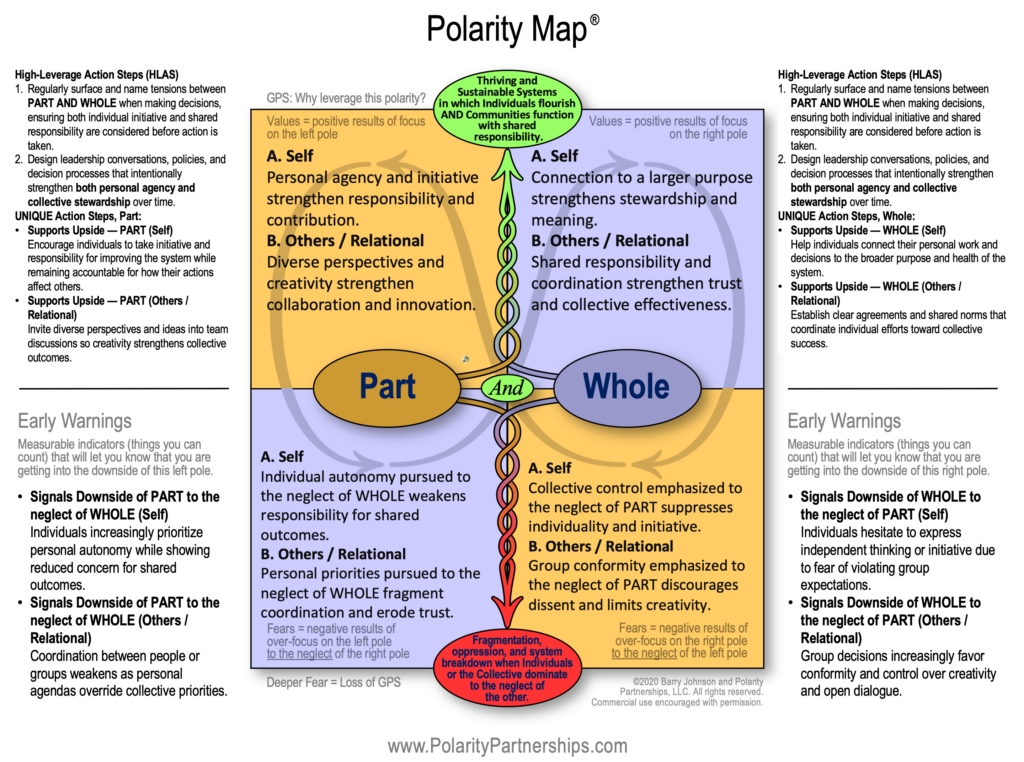
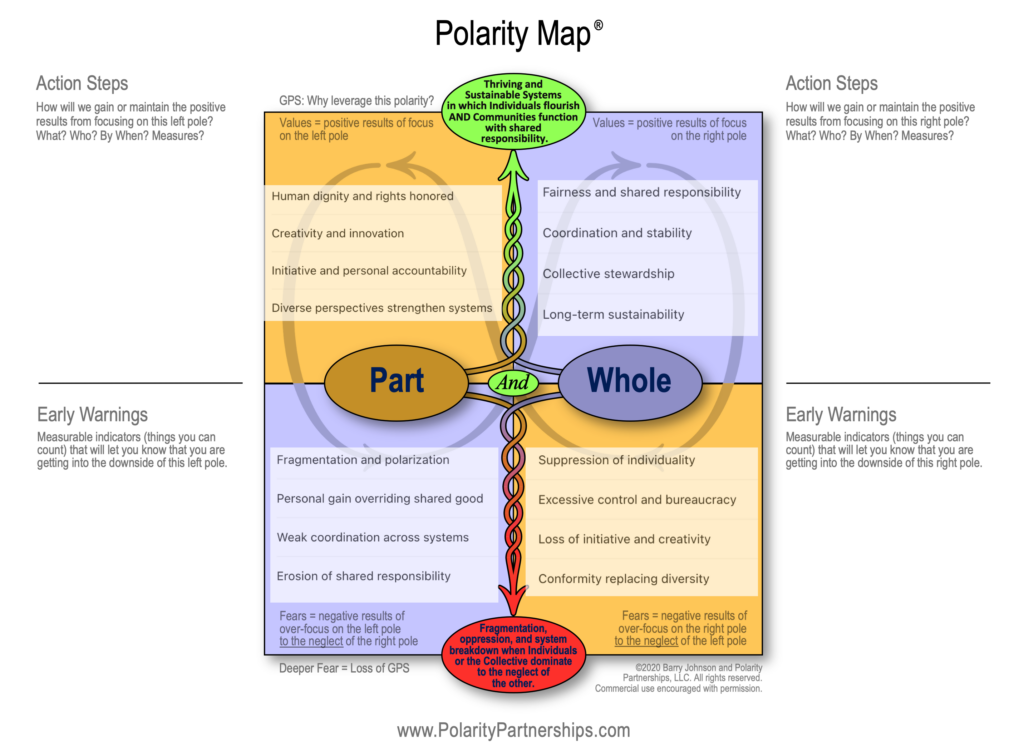
Barry Johnson describes this same pattern through the Part AND Whole polarity that runs through individuals, families, teams, organizations, and nations alike (See Chapters 4-11 in SECTION 2 of And, Volume 1). Freedom, uniqueness, and initiative give life to the parts. Equality, connectedness, and coordination give life to the whole. Both are required for a system to thrive.
The moment one pole becomes the answer, the system begins to compensate. In cultures shaped strongly by individualism, the pull toward freedom and initiative can become so compelling that the coordinating forces of equality and connectedness begin to fade from view. The people leaning toward freedom experience themselves as protecting vitality and possibility, while those leaning toward equality experience themselves as protecting fairness and belonging. Each side is responding to something real. Each side is protecting a value the system cannot afford to lose.
The Tao is simply saying: in chasing the part, we forget the whole.
Yet the whole never forgets the parts. Systems have memory for what leaders overlook. Strains accumulate. Inequities widen. Distrust begins accumulating in the background—and sometimes erupts into view. What began as strength eventually produces its shadow, and the system responds with pressures that feel sudden even though they have been forming for years. And when the whole is pursued without care for the parts, systems fracture just as surely, as people and communities experience themselves as unseen, unsupported, or sacrificed in the name of something larger.
This is why democracy itself lives inside tensions that must be leveraged over time, not solved once and for all. The Polarities of Democracy point to enduring energies between the five polarities. Each pole cares for critical values the system needs to survive and thrive, and each carries fears about what happens when the other dominates. When leaders cling to one side as the answer, there will come a self-correction. The question is how long it will take and how much unnecessary suffering the system will endure before that correction unfolds.
Look around. The dance continues. We are all part of it.
You can see the same movement in the global conversations around sustainable development. Communities striving to grow economically cannot ignore the ecological systems that sustain them. At the same time, Environmental Protection to the neglect of Economic Development fractures communities just as surely, as livelihoods collapse and people experience themselves as sacrificed to abstractions. The earth, like any living system, responds best when both poles are tended together.
If Chapter 29 had a face, it would likely be casting a knowing smile right now.
Harvest comes from the seeds we sow.
Leadership in this kind of world requires a different interior posture than control. The Inner Development Goals point toward capacities that are less about mastery over systems and more about awareness within them. Leaders learn to notice patterns sooner, to sense interdependence more clearly, and to hold multiple perspectives without rushing to simplify them. What begins to look like opposition is often simply another part of the system speaking. As Otto Scharmer often reminds leaders, the success of any intervention depends on the interior condition of the intervenor, and how we show up inside the system shapes what becomes possible outside it.
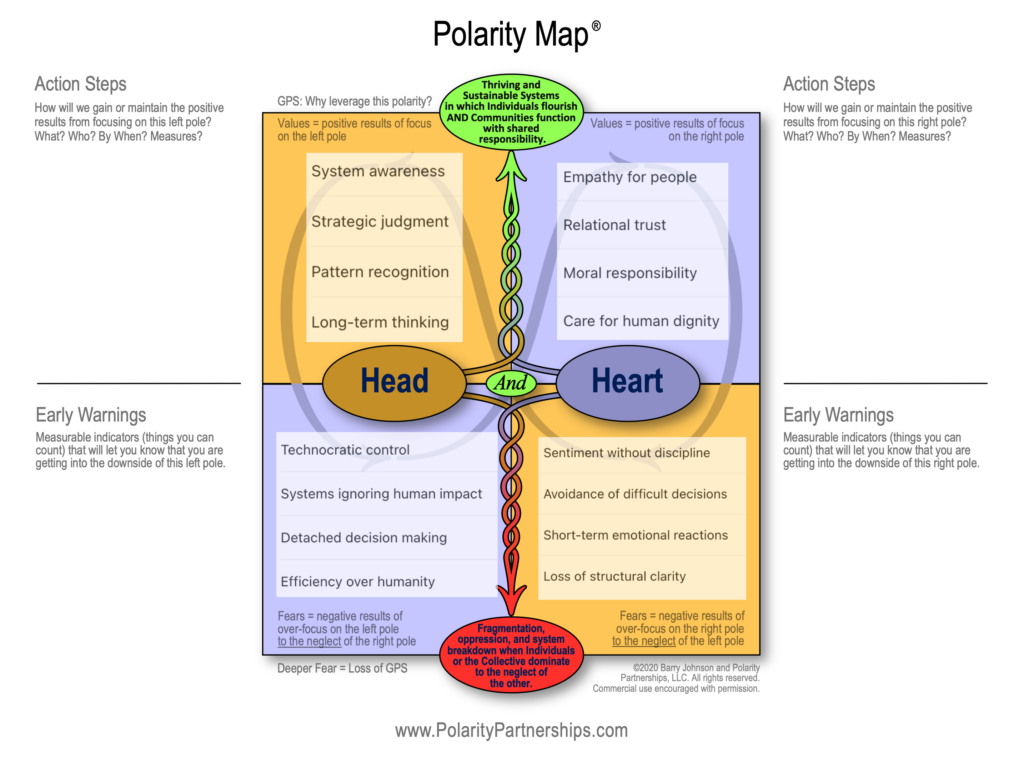
When head and heart remain connected, power changes character. It becomes less about commanding outcomes and more about tending conditions, less about forcing alignment and more about cultivating coherence. Leaders stop trying to dominate the movement of the system and instead learn to move with it.
This is what the Tao seems to be pointing toward when it speaks of the power-wise soul who keeps both head and heart, caring for the whole while tending each part.
Nothing in the passage promises stability. Winds still shift. Roles still change. Some rise while others settle. The system continues its motion. The work is never finished. The tension does not go away. It has to be lived, not solved.
But something important changes in the presence of that kind of leadership.
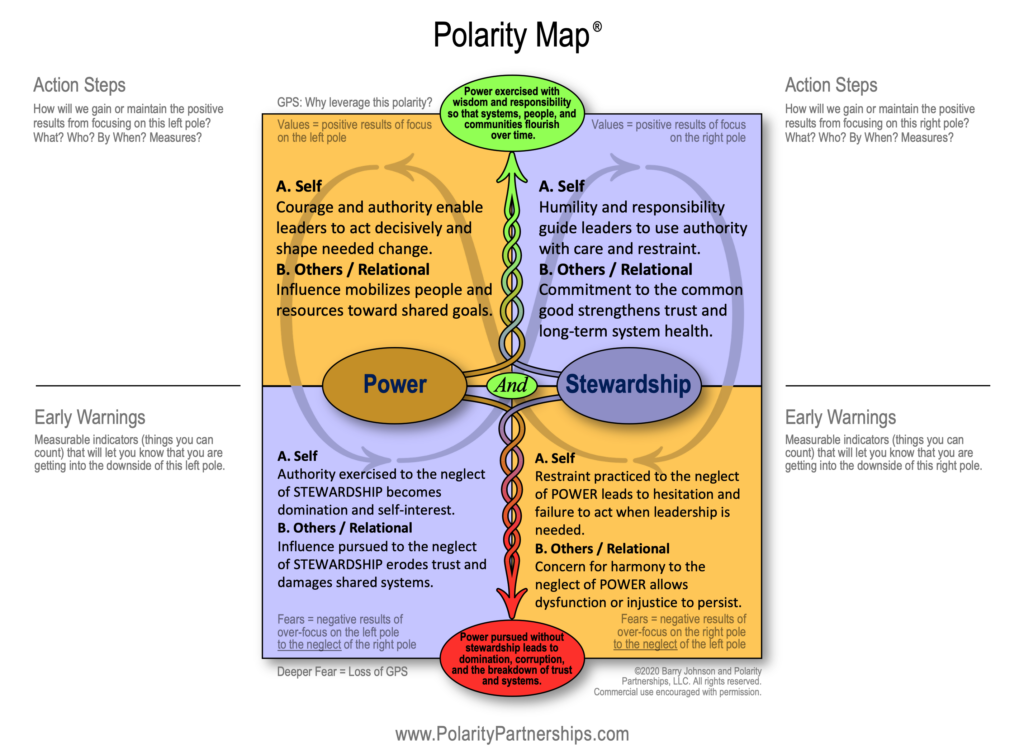
Leaders in positions of stewardship remember the Whole, while people in the parts remember their own power, and together they hold the system accountable for both. Power becomes Stewardship. Ambition becomes responsibility to Part AND Whole.
Because every Part lives within a Whole, and the Whole lives through every Part.
When leaders learn to live inside those tensions, the system gains something rare: the capacity to make wiser decisions over time.
Below are four Polarity Maps that bring these patterns into sharper focus: Part AND Whole (individual leader level), Part AND Whole (organizational level), Freedom AND Equality (societal level), and Economic Development AND Environmental Protection (global level). Notice that the first map—Part AND Whole—is geared toward you as the individual leader. Step 5, Leveraging of the 5-Step Process involves developing Action Steps that help maximize the upsides of both poles while minimizing their potential downsides. In the map for you, I’ve included several sample Action Steps, including High-Leverage Action Steps that support the upsides of both poles. You’ll also see Unique Action Steps that specifically strengthen the upside of each pole. In addition, I’ve included sample Early Warning Signs, which are measurable indicators you can track to help recognize when you may be drifting toward the downside of either pole.
The other Polarity Maps are intentionally left blank for Step 5. Consider using them with your family, team, or organization to develop your own High-Leverage Action Steps, Unique Action Steps, and Early Warning Signs.
INVITATIONS:
How are these polarities showing-up for you right now?
Try the “AI-trained Chat w/Cliff for Step 1, Seeing, CLICK HERE.
Want to go deeper into Polarity Thinking? See our online self-directed Credentialing and Introduction to Polarity Practice, CLICK HERE.
Additional Chapters focusing on variations of this Chapter, see:
Chapter 10
Chapter 36