


See the Series Introduction for Just Tao It, Part I: HERE
See the Just Tao It Series Introduction Tao/It on-ramp, PART II: HERE
See Just Tao It, Chapter 1: HERE
From my interpretation of the Tao Te Ching, Chapter 29 (Unpublished):
Some reach for the powerful place
Without concern for the whole.
Some climb to the highest space
With the intention to control.
In chasing the part
They forget the whole.
Yet the parts are connected.
The whole remembers them all.
Under heaven some lead
And some follow.
Cool winds arrive
And warm winds go.
Some rise high.
Some settle low.
Harvest comes
From the seeds we sow.
The power-wise soul
Keeps both head and heart.
Caring for the whole,
It tends each part.
—
There is a form of leadership that believes power is fundamentally a zero-sum game. When they gain power, we lose it. When they speak, we are silenced. When they lead, we are diminished. That story has existed throughout human history, and it has justified an astonishing amount of suffering along the way.
In chasing the part, they forget the whole.
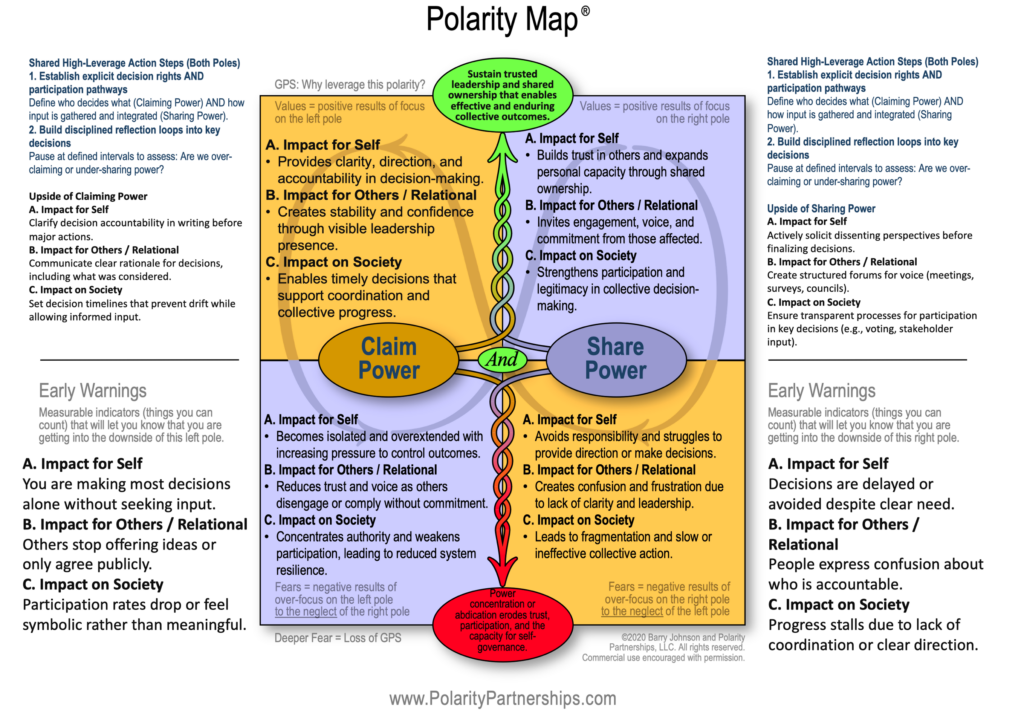
Barry Johnson’s Chapter 22 in And, Volume One remains one of the clearest descriptions I know of this tension: Claiming Power AND Sharing Power. Every individual, group, organization, nation, and democracy requires the capacity to claim power. Human beings need agency, voice, influence, and the ability to shape conditions affecting their lives. Claiming power matters. Though the moment it loses relationship with Sharing Power, systems begin reorganizing around domination — and domination eventually destabilizes everything.
That pattern becomes easier to recognize once you stop looking at politics primarily through ideology and start looking at systems through the lens of power dynamics. Systems that frame power as scarce and under threat eventually make fear politically useful. So does humiliation. So does division. Leadership itself starts becoming performative strength theater: dominance confused for maturity, cruelty confused for honesty.
We’re watching versions of this happen globally now. The V-Dem Institute’s 2026 Democracy Report describes the current period as a “third wave of autocratization,” with roughly 74% of the world’s population now living in autocracies or autocratizing systems, and freedom of expression at 50-year lows. Decline rarely arrives through dramatic coups anymore. It arrives gradually, through institutions weakened from inside by the people meant to steward them — a pattern showing up in established democracies as much as fragile ones.
The whole remembers them all. That’s not just poetry. Damage doesn’t stay contained to one part of a system for long.
Democracy has always contained conflict. Healthy democracies require it. The principle of loyal opposition emerged precisely because democratic systems require a way for people to oppose each other fiercely without abandoning loyalty to the larger constitutional whole holding everyone together.
“His Majesty’s Loyal Opposition,” as it emerged in Britain, recognized something profoundly important: loyalty to a nation and loyalty to its current leadership are different things entirely. The ruling party acknowledges the opposition’s legitimacy. The opposition acknowledges the legitimacy of the constitutional system itself. Both remain accountable to something larger than temporary political victory.
That arrangement requires maturity — enough restraint to tolerate dissent without treating disagreement as betrayal, enough systems-awareness to recognize that peaceful transfer of power depends on preserving legitimacy even when outcomes feel painful. The moment opposition itself gets framed as illegitimate or unworthy of participation, a system starts shifting toward something else entirely.
That movement rarely happens all at once. A population feels threatened, displaced, or exhausted by instability. Someone arrives promising strength, certainty, and enemies to blame. Finally someone is fighting for us. That energy can create real feelings of empowerment among people who felt unseen. Until the compensations begin, and the system starts requiring increasing loyalty, increasing conformity, increasing tolerance for cruelty.
Cool winds arrive. Warm winds go. No tide stays high forever, in any direction — which is exactly why the question was never which side holds power. It’s whether power stays in relationship with the whole once it has it.
Barry Johnson describes something similar in Reality 51 — how groups get “hooked” by one value, unable to access the wisdom of the pole they fear. The more threatened people feel, the more tightly they grip whatever they believe will save them.
Chapter 29 never argues against strength or authority. Those capacities remain necessary. What it recognizes is something modern cultures keep forgetting: power without stewardship eventually becomes self-destructive.
Martin Luther King Jr. named this precisely: “Power without love is reckless and abusive, and love without power is sentimental and anemic.” Some leaders overidentify with force and certainty. Others overidentify with accommodation and avoiding conflict. Healthy systems require both strength and restraint, both advocacy and inquiry — both Claiming Power AND Sharing Power.
Barry Oshry described a similar dynamic through Power Processes AND Love Processes. Too much integration without differentiation produces groupthink. Too much differentiation without integration produces fragmentation. Healthy systems require both.
Technology is accelerating nearly every destabilizing force at once — rewarding outrage faster than discernment, certainty faster than complexity. And reality eventually responds. Systems fragment. Trust erodes. History has a long memory for what happens when power drifts too far from the whole it was meant to serve.
The power-wise soul Keeps both head and heart.
Power remembers itself, eventually. The whole remembers every part it stopped paying attention to. Democracy remembers every voice it stopped listening to. Leadership remembers every life entrusted to it, whether or not it meant to.
Harvest comes from the seeds we sow. That was never only about elections.
Here’s a Polarity Map for Claim Power AND Share Power:
INVITATIONS:
How are these polarities showing-up for you right now?
Try the AI-trained “Chat w/Cliff” for Step 1, Seeing, CLICK HERE.
Want to go deeper into Polarity Thinking? See our online self-directed Credentialing and Introduction to Polarity Practice, CLICK HERE.
Additional Chapters focusing on variations of this Chapter, see:
Chapter 10
Chapter 36