

See the Series Introduction for Just Tao It, Part I: HERE
See the Just Tao It Series Introduction Tao/It on-ramp, PART II: HERE
See Just Tao It, Chapter 1: HERE
From my interpretation of the Tao Te Ching, Chapter 46:
When It flows
warhorses
pull plows
Ignore It
Mares deliver foals
on battlefields.
Look within.
Know when
enough
is enough.
—
What I love about reading Lao Tzu is how you find yourself inside the mystery just making sense of an image handed to you in a spare handful of words. The wisdom is so obvious you might forget there’s anything left to figure out. When the Tao moves through a nation, warhorses get put out to pasture and pull plows instead. When a nation ignores the Tao, war reaches all the way into the pasture, and mares are dropping foals on the battlefield.
That second image is just. Wow. A mare, laboring to bring new life into the world, surrounded by artillery and the dead. Something is wrong here, in the register that makes your stomach drop before your mind catches up. Once you’ve lived inside that wrong long enough, though, it stops registering as wrong at all. It just becomes the weather, and the battlefield becomes just another place new life arrives — as ordinary, in its way, as a nursery.
I asked my undergraduate history teacher a version of that question once. We were deep into a unit on the Nazi regime, working through numbers too large to hold in your head, let alone your heart. Seventeen million dead. Six million of them Jewish, a million and a half of them children. I remember sitting in that lecture hall with a question that felt almost embarrassingly simple, and asking it anyway: How did they get there?
She paused a long time before answering, longer than teachers usually pause. Then, in a measured, deliberate voice, like someone who knew she’d earned the right to say it slow and clear, she said: “They got there in drips and dribbles.”
A slow accumulation of smaller decisions. A society adjusting, and adjusting again, until the unthinkable had become procedure.
I have never forgotten that sentence, mostly because it refuses to stay in the past where most of us, myself included, wish we could keep it. Drips and dribbles is not a description of Germany in the 1930s. It is a description of how deviance normalizes anywhere, in anyone: in a marriage, a company, a country. Something crosses a line. Nothing happens. It crosses again, a little further this time. Still nothing happens, or nothing anyone is willing to name out loud. The line, which used to mean something, moves to wherever the radar has stopped picking it up.
James Hollis, writing on the psychology of our darker selves, offers support to name the mechanism plainly. The first place to look for the Shadow, he says, is in the many daily deals we make: the adaptations, the denials, that only deepen the darkness. Small enough each time to seem forgivable, even reasonable. Cumulative enough, over years, to produce a stranger wearing your face.
The challenge, for me, is what Jung insists on: that we remain wholly accountable for the actions and consequences of our Shadow, even when we were unconscious of it at the time — accountable for what we did, and for what we watched happen and said nothing about. Ignorance does not purchase innocence. That is a hard sentence for a species that prefers its villains obvious and its own hands clean.
Which raises the real question underneath “how did they get there”: how does a population of otherwise ordinary, otherwise decent people arrive somewhere none of them would have consented to if you had shown them the destination on day one? My mentor, partner, and friend Barry Johnson has spent much of his life’s work answering exactly that question — how people get trapped in false choices. His answer is one I initially found more unsettling than any villain, mainly because it removes the villain entirely. There is no evil source architecting harm, even harm at scale. All it takes is a handful of good, ordinary human desires, each pursued to the neglect of the interdependent good beside it. Solve problems without staying open to what you cannot yet see, and you get rigid. Protect your own without also protecting the people outside your circle, and protection curdles into abuse of power. Provide for your own without providing for everyone, and providing becomes hoarding with a clean conscience. Belong to your group without belonging to the whole of things, and belonging turns into a war of Us against Them.
Years ago, in a letter to a friend, I wrote a sentence that makes better sense to me now than it did then: it’s all good, until it becomes all bad. That is the entire mechanism in eight words. Every one of those desires starts as a gift. None of them announces the moment it turns.
None of those desires is the problem. Each one, alone, chasing its upside while blind to its neighbor, becomes the problem. Stack four or five of them and you get a hyper-vicious cycle, one that manufactures genuinely evil results without a single evil actor anywhere in its origin. Barry describes the deeper trap about as plainly as it can be said: the trouble with searching for an evil source is that you will always find one. And once you pinpoint it, that person or group has to be destroyed to stomp out the evil. Genocide starts exactly there, in the conviction that eliminating a category of people is how you eliminate the harm. Most of us, caught in our own smaller drips of normalized deviance, never get near genocide. We get somewhere smaller and easier to live with: I am not the dangerous one, they are. I deflect what I cannot own in myself, and I project it onto whoever is standing nearest, wearing the face of my fear.
This is where the Tao and the psychology shake hands. I call it the Hooked-and-Stuck dynamic — a phrase Barry was generous enough to fold into his own teaching, crediting me for naming a pattern practitioners far older than either of us had already been living inside for decades. The stronger our attachment to one value, the stronger our fear of its opposite, until anyone still holding that opposite value starts to look like a threat instead of a whole human being. The tell is always the same. Contempt — the moment somebody stops needing to understand the other person and starts needing only to defeat them.
Barry names the cost with precision. The degree of inhumanity we employ to hold power over “them” gets matched by the degree of inhumanity we need to project onto them to justify it. The more “they” become less than human, the easier it is for “us” to live with being inhumane to them.
That sentence should stop you, me, and all of us. It names the actual geometry behind the “dumb question” I asked my history teacher, and the answer she gave me decades ago, and behind a hundred smaller cruelties none of us would call by that name, committed daily in offices, comment sections, and family dinners.
Barry has also spent decades articulating and teaching the way out, and it holds up under pressure. Find the value the other side is holding onto, even if their politics make you wince. Find the fear underneath that value; it is rarely as irrational as it looks from the outside. Ask how you might gain what you are going after without asking them to lose what they are rightly protecting — and all of this in service of a (greater) purpose bigger than either pole. None of it requires you to stop believing what you believe. It requires you to stop needing the other side to be worthless in order to keep believing it. It also warns against something else: swinging so hard away from the ditch you were stuck in that you drive straight into the ditch on the opposite shoulder. Getting unstuck was never about trading one pole for the other. It was about learning to stay on the road.
This pattern doesn’t belong to one country, one era, or one side of any argument. I recognize it most easily wherever I’m honest enough to look for it in myself. Language that reclassifies people as burdens or threats before anyone reclassifies them back as neighbors. Institutions that sense something is off and calculate, drip by drip, that this particular adjustment is survivable. My own negotiations with what I’m willing to see and let remain unquestioned.
Which brings me back to the mare, doing the most natural thing a living creature can do, in the least natural place a battlefield can offer. Lao Tzu does not tell us how she got there. He does not need to. He trusts that we already know, somewhere beneath our justifications, when something has gone wrong. The poem does not ask us to end the war. It asks us to look within, and to know when enough is enough.
Gandhi said it plainer than either Johnson or Jung: all humanity is one undivided family, and each of us carries responsibility for the misdeeds of the others; he could not detach himself from the wickedest soul. That is not a comfortable sentence, and it is not supposed to be. It is the same thing my history teacher handed me, forty-some years after the fact, dressed in five words instead of one: there was no them. There was only an us, adjusting.
So here is the only question this chapter is entitled to leave you with, because Lao Tzu never leaves us with answers, only mirrors: where, if you are honest, has enough already stopped being enough?
Look within.
Know when
enough
is enough.
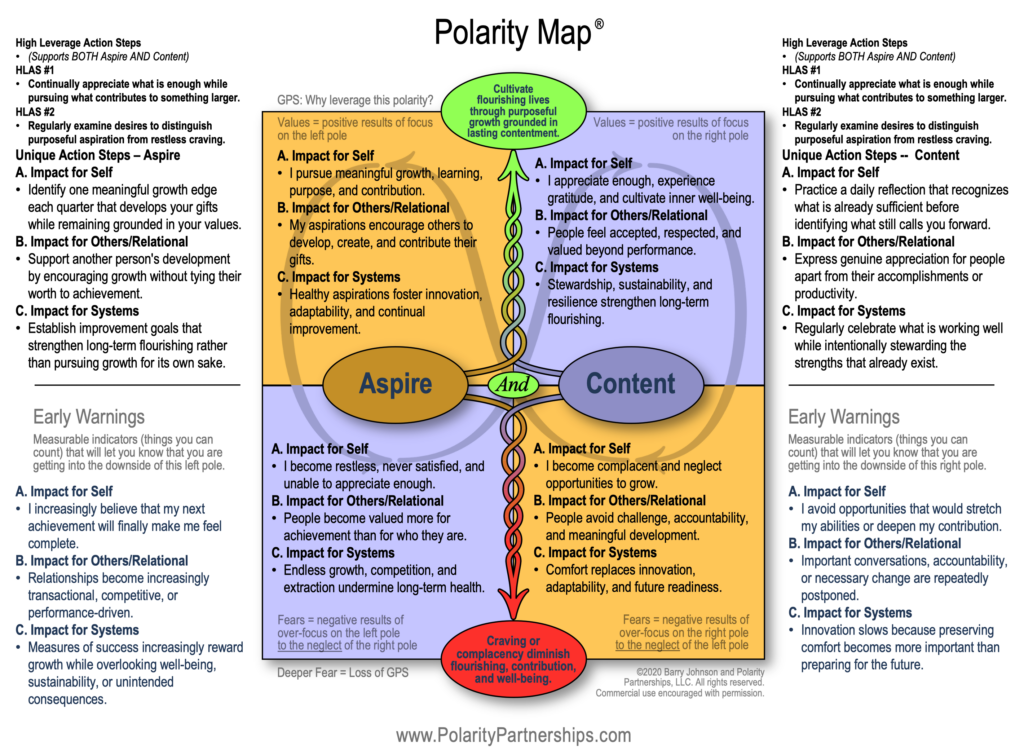
Here’s a Polarity Map for Aspire AND Content:
INVITATIONS:
To use an AI-trained “Chat w/Cliff” for Step 1, “Seeing” CLICK HERE.
Ready for the Polarity Advantage? Go deeper into Polarity Thinking, see our online self-directed Credentialing and Introduction to Polarity Practice or in-person training with Barry Johnson and me at Kayser Ridge by CLICKING HERE.