

See the Series Introduction for Just Tao It, Part I: HERE
See the Just Tao It Series Introduction Tao/It on-ramp, PART II: HERE
See Just Tao It, Chapter 1: HERE
From my interpretation of the Tao Te Ching, Chapter 53 (Unpublished):
Returning to common sense
and common practice,
I walk Its way.
Suffering follows—
when from It, I stray.
See courts adorned magnificently,
while fields grow weedy,
the people hungry,
the granaries empty.
Abundance for some:
lavish robes everywhere,
great weapons on proud display,
basics for all sealed away—
when from It, we stray.
—
Most societies do not deteriorate because people suddenly stop cooperating.
Cooperation gradually drifts too far from what cooperation exists to serve.
Yuval Noah Harari argues that human beings became the dominant species less through individual strength than through the ability to cooperate flexibly in large numbers. Shared stories—religions, nations, laws, currencies, markets, and institutions—allowed strangers to trust one another enough to build food systems, trade networks, governments, healthcare, education, and collective defense.
That capacity reshaped human history.
Eventually, though, every civilization confronts the same underlying question:
Cooperation for whom?
That question lives underneath Chapter 53.
Lao Tzu does not begin with ideology or economics. He begins with patterns. Courts become magnificent while fields grow weedy. Symbols of success multiply while the conditions necessary for shared flourishing weaken underneath them. Spectacle expands while foundations deteriorate.
Once recognized, the pattern starts appearing almost everywhere.
Healthcare systems where insurance companies post record profits while families ration insulin.
Housing markets where investment firms accumulate neighborhoods while teachers and nurses struggle to afford rent.
Educational systems where elite institutions expand endowments while public schools deteriorate.
The surfaces shine while the granaries empty.
This is where Either/Or-thinking starts becoming insufficient. Either/Or-thinking remains essential in many situations. A firefighter evacuates OR stays. A pharmacist dispenses OR refuses. A bridge either holds OR fails. Distinctions remain essential. Limits remain essential. Consequences remain real.
Yet societies cannot remain healthy through binary logic alone once survival depends on tensions requiring ongoing leverage over time.
That helps explain why the endless capitalism versus socialism argument so often generates more heat than wisdom.
One side sees exploitation, concentrated wealth, and systems abandoning vulnerable people while rewarding accumulation without limits.
The other sees stagnation, dependency, overreach, and systems suppressing initiative, innovation, and freedom.
Both perspectives contain important truths.
Both also become dangerous once separated from relationship with the other.
Barry Johnson explored this dynamic in Chapter 29 of AND, through stacked polarities like Abundance for Some AND Basics for All, Claim Power AND Share Power, and All Are Accountable AND All Are Loved. Once these tensions become ideological enemies rather than interdependent realities, systems begin destabilizing themselves.
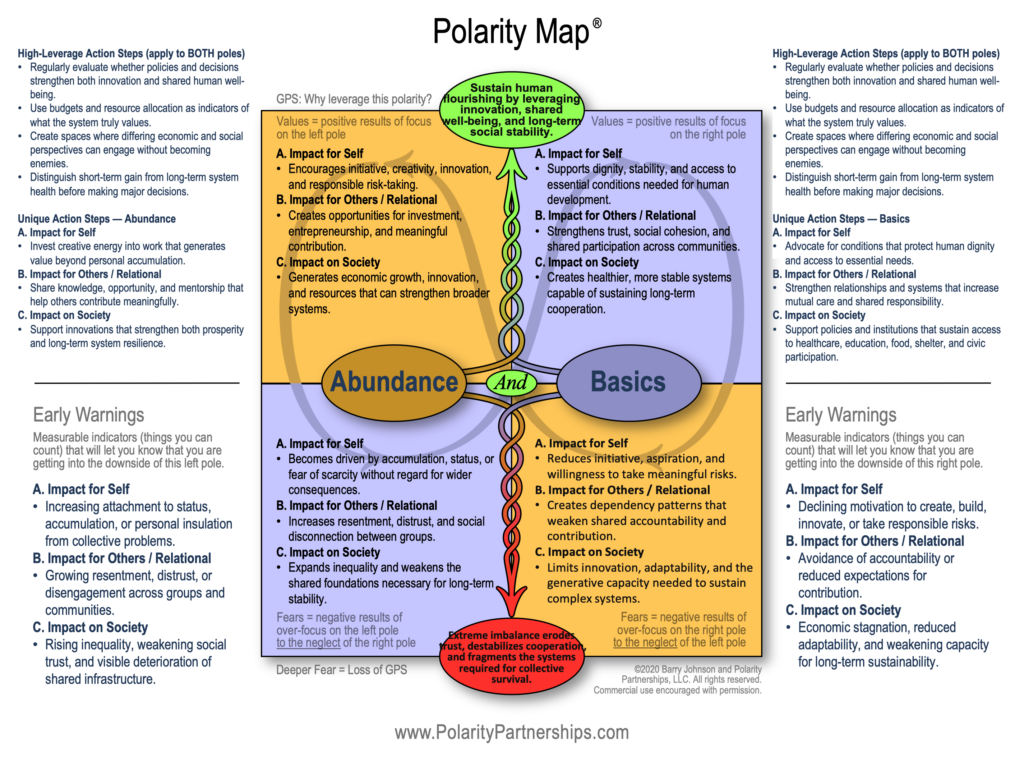
Abundance for Some to the neglect of Basics for All gradually produces distrust, instability, and forms of suffering no amount of private wealth escapes.
Basics for All to the neglect of Abundance for Some creates different dangers. Innovation weakens. Incentives distort. Systems drift toward stagnation and dependency.
The same pattern repeats throughout the larger polarity field.
Claim Power to the neglect of Share Power produces domination. Share Power to the neglect of Claim Power produces fragmentation and drift.
All Are Accountable to the neglect of All Are Loved hardens into cruelty. All Are Loved to the neglect of All Are Accountable drifts toward incoherence.
These tensions do not disappear because one side wins an election or temporarily controls institutions.
They remain.
Oliver Libby’s work surrounding “Strong Floor, No Ceiling” illuminates the same underlying pattern. A strong floor provides enough stability for people to survive, participate, and take meaningful risks. No ceiling preserves the freedom to create, innovate, build, and contribute beyond imposed limits.
Neglect the floor and societies fracture under instability and distrust. Neglect the ceiling and societies lose creative energy and adaptive capacity necessary for renewal.
Neither functions sustainably alone.
This is how interdependent systems actually operate.
The longer I’ve worked inside organizations, the less convinced I’ve become that institutions fail because people stop caring. They more often drift because the work slowly becomes disconnected from the purpose that first gave it life.
Once multiple polarities begin destabilizing simultaneously, trust starts eroding across the larger system: trust in institutions, trust in leadership, trust in neighbors, trust that sacrifice still counts, trust that the future will remain coherent long enough for contribution to mean something.
That erosion is consequential because trust may be one of the most important forms of infrastructure human beings have ever created.
Without trust, cooperation contracts. As cooperation contracts, fear expands. Fear narrows identity. Fear justifies hoarding. Fear turns neighbors into threats and strangers into abstractions.
Soon the weapons return to proud display.
Harari makes another observation worth paying attention to: budgets often reveal the true values of societies more honestly than speeches do. Resource allocation reveals what systems actually protect.
For most of human history, enormous portions of collective wealth flowed toward war, conquest, and protection from enemies. More recently, some societies began investing more heavily in healthcare, education, and human well-being. Imperfectly and unevenly, certainly, though still reflecting an important developmental shift: sustaining life gradually becoming more valuable than dominating rivals.
Fear changes priorities quickly.
And now AI enters this polarity field as both amplifier and accelerant. Systems optimized for engagement naturally amplify outrage, certainty, tribal identity, and emotional reaction because those responses sustain attention. The Radical Middle—the place where most people actually live, where most citizens continue cooperating even as louder extremes dominate attention, and where wisdom often emerges—struggles for visibility inside outrage-driven systems.
Human Judgment AND Artificial Intelligence is no longer a future polarity. It is already reshaping economies, democracies, trust systems, and human identity itself.
This is where the deeper Part AND Whole polarity becomes unavoidable.
Aristotle wrote that the whole is greater than the sum of its parts. True enough. Living systems reveal something equally important: once enough Parts remain neglected long enough, the Whole gradually deteriorates from within.
Plato also recognized something similar. Parts rarely flourish for long inside weakened wholes.
When communities lose trust, nations weaken. When workers lose dignity, economies destabilize. When ecosystems become expendable, civilizations grow fragile.
First trust weakens. Then shared sacrifice weakens. Then coherence weakens. Eventually reality itself fragments into competing stories no longer capable of sustaining cooperation across difference.
And still the courts remain magnificent.
The Tao circles back toward something far less glamorous and far more demanding: common sense and common practice.
Stewardship. Relationship.
The disciplined work of leveraging tensions that do not disappear simply because one side temporarily gains power over the other.
Wiser societies are less defined by eliminating tension than by developing enough maturity to leverage interdependence before suffering forces the lesson upon them.
Because suffering follows—
when from It, we stray.
Here’s a Polarity Map for Abundance AND Basics:
INVITATIONS:
See Barry Johnson’s Chapter 29 discussion of stacked polarities including Abundance for Some AND Basics for All. And_V1_PEEK_C29_Poverty_Racism_Sexism
To use an “AI-trained Chat w/Cliff for Step 1, Seeing” CLICK HERE.
Ready for the Polarity Advantage? Go deeper into Polarity Thinking, see our online self-directed Credentialing and Introduction to Polarity Practice or in-person training with Barry Johnson and me at Kayser Ridge by CLICKING HERE.