

See the Series Introduction for Just Tao It, Part I: HERE
See the Just Tao It Series Introduction Tao/It on-ramp, PART II: HERE
See Just Tao It, Chapter 1: HERE
From my interpretation of the Tao Te Ching, Chapter 6 (Unpublished):
It is, without limit.
Like a valley, still.
Like a mystery spirit—
a well, forever full,
for heaven and earth—
in use,
inexhaustible.
—
Between 2003 and 2010, the identities I had built during my adult life seemed to get chopped at the knees, one by one. Health brought two back surgeries and cancer. My finances were strained by a lawsuit that stretched on for years, followed by a layoff during the global financial crisis. A divorce and the crumbling dream of Kayser Ridge carried their own losses. During those years, I often went to Kayser Ridge to grieve. I sat alone in the unfinished shell of a building—essentially a construction site—with no electricity, water, windows, or doors. Nature had already begun taking it back. I remember sitting there, tired and beaten down physically, mentally, and emotionally. I was exhausted.
The usual ways of making sense of things stopped holding during that stretch. Effort no longer translated the way it once had. Even hope began to feel conditional, tied to outcomes I no longer trusted myself to predict.
And yet something remained on the spiritual side of things. I could only describe it as emptiness.
I began to sense a difference between feeling depleted and being empty. Depletion felt like running out, as though there were nothing left to draw from. Emptiness began to open into space: capacity, a kind of receptivity that did not depend on stored reserves.
The shift began when I stopped trying to figure everything out or manufacture strength I no longer had. Steadier ground became available then. Nothing was resolved, and the circumstances did not change. The ground simply held me.
None of this is unique to me. We each meet some version of it—a moment that asks more of us than we thought we had.
Viktor Frankl lived this tension under conditions incomparably harsher than mine. In the concentration camps, almost every external freedom was stripped away. What he continued to notice was the human capacity to take a position toward what was happening—to orient toward meaning even when the range of possible action had been reduced to almost nothing. His work helped me understand the space between stimulus and response as more than a pause. It can be the remaining ground of human freedom.
Helen Keller encountered the relationship from another edge. Before language opened for her, sensations arrived without shared names. At the water pump, Anne Sullivan spelled w-a-t-e-r into one hand while water flowed over the other, and stimulus became meaning. Touch became language, language became relationship, and a world that had felt inaccessible became reachable. Her response did not erase the conditions of her life. It opened a way to participate in them.
Frankl and Keller lived radically different lives, and neither story can be reduced to a lesson about choosing well. What I recognize in both is a relationship between what reaches us and what moves through us in return. Stimulus matters, response matters, and neither can carry the whole of a life alone.
What happens and what we make of it often arrive together, fused so quickly that they feel inseparable. A disruption becomes a direction; a loss becomes a story about the future before we have had any real say in it. Pressure can loosen that fusion. When it does, what opens feels less like something we control than something we can reach.
The Tao points to it without trying to define it. A valley that receives. A well that gives. A source that does not depend on circumstances to remain what it is.
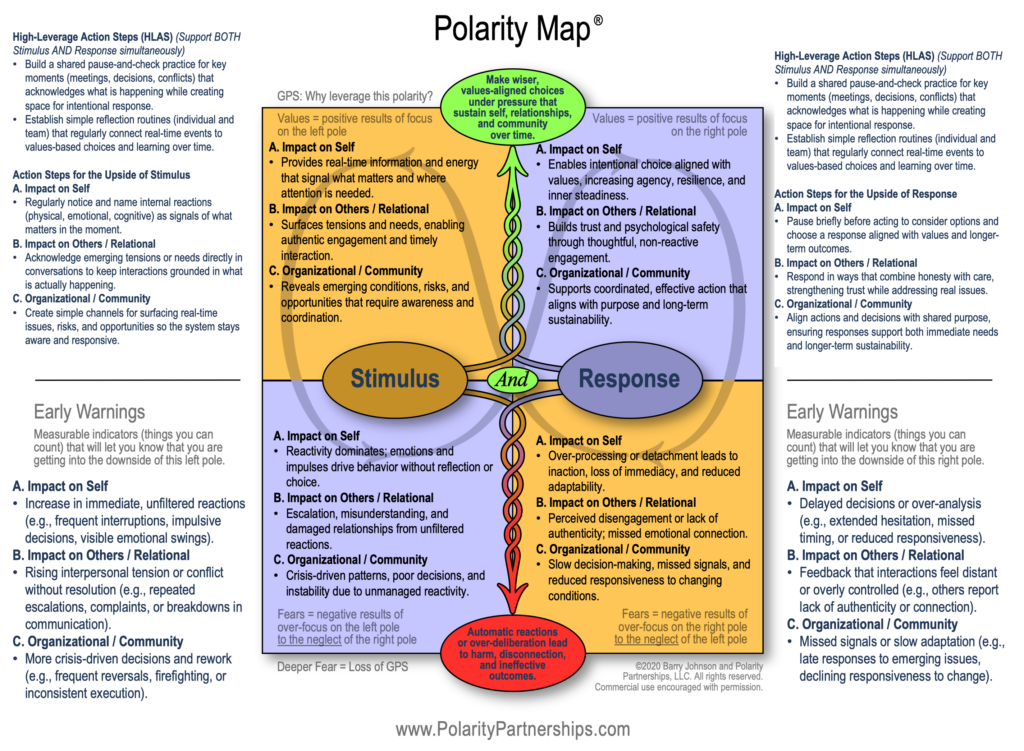
That is why I have come to see Stimulus AND Response as a polarity. Stimulus keeps us in contact with what is happening—in us, between us, and around us. Response gives shape to what follows. When stimulus outruns response, we can become reactive. When response loses contact with stimulus, we can become delayed, detached, or overly controlled. The movement between them is where wiser, values-aligned choice becomes possible.
Hardship remains, outcomes stay uncertain, and explanations rarely arrive. Still, there are moments when the well carries the next step without offering clarity, resolution, or assurance about how things will turn out. It simply does what a well does.
Over time, my relationship to those years changed more than the years themselves. What once felt like an ending became something I had lived through. The emptiness gradually revealed a different kind of fullness: the people who stayed, the relationships that held, and a depth beneath them I still cannot name.
A well keeps no account of what has been drawn from it. A valley receives what comes.
I went to Kayser Ridge to sit alone in an empty shell. Years later, that is where I remember beginning to recognize that I was being held.
Here’s a Polarity Map for Stimulus AND Response:
INVITATIONS:
Self-assess by taking a custom Polarity Assessment for this chapter, HERE.
To use an “AI-trained Chat w/Cliff for Step 1, Seeing” CLICK HERE.
Ready for the Polarity Advantage? Go deeper into Polarity Thinking, see our online self-directed Credentialing and Introduction to Polarity Practice or in-person training with Barry Johnson and me at Kayser Ridge by CLICKING HERE.