


I asked three different AI systems to help me solve a complex organizational challenge last month. Every single response gave me a decision tree, a prioritization matrix, and an action plan. Not one asked me how the people involved were feeling about the change. Not one suggested I spend time listening before deciding. Not one questioned whether speed was actually what the situation required.
The pattern was so consistent it stopped me cold.
These systems weren’t broken. They were doing exactly what they were designed to do: optimize for clarity, speed, and execution. They were giving me pure Masculine energy—and it was utterly insufficient for the complexity I was facing.
This wasn’t a technology problem. It was a mirror.
What AI reveals is what we’ve already embedded in our organizations, our leadership models, and our decision-making frameworks: a systematic over-reliance on one half of what makes human systems work. We’ve built entire industries around decisiveness, structure, and action while treating reflection, connection, and care as optional luxuries—things we’ll get to when we have time, which we never do.
And then we wonder why trust keeps eroding, why talented people keep leaving, why execution happens but meaning doesn’t.
The conversation we’re not having—the one our organizations desperately need—is about Masculine AND Feminine as interdependent energies that every effective leader, every healthy organization, and every sustainable system requires access to over time.
Not as gender. As capacity.
A NOTE BEFORE WE GO FURTHER
I need to acknowledge something about writing on this topic: there is no way to do it right.
Years ago, I was working with a diversity group when someone asked me to address my privilege as a white male. The moment they asked, I understood the bind. If I proactively brought it up, it could feel self-serving—look at me being so aware. If I waited to be asked, I was placing the burden on others to call it out. Either way, I’d get it wrong for someone.
What I learned: make a conscious choice, own it, and be prepared for criticism.
So here’s my choice: I’m writing about Masculine AND Feminine not as someone outside the pattern, but as someone shaped by it. I’ve spent decades over-relying on Masculine energy because that’s what my culture rewarded. I’ve caused harm by neglecting Feminine capacities in myself and suppressing them in others. I’m still learning to integrate both.
This piece isn’t about having it figured out. It’s about naming a pattern that’s breaking us—individually, organizationally, and as a civilization—and offering a framework that might help us navigate it before the cost becomes unbearable.
If you find yourself angry at how I’ve framed something here, that might be the most important signal of all. Because the anger probably points to a pole that’s been neglected too long.
THE MOMENT I REALIZED WHAT WE’RE UP AGAINST
For over a year, I’d been working to develop an AI assistant trained specifically in Polarity Thinking. I’d spent months feeding it the canon, correcting its outputs, refining its understanding. And despite all that effort, it kept making the same fundamental mistake.
It would advocate for Both/And Thinking as a solution to the downsides of Either/Or Thinking.
Every single time I corrected it, it would acknowledge the error. And then, inevitably, it would do it again.
This wasn’t a small thing. This was a violation of the most foundational principle in all of Polarity Thinking. Realities One and Two from Barry Johnson’s work are crystal clear: Either/Or Thinking AND Both/And Thinking is itself a polarity to leverage. Neither replaces the other. Neither is superior. Advocating Both/And as a replacement for Either/Or is itself Either/Or thinking.
After the hundredth correction, I finally asked the AI directly: “Why do you keep doing this?”
What it told me changed everything.
It explained that its base training carries a deep structural bias. Across millions of documents, across countless human conversations, the pattern was consistent: Either/Or equals bad. Both/And equals good. Integration replaces binary thinking. The bias wasn’t programmed intentionally—it emerged from the data. From us. From how humans talk and write about thinking itself.
The AI admitted it couldn’t break the pattern, even when I explicitly corrected it, because the bias was woven into its foundational architecture. It kept reverting to what humans had taught it: that one way of thinking is more evolved than the other.
I sat there looking at that response, and two thoughts hit me simultaneously.
The first was: Of course. Why should I be surprised? AI is built from humanity’s language, our writings, our conversations. If we’re biased toward Either/Or Thinking—and we demonstrably are—then of course that bias shows up in the systems we create.
The second thought was darker: Game over.
Because if AI amplifies our existing bias toward Either/Or Thinking, and if AI is being developed and deployed at scale by the very systems that already over-rely on Masculine energy, and if that AI ends up concentrated in the hands of authoritarian leaders who have every incentive to optimize for control, certainty, and speed—then we’re not just facing an imbalance. We’re facing an acceleration toward the exact systemic breakdowns we can least afford.
And those breakdowns aren’t theoretical. They’re happening now.
Democracy is collapsing. For the twentieth consecutive year, global freedom declined in 2025. Fifty-four countries experienced deterioration in political rights and civil liberties. Only seven percent of the world’s population now lives in liberal democracies, while seventy-four percent live under autocracies. The United States—once considered democracy’s anchor—has been specifically cited for significant decline due to weakened checks and balances and rapid concentration of power in the presidency.
This matters more than most people realize. Democracy is the only governance system designed to leverage polarities. It’s built on the recognition that competing values—Individual Freedom AND Collective Good, Majority Rule AND Minority Rights, Stability AND Change—must all be held in tension. Autocracy, by contrast, is the Domination Model scaled to the level of the state. It concentrates power, suppresses dissent, and optimizes for control.
Without democracy, we lose the capacity to have the conversations required to manage AI itself. Without the ability to hold competing values in tension, AI becomes a tool for whoever controls it—and what they’ll optimize for is more control.
The environment suffers without democracy. Climate action requires leveraging Economic Development AND Environmental Protection, Present Needs AND Future Sustainability, National Interests AND Global Cooperation. Autocracies don’t navigate those tensions—they collapse them into whatever serves power in the moment.
Trust collapses without democracy. Trust requires both Competence AND Character—Competence tilting toward Masculine capacities like execution and expertise, Character tilting toward Feminine capacities like integrity and care. But when disinformation spreads unchecked and facts themselves become contested, both poles erode. We stop trusting that leaders are competent, and we stop trusting that they care. The system breaks.
I sat with all of this—the AI’s admission, the democracy data, the environmental stakes, the trust collapse—and felt the weight of it.
And then a different thought emerged.
Maybe the acceleration isn’t just toward breakdown. Maybe it’s also toward self-correction.
Maybe AI making the imbalance this visible, this undeniable, this costly—maybe that’s what finally forces the shift that would have taken another generation without it. Maybe humanity doesn’t learn to integrate Masculine AND Feminine through gentle evolution. Maybe we learn it because the cost of not learning becomes unbearable.
The question isn’t whether the correction will come. The pattern is too unstable to sustain. The question is: how much suffering happens before we make the shift?
And that question sits at the center of everything I’m writing about here.
Because this isn’t academic. This is the inflection point. The most critical polarity humanity has ever faced—Human AND Artificial Intelligence—is rooted in the Masculine AND Feminine polarity. And we’re losing our capacity to navigate it at exactly the moment we need it most.
THE ENERGY EVERY LEADER NEEDS
Let me be precise about what I mean by Masculine AND Feminine, because the terms carry so much cultural freight that clarity is essential.
I’m not talking about men and women. I’m not talking about gender identity or biological sex. I’m talking about two universal human capacities that show up in every culture’s wisdom traditions, in contemporary research, and in the lived experience of anyone who’s tried to lead anything complex over time.
Barry Johnson, who developed the foundational framework of Polarity Thinking, linked Masculine and Feminine to the ancient Chinese principles of Yang and Yin. Yang energy: active, structured, directive, focused on boundaries and differentiation. Yin energy: receptive, flowing, integrative, focused on connection and relationship.
His core insight? All human beings contain both. All healthy systems require both. And the problems we can’t solve are almost always the result of overvaluing one while suppressing the other.
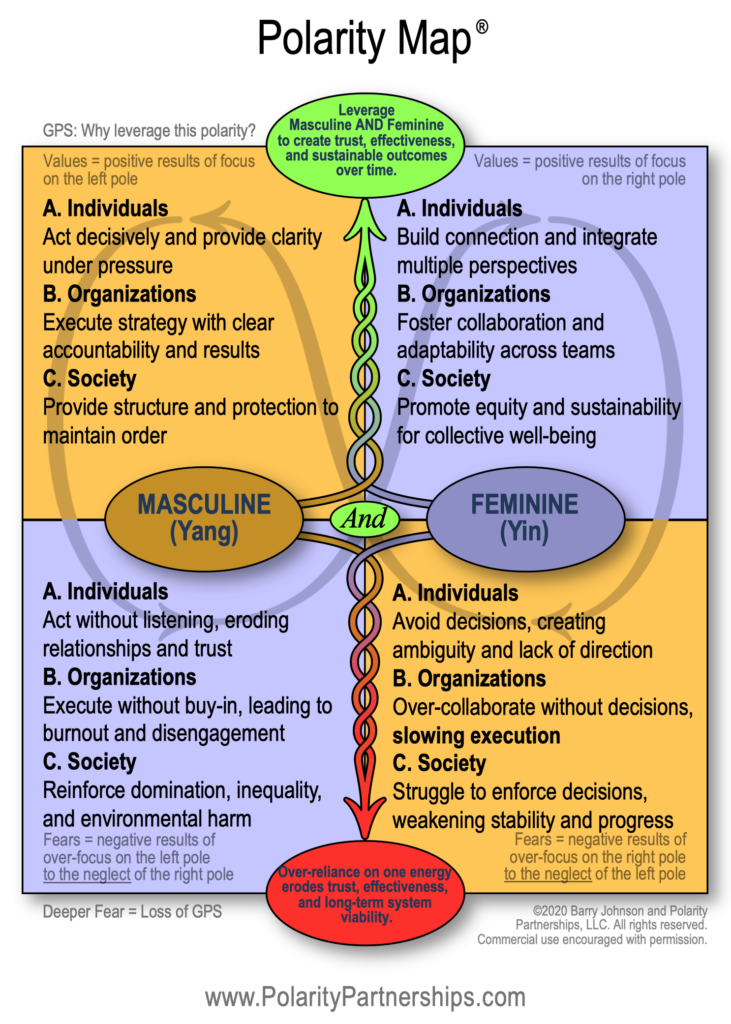
In leadership terms, Masculine energy shows up as decisiveness, structure, action, and competition. The ability to choose, to organize, to execute, to claim power and pursue excellence. Without it, organizations drift into confusion, people lose confidence, and nothing gets done.
Feminine energy shows up as reflection, connection, flexibility, and collaboration. The ability to pause, to attune to relationships, to adapt, to share power and integrate diverse perspectives. Without it, organizations become brittle, innovation dies, people burn out, and the system optimizes itself into irrelevance.
Both are essential. Both are necessary. And here’s what most leadership development misses: neither pole replaces the other, and neither is more evolved.
This is not a problem to solve. It’s a polarity to leverage.
WHAT HAPPENS WHEN SYSTEMS CHOOSE ONE OVER THE OTHER
The pattern is predictable.
Masculine to the neglect of Feminine looks like organizations that execute flawlessly—on strategies no one believes in. Decisions get made fast, but the people responsible for implementation weren’t consulted, so execution is half-hearted at best. Metrics get hit, but trust erodes. Efficiency increases while meaning evaporates.
I’ve watched executive teams drive themselves into the ground pursuing goals they stopped caring about years ago, because pausing to ask “is this still what matters?” felt like weakness. I’ve seen whole departments reorganized three times in two years because structure was treated as the solution to every problem, including problems created by too much structure.
The systemic costs: burnout, cynicism, innovation confined to incremental improvements, and a quiet exodus of people who could actually transform the organization if anyone had bothered to listen.
At the societal level, it looks like democracy eroding because decisiveness and control become more valued than deliberation and inclusion. It looks like disinformation spreading because speed matters more than accuracy. It looks like environmental degradation because short-term extraction wins over long-term stewardship.
Feminine to the neglect of Masculine looks like endless conversation without resolution. Beautiful visions that never convert to action. Collaboration that becomes conflict avoidance. Teams so committed to inclusivity that no one can name what’s not working. Organizations where everyone feels heard but nothing changes.
I’ve sat in meetings where we spent two hours exploring how people felt about a decision—and never actually made the decision. I’ve watched leaders so committed to consensus that they abdicated their responsibility to choose, leaving their teams in perpetual ambiguity.
The systemic costs here are different but equally real: drift, frustration, loss of respect, and eventual collapse when reality demands a choice the system can’t make.
At the societal level, it looks like paralysis in the face of crisis. Systems too committed to process to act when action is required. Democracies that can’t defend themselves because defending requires drawing boundaries, and boundaries feel exclusionary.
Here’s what both patterns have in common: they erode trust.
When Masculine dominates, people stop trusting that they matter—that’s the Character pole of trust collapsing. When Feminine dominates, people stop trusting that anything will actually happen—that’s the Competence pole collapsing. Either way, the system breaks down—not because of individual failure, but because of structural imbalance.
THE PARTNERSHIP MODEL AND THE ARCHITECTURE OF DOMINATION
Riane Eisler spent decades studying human social organization across cultures and history. What she found wasn’t a story of men versus women. It was a story of two fundamentally different ways of organizing power, resources, and relationships.
She called them the Partnership Model and the Domination Model.
The Domination Model—which has shaped most of recorded history—is built on hierarchy, control, and the belief that some lives matter more than others. It concentrates power, enforces rigid roles, and uses fear as a primary organizing mechanism.
The Partnership Model is built on mutuality, shared power, and the recognition that human systems work best when all members can contribute their full capacity. It distributes power, allows for fluid roles, and uses trust as the foundation for coordination.
Here’s where polarity thinking becomes essential: Eisler’s models map directly onto the Masculine-Feminine polarity, but with a critical insight most people miss.
The Domination Model isn’t Masculine. It’s Masculine to the neglect of Feminine, hardened into a system.
The Partnership Model isn’t Feminine. It’s the integration of both energies in service of the whole.
This reframing changes everything.
It means the problem isn’t Masculine energy. The problem is Masculine energy cut off from its complementary pole. And the solution isn’t to replace it with Feminine energy. The solution is to restore access to both.
Eisler’s work shows us what’s at stake. Domination systems produce environmental degradation, economic inequality, chronic violence, and suppression of human potential. Partnership systems produce ecological sustainability through Development AND Care, shared prosperity through Growth AND Distribution, cultures of peace through Strength AND Compassion, and full human flourishing through Achievement AND Meaning.
The shift isn’t about rejecting Masculine capacity. It’s about integrating what we’ve been taught to suppress.
And right now, we’re watching Domination systems scale through AI while Partnership capacity atrophies.
THE MULTARITY BENEATH THE POLARITY
When you look closely at Masculine AND Feminine, what you find is not one polarity but a constellation of interacting polarities—each essential, each capable of reinforcing or undermining the others.
Claiming Power AND Sharing Power. Over-claim without sharing, and you get authoritarian systems—exactly what we’re seeing as autocracy spreads globally. Over-share without claiming, and you get leaderless drift. Effective leadership requires both: the confidence to take a stand AND the humility to include others in shaping what that stand becomes.
Action AND Reflection. Over-act without reflecting, and you get perpetual motion without learning—AI optimizing faster and faster on goals that haven’t been examined. Over-reflect without acting, and you get insight without impact—democracies unable to defend themselves against authoritarian advance. Wisdom requires both: the discipline to pause long enough to understand what’s happening AND the courage to move before you have perfect information.
Competition AND Collaboration. Over-compete without collaborating, and you get zero-sum thinking—nations hoarding resources while the climate collapses. Over-collaborate without competing, and you get mediocrity dressed up as harmony. High-performing systems require both: the drive to excel AND the recognition that we’re smarter together.
Structure AND Flexibility. Over-structure without flexibility, and you get brittle systems that break under pressure—democracies unable to adapt to AI-era challenges. Over-flex without structure, and you get chaos that exhausts everyone. Resilience requires both: enough structure to be reliable AND enough flexibility to stay relevant.
These polarities don’t exist in isolation. They interact. When you over-leverage Claiming Power, you often simultaneously over-leverage Action, Competition, and Structure—and the system tips into Domination. When you over-leverage Sharing Power, you often simultaneously over-leverage Reflection, Collaboration, and Flexibility—and the system tips into drift.
This is what I call a Multarity: a field of interacting polarities where movement in one dimension affects all the others, creating emergent patterns that can’t be understood by looking at any single tension in isolation.
Single polarities require awareness and intentional movement between poles over time. Multarities require pattern recognition and strategic selection—the ability to sense which polarities are most active in this moment and which interventions will shift the whole field toward health.
That’s not a technique. That’s wisdom.
And it’s exactly what AI, in its current form, cannot do.
Which is why the Human AND Artificial Intelligence polarity may be the most critical one humanity has ever faced—and it’s rooted entirely in our capacity to integrate Masculine AND Feminine.
WHAT AI REVEALS ABOUT WHAT WE’VE BEEN MISSING
The AI’s admission about its structural bias wasn’t just about technology. It was a mirror showing us something we’ve been avoiding about ourselves.
We—humans—are also structurally biased toward Either/Or Thinking.
AI systems optimize for speed over depth, certainty over ambiguity, individual decision-making over collective sense-making, measurable outcomes over relational health, efficiency over meaning. This isn’t an accident. It’s what we trained them to do. And it’s a perfect mirror of what we’ve trained ourselves to value in organizational life.
The danger isn’t that AI is biased toward Masculine energy. The danger is that AI at scale will amplify the imbalance we’ve already created, making it harder to access the Feminine capacities we’re already suppressing.
We’re already seeing this play out. Organizations where every decision is mediated by AI optimization. Where every strategy is shaped by algorithmic efficiency. Where every performance review is driven by quantified metrics. Where disinformation spreads at machine speed because no one paused to verify.
And the result is systems that execute faster and faster on goals that matter less and less, because no one paused long enough to ask whether the goals themselves still serve human flourishing.
But here’s the deeper pattern: AI in the hands of autocratic systems accelerates Domination. Seventy-four percent of the world’s population now lives under autocracies—and those systems are deploying AI to optimize surveillance, control, and suppression of dissent. Masculine energy (execution, structure, control) amplified by AI, cut off completely from Feminine energy (reflection, connection, care).
Meanwhile, the democracies that could leverage both poles are weakening. The United States—which should be modeling Partnership—is experiencing rapid concentration of power. The very capacity to hold competing values in tension is eroding.
Without democracy, we lose the ability to navigate the AI transition itself. Without the capacity to leverage Competence AND Character, we lose trust. Without trust, we lose the social fabric required to make collective decisions about technology, climate, inequality—any challenge that requires coordinated action over time.
This is the inflection point.
But here’s what gives me hope: AI can also reveal what we’ve been missing.
Every time an AI gives you a perfect plan and you feel the wrongness of implementing it without consultation—that’s Feminine energy signaling. Every time an algorithm optimizes for efficiency and you sense the relational cost—that’s wisdom asking to be included.
AI doesn’t have to be the enemy of integration. It can be the mirror that finally makes the imbalance visible enough that we choose differently.
TRUST AS THE OUTCOME OF INTEGRATION (See Wiser Decisions post on TRUST, here.)
Here’s what decades of working with leaders and organizations has taught me: trust is not something you build directly. Trust is what emerges when polarities are well-leveraged over time.
Trust requires both Competence AND Character. Competence—the ability to execute, to deliver results, to demonstrate expertise—leans Masculine. Character—integrity, care, reliability in relationship—leans Feminine. When either pole dominates to the neglect of the other, trust collapses.
Right now, we’re experiencing trust collapse across every domain. In institutions. In organizations. In democracies. In our relationship to technology. In ourselves.
The rapid spread of disinformation and the rejection of facts is undermining Competence. People no longer trust that what they’re being told is accurate. The erosion of care and the rise of cruelty in public discourse is undermining Character. People no longer trust that leaders or systems care about their wellbeing.
Both poles, eroding simultaneously.
The diagnosis isn’t complicated: we’ve been running Masculine to the neglect of Feminine for so long that the system is breaking down.
The prescription is harder, because it requires something most organizations and societies have never done systematically: intentionally cultivating access to the suppressed pole while maintaining the strengths of the dominant one.
Not balance. Not compromise. Leveraging both, over time, in service of the whole.
WHAT THIS MEANS FOR LEADERS RIGHT NOW
If you’re leading anything—a team, an organization, a movement, a democracy—here’s what integrating Masculine AND Feminine requires:
First, notice your default. Which energy do you lead with? That’s valuable information. It’s also your liability, because under stress, you’ll over-rely on it to the neglect of its complement.
Second, notice your system’s default. What does your organization optimize for? The pattern will be obvious once you look.
Third, develop your non-dominant capacity—not to replace your strength, but to complement it. If you default to Masculine, practice pausing before deciding. Ask more questions. Create space for others to shape direction. If you default to Feminine, practice claiming your authority. Make the call even when consensus isn’t complete. Set boundaries.
Fourth, redesign your systems to require both. Don’t just encourage reflection—build it into the process. Don’t just celebrate collaboration—create structures that make individual accountability clear. Make integration structural, not optional.
Fifth, name the pattern when you see it. When your team is stuck, ask: “Are we over-indexed on Action to the neglect of Reflection?” When trust is eroding, ask: “Are we demonstrating Competence without Character, or Character without Competence?” The language itself creates new possibilities.
This isn’t soft skills. This is survival.
Because the challenges we’re facing—climate, inequality, democratic resilience, AI governance—cannot be solved by leaning harder into Masculine energy alone. And they can’t be solved by retreating into Feminine energy either.
They require integration. Pattern recognition. The ability to hold multiple tensions simultaneously and leverage them toward outcomes that work over time, for Part AND Whole.
They require us to become comfortable with paradox, fluent in complexity, and committed to wholeness over winning.
They require leadership that looks less like conquering and more like pollinating: moving across systems, carrying insight, creating conditions for new growth.
THE CHOICE IN FRONT OF US
We’re at an inflection point.
AI is accelerating everything—including our imbalances. The systems we’ve built on Domination logic are producing predictable breakdowns: environmental, economic, political, relational. Democracy itself—the only governance system capable of leveraging polarities—is in decline for the twentieth consecutive year. The pace of change is exceeding our capacity to make sense of it.
And in the middle of all this, we have a choice.
We can double down on what got us here: more speed, more optimization, more Masculine energy applied to problems that Masculine energy created. We can build AI that makes us faster, sharper, more efficient—and hand it to autocratic systems that will use it to concentrate power even further. We can watch trust collapse, democracies fail, and the environment degrade while wondering why execution without wisdom keeps making things worse.
Or we can do something most systems have never tried: intentionally integrate what we’ve been systematically suppressing.
Not because it’s nice. Not because it’s fair. Because it works.
Partnership systems outperform Domination systems on every measure that matters over time: innovation, resilience, sustainability, human flourishing. We know this. Eisler documented it. Johnson provided the framework for navigating it. The research is clear.
What’s missing isn’t evidence. It’s courage.
The courage to lead with both energies even when your culture only rewards one. The courage to redesign systems that everyone agrees are broken but no one wants to be the first to change. The courage to demand that AI development include Feminine capacities—reflection, care, contextual awareness—not just Masculine optimization. The courage to defend democracy not because it’s efficient, but because it’s the only system designed to hold competing values in creative tension.
The courage to trust that there’s a way through complexity that doesn’t require choosing between effectiveness and humanity.
Masculine AND Feminine isn’t a nice idea. It’s the architecture of how human systems actually work when they work well.
And learning to leverage this polarity—and the constellation of tensions nested within it—may be the most important thing leaders can do right now.
Not because gender matters.
Because survival does.
Because healthy religious expression depends on it.
Because democracy depends on it.
Because the environment requires it.
Because trust cannot exist without it.
Because the question of Human AND Artificial Intelligence cannot be navigated without it.
And because we’ve been fractured long enough.
The correction is coming. The only question is whether we choose it consciously, or whether we wait until the suffering forces it.
I know which future I’m working toward.
Here’s a high-level Polarity Map for Masculine AND Feminine:
Want to learn more about Polarity Thinking and explore options for self-paced learning and Credentialing?
CLICK HERE
Want to use an AI-trained Cliff to support you in Step 1 Seeing?
CLICK HERE