


See the Series Introduction for Just Tao It, Part I: HERE
See the Just Tao It Series Introduction Tao/It on-ramp, PART II: HERE
See Just Tao It, Chapter 1: HERE
From my interpretation of the Tao Te Ching, Chapter 23 (Unpublished):
Nature
doesn’t linger.
The
watcher
and listener
Sees.
Fierce winds
don’t last.
Driving rains
soon pass.
While
It
is.
From It,
all.
Of It,
we are.
In It,
we are.
There is a porch at Kayser Ridge where storms have become some of my most faithful teachers.
I have sat there while wind pushed against the trees with a force that made me wonder whether the whole ridge might give way. Rain hammered the roof so hard that conversation became impossible. More than once I watched the woods disappear behind sheets of water, wondering what might happen if it went on too long.
To date, it never did.
Sometimes, within minutes, I would step outside the cover of the porch into an odd stillness and see a rainbow stretched across the valley — a double, and once, even a triple — as though the mountain were reminding me that its steady work continued no matter what catastrophe I imagined.
The porch wasn’t finished when the real storms started. I bought the land and broke ground not long before two back surgeries in two years, a divorce, a layoff, and a financial crisis all arrived close enough together that I stopped being able to tell where one ended and the next began. I built a consulting and coaching practice back up from nothing, and cancer showed up to test whether I’d learned anything at all. I spent the years after that adding on, fixing, refining — the house and the life both, though I couldn’t always tell which repair was which. Then came COVID, then a mountain bike date with a tree that fractured my neck, then the slow, ongoing degeneration lower down my spine that the accident only accelerated.
None of that shows up in the wind or the rain. It shows up in me. And the ridge kept standing through all of it, whether or not I did.
Living only a few blocks from the Capitol in Washington, D.C., I mostly experience rhythm as every-minute, every-hour outrage — one prediction or certainty after another that this moment will define history forever. I have allowed myself to become acclimated to mistaking urgency for permanence.
James Hollis opens his work on the second half of life with a question that lands differently depending on how loud your own storm is: Whose life are we living? That question is hard to hear in the middle of a storm of our own making. In my experience, and that of history, the answer usually arrives only after the wind settles.
I think of Thoreau often at Kayser Ridge. Walden Pond gave him distance, and that distance gave him back his ability to see the world more completely. That’s closer to what the ridge does for me than escape ever was.
The trouble now is that the storm is in my pocket. Rain passes, eventually. The news cycle only refreshes, over and over, never quite finishing. A thunderhead tires itself out over a ridge in an hour or two. My phone, computer, watch, and pad run all day and night, notification after notification, with nothing built into it that knows how to stop. By the end of most days, I’m tired from being reachable — a different kind of tired than the day itself would explain.
We evolved inside circadian rhythms — morning and evening, work and rest, storm and clearing, attention and recovery. The ridge still holds them. Owls don’t check email. The trees never got notifications. Dawn arrives here without asking what the markets did overnight. Increasingly, though, the rest of what surrounds me doesn’t share those rhythms at all — financial markets, information, artificial intelligence, all of it running around the clock, whether or not anyone is awake to watch it. Yuval Noah Harari has warned that humanity may eventually lose agency gradually, decision by decision, as we surrender choices to systems built to stay alert every hour of every day while we cannot. The porch teaches me something those systems cannot: fatigue isn’t a flaw in being human. Rhythm is part of being alive.
Kayser Ridge gifts me with an interruption to that illusion. It stays honest about what’s wrong in the world without asking me to look away from it, and still returns me to a larger rhythm — the reminder that wind passes, rain passes, seasons turn, and life unfolds without asking anyone’s permission, mine included.
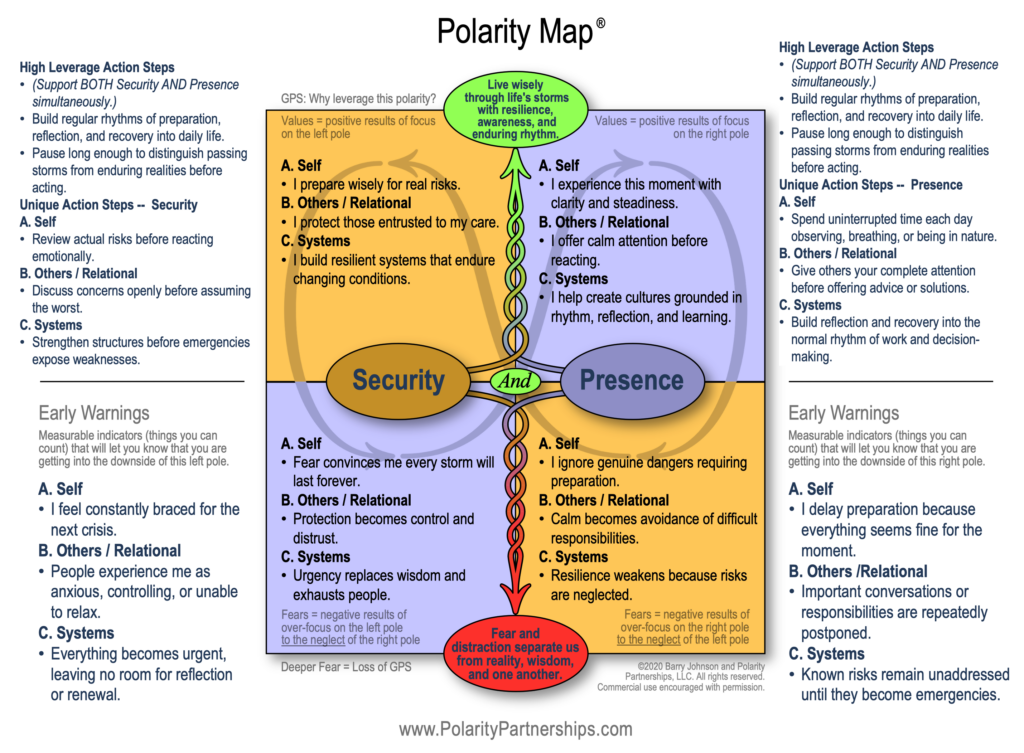
The porch has a name for this now: Security AND Presence, the polarity Barry Johnson contributed decades to helping teach me to see. The downside of Security to the neglect of Presence is what I was living the night I was certain the ridge would give way, fear totalizing itself until every gust felt like it would last forever. The downside of Presence to the neglect of Security is pretending the storm, or the feed, or the market, isn’t real — admiring the view while the roof comes off. Neither pole is the villain. Security wants me safe. Presence wants me here. They need each other the way the storm and the rainbow do: two halves of one weather system.
Presence is what lets me notice, eventually, that the ridge is still standing after all these decades. Security is what built a porch sturdy enough to sit on while I listened to all of them.
Most evenings, I’m back on the porch. The boards still hold. So, somehow, so do I. So far, anyway. 😉
The storms come and go.
It
is.
From It,
all.
Of It,
we are.
In It,
we are.
Here’s a Polarity Map for Security AND Presence:
INVITATIONS:
To use an AI-trained “Chat w/Cliff” for Step 1, “Seeing” CLICK HERE.
Ready for the Polarity Advantage? Go deeper into Polarity Thinking, see our online self-directed Credentialing and Introduction to Polarity Practice or in-person training with Barry Johnson and me at Kayser Ridge by CLICKING HERE.