


See the Series Introduction for Just Tao It, Part I: HERE
See the Just Tao It Series Introduction Tao/It on-ramp, PART II: HERE
See Just Tao It, Chapter 1: HERE
From my interpretation of the Tao Te Ching, Chapter 8 (Unpublished):
Acting as water,
It is like water.
A subtle necessity,
It finds Its way
To every
Low place
And valley.
It brings life
And beauty.
Without competing,
Adapting and surrounding,
Providing,
It is in and for everything.
Those flowing naturally in It
Are like water, acting watery.
They love themselves
As their neighbors.
What they do for others
Returns without demand.
They focus on the meaningful,
Speak what is true,
Give as they are able.
They are a vessel
For the sourceless well.
—
I didn’t set out to find this chapter at Kayser Ridge. It found me.
When I added the adjacent 20 acres back in 2020, it wasn’t for discovery. It was protection. Keep the ridge intact. Keep space around something that had already started to matter more than I understood at the time. Somewhere in walking that land, I came across a pond shaped like an infinity loop, fed by two small waterfalls that keep moving whether I’m there or not.
I started calling it Johnson Falls, partly in jest, partly because naming something is a way of noticing it long enough for it to begin teaching you something back—and partly because the infinity loop shape of that pond had already been teaching me something for decades, even if I didn’t always know I was learning.
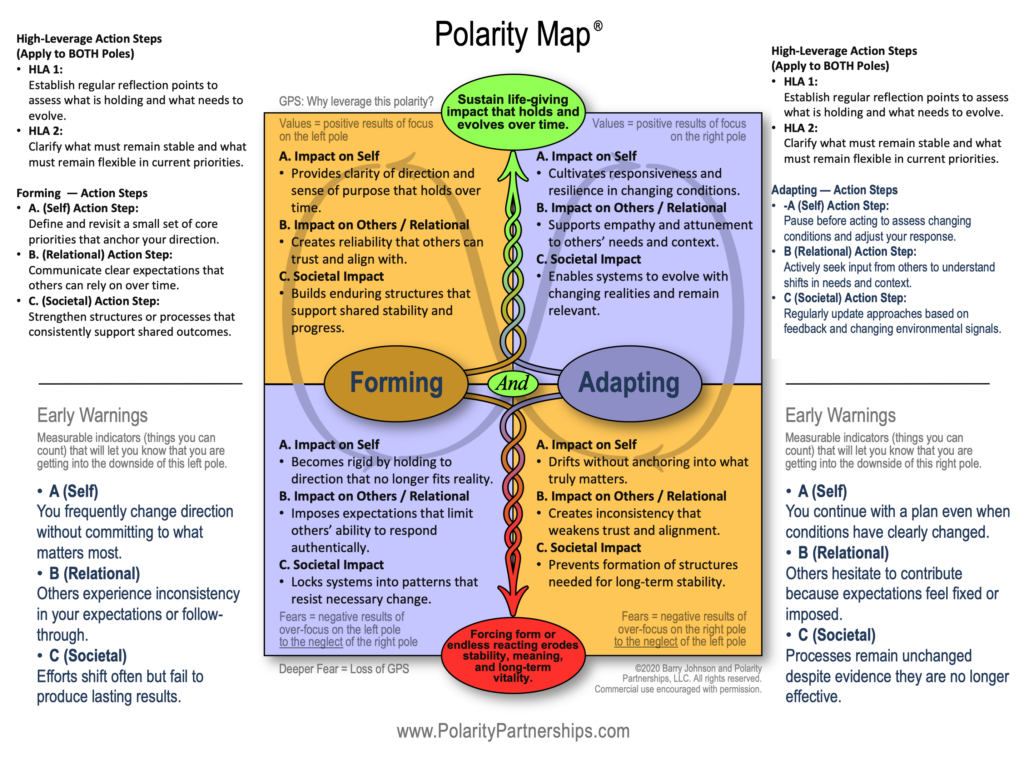
The infinity loop in a Polarity Map isn’t a visual preference or design flourish—it’s a structural representation of reality. Polarities are not problems to solve; they are interdependent pairs that exist in ongoing relationship. Each pole contains value that can only be sustained over time through its connection to the other. The infinity loop makes this visible. It shows that movement between poles is continuous, not linear, and that outcomes are shaped by how energy flows over time, not by choosing one side.
Every polarity operates as an energy system. When we focus on one pole to the neglect of the other, we don’t eliminate the second pole—we cue up the inevitable downsides of the overfocused pole. That consequence then drives us toward the perceived “solution,” the upsides of the other pole, often reactively. And the same pattern repeats in reverse. Before I came to Taoist philosophy and Polarity Thinking, I learned these dynamics the long way. Some of those cycles spanned decades. After saying, “I’ve been here before” enough times, I learned—but it was from the School of Hard Knocks.
The loop captures this dynamic. It reflects the lived experience of oscillation, overcorrection, and, with practice, more intentional leveraging. The amount of pain we experience in polarities is optional—if we can see the energy dynamic.
Without the infinity loop, polarity maps risk being interpreted as static frameworks or trade-offs—just another 2×2 matrix. With it, they communicate something essential: sustainability depends on ongoing movement, awareness, and recalibration. Interdependency is not conceptual; it is operational. The benefits of each pole are accessible only through the presence of the other. The Greater Purpose for the tension—unreachable without both upsides—becomes the north star that gives the loop its direction over time.
It is not decoration. It is the map of the terrain. And the map is not the territory.
I’ve sat at Johnson Falls long enough to stop trying to figure it out. Long enough to notice how the sound changes with the seasons, to watch ice form at the edges and still hear water moving underneath, and eventually to stop asking what it means and start letting it mean what it is.
Water doesn’t explain itself. It doesn’t need to. It moves, it gathers, it yields, and over time it shapes everything it touches without announcing any of it. If you stay with it long enough, what looks like adaptation begins to reveal itself as forming, and what looks like forming only exists because it never stops adapting. The two aren’t in opposition. They’re the same movement seen from different moments in time.
That pairing shows up for me here as Forming AND Adapting.
It’s easy to miss because we tend to look for intention. We assume that anything shaping something else must be trying to do so. Water doesn’t try. It stays. It flows. It finds its way to the lowest place, and in doing so, it becomes essential to everything around it. The forming happens because the adapting never stops.
A few years later, I added a smaller pond behind the house and, without much deliberation, named it Walden Pond @ Kayser Ridge. That one is artificial, but the sound of the waterfall is real enough. It’s a constant reminder that even when we build something, we’re still borrowing from patterns that were here long before we showed up. Thoreau went to Walden to see what would hold when everything unnecessary was stripped away. Sitting here, it’s harder to pretend that we’re the ones creating the conditions. More often, we’re the ones deciding whether to interrupt them.
There’s something in this chapter that connects directly to how we relate to each other, and it shows up in places that don’t always get traced back to water. The Golden Rule is one of those places. Versions of it appear across traditions, which usually tells you it’s pointing to something deeper than doctrine. It’s often framed as instruction—do this, don’t do that—but underneath it is something closer to recognition. If water is in and for everything without competing, then what we do to others isn’t separate from what eventually returns—not as a transaction, but as a property of being in the same system. Water doesn’t wait for reciprocity. It just flows. And in flowing, it shapes everything, including what flows back.
That’s where Forming AND Adapting becomes more than observation.
Forming to the neglect of Adapting shows up as force—the need to shape outcomes before they have time to emerge, the assumption that direction must be imposed to be effective. Adapting to the neglect of Forming looks different, but it carries its own drift. Things don’t quite hold. Direction softens into uncertainty. What could have taken shape dissipates because nothing stayed with it long enough to matter.
Water doesn’t choose between those. It doesn’t balance them either. It leverages them by staying in motion long enough for something else to take form.
The best way to experience a polarity is by walking the infinity loop—experiencing the unique dimensions of energy in each quadrant and appreciating the predictability of how the dynamic works over time. You feel the upsides lift you toward what matters. You notice the downsides pull you away from it. And if you stay with it long enough, you begin to sense when to lean in and when to let go—not because you’ve mastered anything, but because the pattern starts to reveal itself through repetition.
It’s hard not to think about that in the context we’re in now. We’ve built systems that amplify attention, preference, and reaction at a scale water never had to contend with. The movement is faster, the signals are louder, and the feedback loops are tighter. We shape what we see, and what we see reshapes us—often before we’ve had time to notice what’s happening. In that kind of environment, forming happens quickly, but it doesn’t always hold. And adapting can start to look a lot like reacting.
Which brings it back to something simpler than all of that.
Recently, I brought in some heavy equipment and cut a short road to create an easier path to the overlook just above Johnson Falls. It’s now tied for first place—along with the upper deck for sunrises, the firepit at night, the back patio’s hummingbird center, and several other spots I’ve convinced myself are essential—as my favorite place on the property. I’m aware of the irony. I own land to protect it from being disturbed, then I disturb it to make it easier to sit and reflect on not disturbing things. If water had a sense of humor, it would probably have something to say about that.
But sitting there, the water doesn’t speed up because I’m paying attention to it, and it doesn’t slow down when I leave. It just continues, shaping and adapting in a way that holds over time without needing to be optimized or improved. There’s a steadiness in that that doesn’t resist change, and a fluidity that doesn’t lose its direction.
I don’t walk away from that with a method. If anything, I leave with a little less certainty about when to step in and a little more curiosity about when to let something unfold without adding to it. That’s not always comfortable, especially when things feel like they need to move, but there’s something about watching water long enough that makes it harder to believe that everything depends on pushing.
The water at Johnson Falls doesn’t ask permission. It doesn’t announce its arrival. It just continues—shaping and being shaped, forming and adapting, holding and releasing.
And maybe that’s enough.
Here’s an interior Polarity Map for Forming And Allowing:
INVITATIONS:
To use an “AI-trained Chat w/Cliff for Step 1, Seeing” CLICK HERE.
Ready for the Polarity Advantage? Go deeper into Polarity Thinking, see our online self-directed Credentialing and Introduction to Polarity Practice or in-person training with Barry Johnson and me at Kayser Ridge by CLICKING HERE.